
The Eagles–Rams defensive discussion begins with a distinction that deserves more attention than a simple thumbs-up or thumbs-down: a defense can play credible football without controlling the game. Bleeding Green Nation’s assessment places Philadelphia in that space between competence and excellence. The interesting question is what separates those two levels—and what evidence should move an evaluation from one to the other.
Here, film review means examining football footage. The subjects are athletes making decisions under pressure, and the essential story is how their responsibilities connect. This commentary explores the meaning of that qualified assessment; it does not assign individual game grades or claim a fresh, snap-by-snap review of Eagles–Rams footage.
Why a positive assessment can still contain a serious criticism
Calling a defense solid recognizes a foundation. Calling it great makes a stronger claim about reliability: the unit can repeatedly make an offense’s preferred options difficult, respond when the opponent changes its approach, and avoid turning manageable problems into decisive mistakes.
Those are different standards. A handful of impressive plays can demonstrate ability. They cannot, by themselves, establish consistency. Equally, a damaging completion does not erase every sound decision that preceded it. A useful Eagles–Rams discussion should preserve both possibilities instead of forcing the defense into the role of either savior or culprit.
My view is that the higher standard should be repeatability. Can the same defensive structure survive a second attempt at the same offensive idea? Can players maintain their spacing when the initial picture changes? Those questions make a qualified verdict meaningful because they identify what improvement would actually look like.
Start with the defender’s job, not the camera’s favorite player
Football coverage naturally pulls the eye toward the ball. Evaluation requires a wider field of attention. The nearest defender at the end of a play may be cleaning up someone else’s mistake, while a player outside the frame may have performed the assignment that made the offense choose that route in the first place.
The defensive front: pressure needs a destination
For a defensive lineman, moving forward is only part of the task. Rush lanes, leverage, and the quarterback’s escape options matter too. In a hypothetical passing play, an outside rusher could beat a blocker but leave a route out of the pocket. Another rusher could register no obvious individual victory while keeping the quarterback contained.
That distinction matters when assessing Philadelphia against Los Angeles. The useful question is whether the front restricts the offense’s choices together. A spectacular effort and a coordinated effort can overlap, but one does not automatically prove the other.
The linebacker: a short delay can change the whole picture
A linebacker’s assignment can involve reading the backfield, respecting a potential run, locating a receiver, and navigating bodies before reaching the ball. Watching only the final pursuit can hide the decision that determined whether the player had a realistic chance to arrive.
A fair review therefore asks where the delay began. Was the defender slow to recognize the threat? Did traffic obstruct the route? Did the offensive design create competing responsibilities? Without establishing that sequence, criticism of effort or athleticism can become an unsupported explanation for a much more specific problem.
The secondary: a completion is the beginning of the question
A defense sometimes accepts a short throw while protecting deeper space. That exchange becomes useful only if the defenders limit what follows. Distance to the receiver, closing angle, available help, and the location of the first-down marker all change the value of the same-looking catch.
For Eagles–Rams, this provides a better viewing question than whether a receiver appeared open: What did the defense concede, and what did it prevent? The answer requires the full play rather than a frozen image of separation.
Tackling is where the defensive bargain gets tested
Any approach that allows underneath receptions places a practical demand on the players arriving afterward. They must convert the space conceded before the catch into a controlled finish. Otherwise, a limited gain can become an opportunity for the offense to keep its entire playbook available.
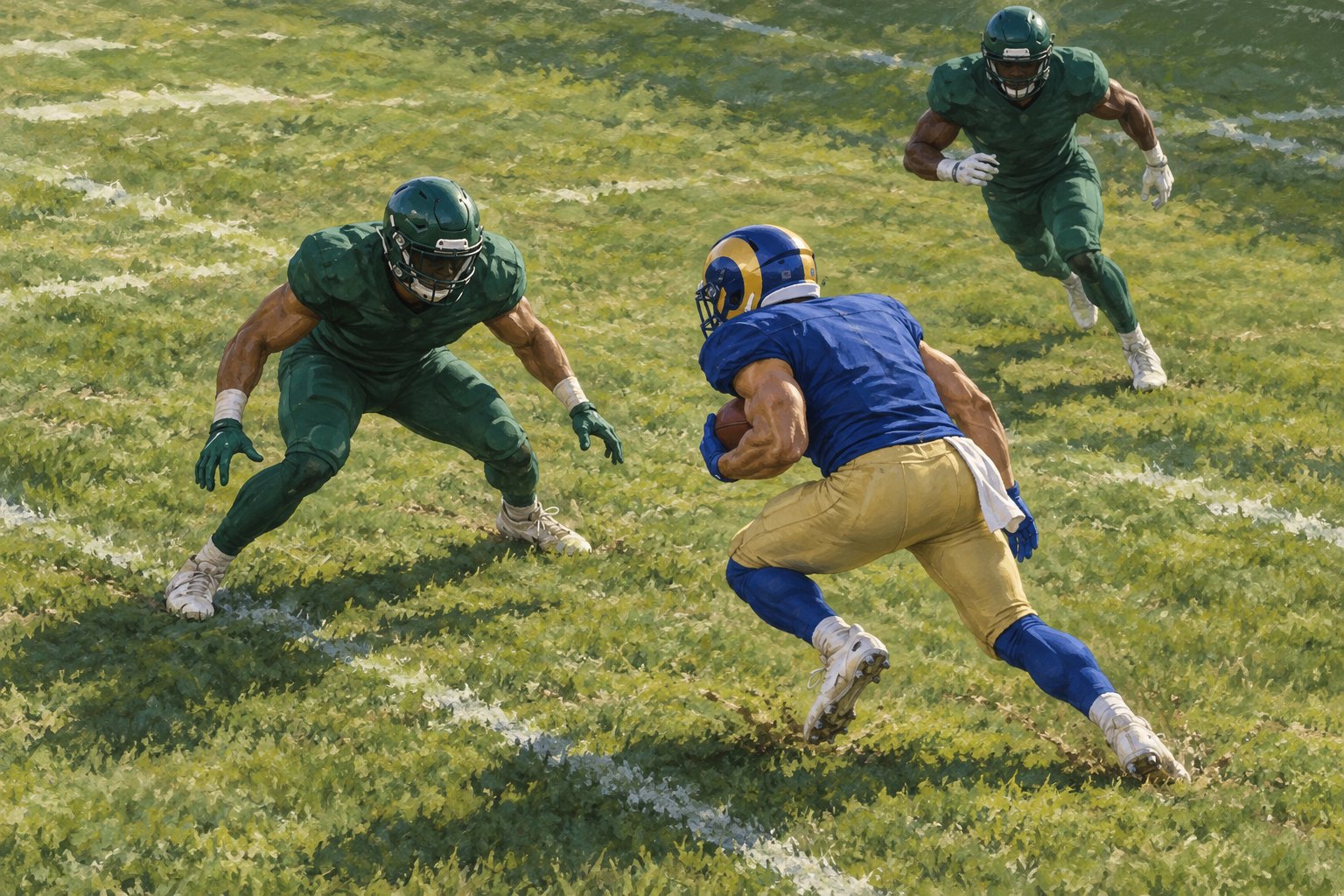
Consider a hypothetical defender approaching a ball carrier with help to the inside. A disciplined outside position may steer the runner toward that help. Charging straight at the runner might look more forceful while creating an escape route. The visible collision is only the last part of the work.
This is why tackling deserves more than a generic demand to be tougher. A useful critique identifies the angle, the spacing, and the support. Those details distinguish an individual failure from a situation in which the defense left one player with an unnecessarily difficult assignment.
Watch the Rams’ choices as closely as the Eagles’ reactions
Evaluating Philadelphia also requires giving the opponent agency. Offensive success can reflect good execution, a favorable matchup, or a design that forces a defender to choose between two threats. Treating every gain as evidence of defensive incompetence removes half the contest from the analysis.
On a rewatch, repetition is especially revealing. If an offense returns to a similar concept, look for what changes: the formation, the receiver’s starting position, the defender’s leverage, or the help available nearby. Then ask whether the defense responds. This is a method for testing the Eagles–Rams assessment, not a claim that any particular sequence occurred.
A strong defense can lose a rep. The more consequential concern is whether an opponent can reproduce the same advantage without being forced to solve a new problem.
How to make the verdict more precise
A practical viewing checklist keeps the evaluation attached to observable decisions:
- Before the snap: Note field position, distance needed, alignment, and potential receiving threats.
- At the start: Watch the defender’s first steps and the space those steps protect or expose.
- At the throw or handoff: Identify where the offense has created its advantage.
- At the finish: Separate the initial concession from any additional damage.
- On a similar play: Look for evidence of adjustment rather than assuming the first result must repeat.
This approach also guards against mistaking a measurement for an explanation. Our discussion of what a jump-scare count can actually establish explores a comparable critical problem: counting outcomes is useful, but understanding their effect requires context.
Likewise, our Money in the Bank commentary on results and interpretation separates what happened from what an ending encourages audiences to believe. Football demands its own evidence, but that distinction remains valuable when one final image threatens to define an entire performance.
The deeper question is trust
The most useful interpretation of the Eagles–Rams verdict concerns trust between defenders. Each player’s choice depends partly on someone else holding a position, recognizing a threat, or arriving at the right angle. Excellence emerges when those dependencies remain dependable under pressure.
That is the standard I would use to distinguish a capable Philadelphia defense from a great one: how consistently its decisions make the next teammate’s job manageable. Highlights reveal what individual players can do. Connected, repeatable execution reveals what a defense can become.
Original content by this site's editorial team. Published: October 10, 2026 at 20:57:04 PDT (Los Angeles time)