Dancing with the Stars ended its Horror Movie Night with a double elimination, giving the evening’s frightening theme a competitive consequence: two celebrities were sent home. The pairing invites a question that goes beyond the results. When a dance competition borrows the language of horror, where does the suspense come from—the story being performed or the possibility that a performer’s time is running out?
Results spoiler: This article discusses the double-elimination outcome. It examines the relationship between horror storytelling and competition suspense, rather than offering a routine-by-routine recap.
My view is that Horror Movie Night is most interesting when those two sources of tension remain distinguishable. A dance can create fear through movement, distance, and uncertainty. An elimination creates anxiety through attachment to a real person. They can intensify each other, but they ask different things of the audience.
Two eliminations give the horror theme a second meaning
The double departure supplies a simple dramatic structure: the evening contains a loss, and then another. Even without attaching a particular film reference to that structure, the connection to horror is clear. Relief becomes provisional. One outcome does not necessarily end the uncertainty.
That is an interpretation of the format, not evidence that producers engineered a particular emotional response. The distinction matters. A horror theme and a double elimination can reinforce each other without every reaction becoming part of a carefully scripted scare.
For viewers, the combination also changes what deserves attention. A themed routine has its own beginning, development, and ending. The competition continues beyond that ending. A successful final pose can resolve the miniature story on the dance floor while leaving the larger question of survival completely open.
This is where a results-driven viewing habit can flatten the evening. If every performance becomes merely a prediction about who will leave, its storytelling disappears behind the outcome. Our separate discussion of Horror Movie Night and fair scoring addresses the judging question. The artistic question is different: did the dance establish a compelling relationship before the competition supplied its verdict?
Horror choreography begins with what a character wants
A frightening costume can identify a genre instantly. It cannot, by itself, establish a scene. For that, a performer needs an objective: approach someone, escape them, gain their trust, resist their control, or discover what they are hiding.
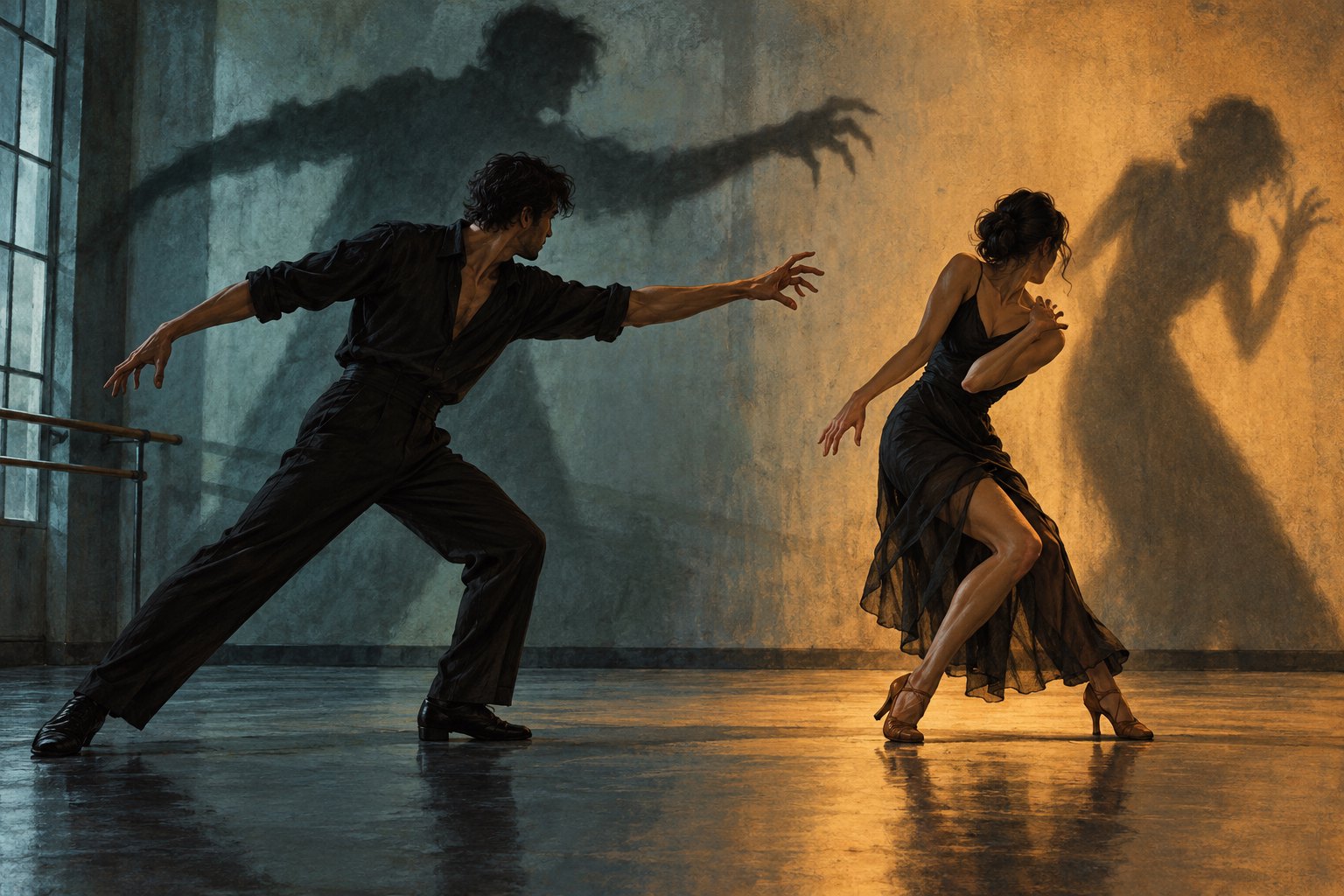
These are useful ways to read a horror-inspired dance because they put character ahead of recognition. Instead of asking only which movie a costume resembles, watch who initiates contact. Notice whether the other dancer welcomes it, delays it, or pulls away. A familiar ballroom gesture can acquire a threatening meaning when the response changes.
Consider an illustrative example, rather than a description of a specific routine: an offered hand might initially promise security. If the recipient hesitates, the gesture becomes uncertain. If the hand closes into a grip that prevents departure, the same movement becomes a threat. The dramatic information comes from the relationship between the performers.
That is the standard I would bring to Horror Movie Night. Does the movement communicate something that the styling cannot? Would the encounter still make emotional sense without the costume? A strong adaptation gives viewers who do not recognize its reference something concrete to follow.
A pause can do more than a frightening pose
Horror depends on timing. A threatening image delivers immediate information; a delay makes the audience work with incomplete information. Dance can use that difference through stillness, interrupted momentum, and a movement that arrives later than expected.
The interesting detail is often the transition. A performer who shifts abruptly from openness to withdrawal suggests that something has changed. A dancer who remains still while a partner approaches can make the space between them feel charged. These are general possibilities of movement, not claims about particular steps performed during this episode.
For a viewer, the practical test is whether anticipation develops. Do you start watching a doorway, a hand, or the distance between two bodies because the performance has made it significant? Or are you simply receiving a succession of spooky images?
I find the first approach more rewarding. It allows a dance to borrow horror’s dramatic logic instead of relying entirely on its appearance. The distinction also explains why an elaborate visual presentation and a persuasive performance are not automatically the same achievement.
The television frame becomes part of the dance
There is another layer between the performers and the audience: the camera. A wide view can let us see one dancer approaching while another seems unaware. A close view can withhold that information and concentrate attention on a face. Each choice offers a different experience of suspense.
This makes horror-themed television an especially useful occasion to watch the frame itself. Can you understand where the performers are in relation to each other? Does the shot let a movement finish? Is uncertainty coming from the characters’ situation, or simply from being unable to see the action clearly?
Those questions also help separate spectacle from execution. Lighting and framing may deepen a dramatic moment, but viewers still need enough visual information to appreciate the dancers’ contribution. Our commentary on why a perfect score is only part of Horror Movie Night’s story offers a related way to think beyond a single competitive measure.
The performer is not the horror character
The double elimination introduces a boundary that fictional horror does not have to manage in quite the same way. Inside a routine, a dancer may portray menace, panic, obsession, or surrender. Outside it, that person is responding to a competition with personal and professional stakes.
It is tempting to carry the theme across that boundary—to turn disappointment into a dramatic breakdown or describe an exit as though it completed a character arc. But an expressive face does not establish an inner monologue. A brief reaction cannot tell viewers everything someone feels about a partner, a judge, or a result.
Respecting that limit actually improves the criticism. It keeps attention on choices we can assess: what a performance communicates, how the broadcast presents it, and what the elimination changes. It also leaves room for an ordinary human response that does not fit the evening’s entertainment narrative.
What Horror Movie Night ultimately asks us to watch
The deeper appeal of this pairing lies in control. Choreography depends on practiced coordination, while horror often imagines that control slipping away. Competition adds another uncertainty: performers can prepare their work without possessing the outcome.
That tension makes Horror Movie Night a promising frame for dance. The strongest version would let us admire the precision required to portray instability, then recognize the real vulnerability that remains when the performance ends.
The double elimination provides the evening’s consequence. It should not become the sole measure of its artistic value. What deserves to last is the moment when movement makes a relationship legible—when an approach becomes a threat, a pause becomes a decision, or a familiar gesture suddenly stops feeling safe.
Original content by this site's editorial team. Published: October 28, 2026 at 08:55:24 PDT (Los Angeles time)