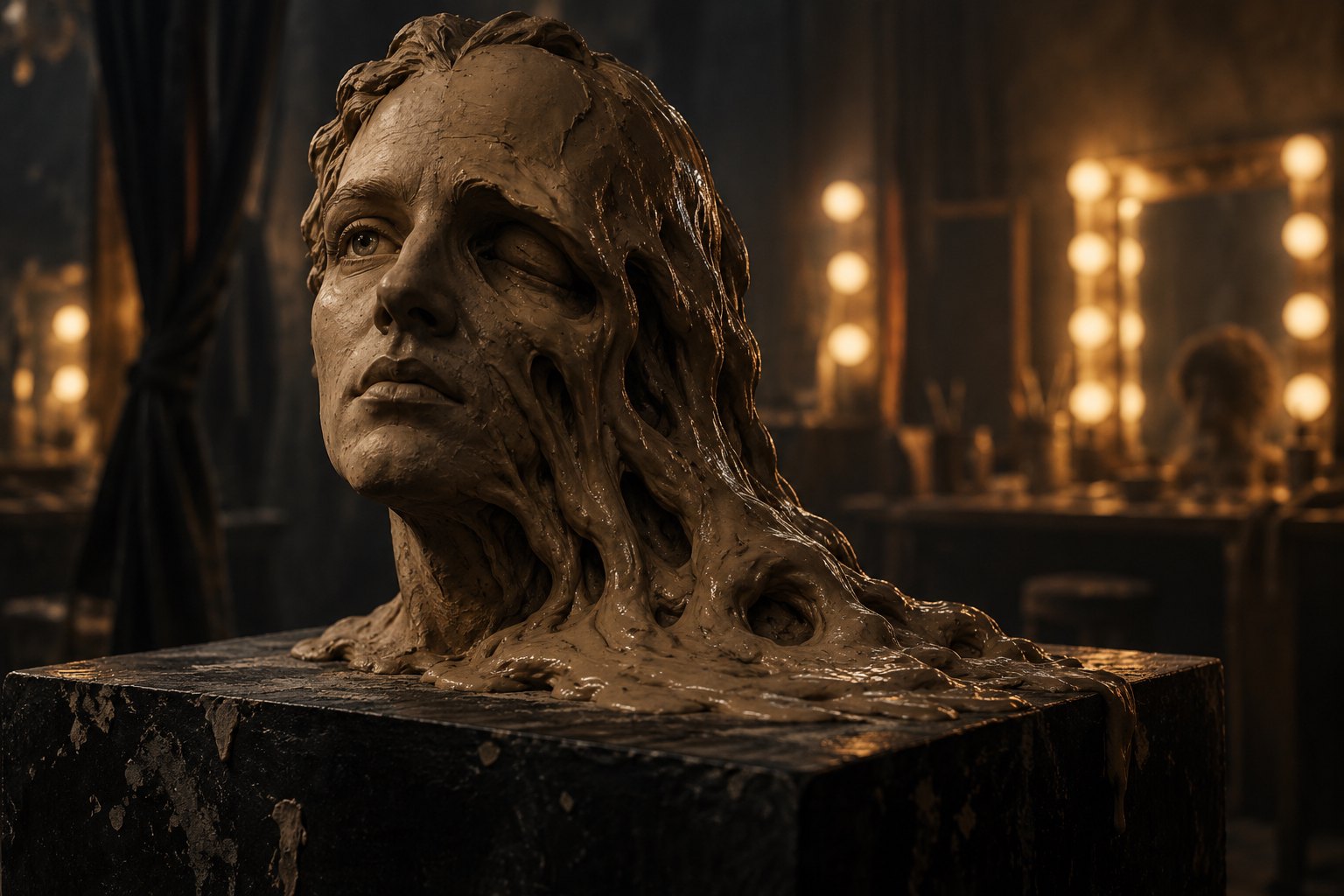
Dancing With the Stars brought two kinds of anxiety to Horror Movie Night: sharply contrasting scores and a double elimination. Those are the central developments identified in Entertainment Weekly’s coverage, and together they make an unusually pointed pairing. A night devoted to fictional danger also carried a concrete competitive consequence: two departures.
For a movie-minded viewer, the interesting question reaches beyond whether the evening was shocking. Horror depends on vulnerability, uncertainty, and our investment in someone facing a threat. A dance competition draws on those same emotional responses, even though its participants are real people and its consequences belong to entertainment rather than fiction. Horror Movie Night puts those mechanisms unusually close together.
Commentary with spoilers for the double-elimination outcome. The discussion below examines the evening’s reported scoring contrast and its horror theme, without assigning individual scores or judging unverified performance details.
What the scoring contrast does—and does not—tell us
A wide spread of scores makes a competition feel volatile. It gives the evening peaks and troughs, and it encourages viewers to compare performances immediately. But sharply contrasting marks do not, by themselves, establish inconsistent judging. Different routines can merit different evaluations. Nor does a polarized scoreboard necessarily mean that judges disagreed with one another about the same dance.
That distinction matters here. The useful critical question is whether the reasons behind a score explain its distance from another score. A number can register approval or disappointment; it cannot independently show whether the decisive issue was timing, control, partnering, characterization, or some combination of those qualities.
My standard for persuasive judging is straightforward: the explanation should help a viewer see the performance more clearly. If a technical weakness changes the effect of a routine, the connection deserves to be made explicit. Otherwise, audiences are left arguing over the severity of the number while talking past the underlying assessment.
Horror creates a second performance inside the dance
A horror-themed routine asks viewers to process movement as both dance and storytelling. A reaching arm might complete a choreographic phrase while also suggesting pursuit. A retreat might establish distance between partners while communicating fear. The challenge is to make both meanings legible without allowing the fictional situation to swallow the dancing.
From a character perspective, the most productive question is what each person wants. Is one figure seeking escape, connection, control, or protection? Those are possible dramatic motives, not descriptions of particular routines from this episode. They illustrate why characterization involves more than an ominous expression. Intention gives a gesture direction; a change in intention gives the sequence somewhere to go.
That is also why costumes cannot carry the entire interpretation. An audience may recognize a horror reference instantly and still have little reason to care about the relationship on the floor. Recognition supplies an entry point. Performance must supply the emotional development.
Our discussion of movie monsters, attraction, and screen chemistry explores a related concern: appearance can attract attention, but behavior determines what a relationship means. Horror Movie Night invites that same distinction between a striking image and a persuasive character.
Why a favorite routine may not deserve the highest score
The scoring contrast raises a familiar problem for anyone who reviews movies: admiration does not arrive through a single channel. We can respond strongly to an interpretation while noticing weaknesses in its execution. We can also recognize considerable skill in a performance that leaves us emotionally distant.
On a horror-themed evening, those judgments may pull especially hard in different directions. A physically restrained passage could convey dread, but restraint still needs control and purpose. An explosive passage could suggest panic, but intensity alone does not establish precision. The dramatic choice and the quality of its execution need separate attention before they can be assessed together.
For viewers reconsidering a score, three questions offer a useful starting point:
- Was the relationship between the performers understandable through movement?
- Did the characterization remain clear during transitions, rather than only in posed moments?
- Did the judging explanation identify something observable in the dance?
These questions leave room for disagreement without turning every difference in taste into a claim of unfairness. A favorite can remain a favorite even when another routine meets the competitive criteria more successfully.
A double elimination changes the meaning of the ending
Two departures give an episode a different emotional shape from a single farewell. There are two interrupted journeys to absorb, and the audience has less room to settle into either one. Whatever satisfaction the performances provided must coexist with the finality of people leaving.
There is a temptation to let that ending rewrite everything before it. Once someone exits, earlier mistakes can start to look inevitable or decisive. Conversely, an admired routine may become evidence that the result must have been wrong. Neither reaction establishes the actual cause of an elimination. The reported scoring contrast and double departure alone cannot support that conclusion.
A more generous reading preserves the performance as its own event. Leaving the competition does not erase a moment of expression, and remaining does not settle every argument about artistic quality. The outcome determines continuation. It does not provide a complete critical verdict.
The horror connection runs deeper than decoration
Horror often becomes effective when an audience understands vulnerability before it understands the threat. On a competition show, the equivalent emotional investment is watching someone attempt something difficult while knowing the attempt may not secure their future. The stakes are different, but the structure of anticipation is recognizable.
That helps explain why the combination of a horror theme and a double elimination is so potent as television. One element invites the pleasure of staged fear; the other introduces disappointment that cannot be undone within the evening. The theatrical frame and the competitive result can reinforce each other without becoming morally equivalent.
Our examination of why certain horror experiences linger after the ending considers how vulnerability can outlast spectacle. Here, too, the most durable feeling may come from attachment rather than imagery. Viewers remember what a departure means to them, not simply how ominous the surrounding presentation looks.
The verdict: keep the performances in the conversation
Horror Movie Night’s contrasting scores and double elimination offer plenty of material for argument. The more rewarding discussion asks what those arguments reveal about our expectations: technical excellence, convincing characterization, visible improvement, emotional connection, or a balance among them.
My view is that the evening’s horror premise deserves to be considered through the performers’ dramatic choices, while the scores deserve scrutiny through clearly explained standards. The elimination supplies the ending, but it should not consume the whole story. A meaningful response leaves room for what a performance communicated before the competition decided who could continue.
Original content by this site's editorial team. Published: October 29, 2026 at 02:28:32 PDT (Los Angeles time)