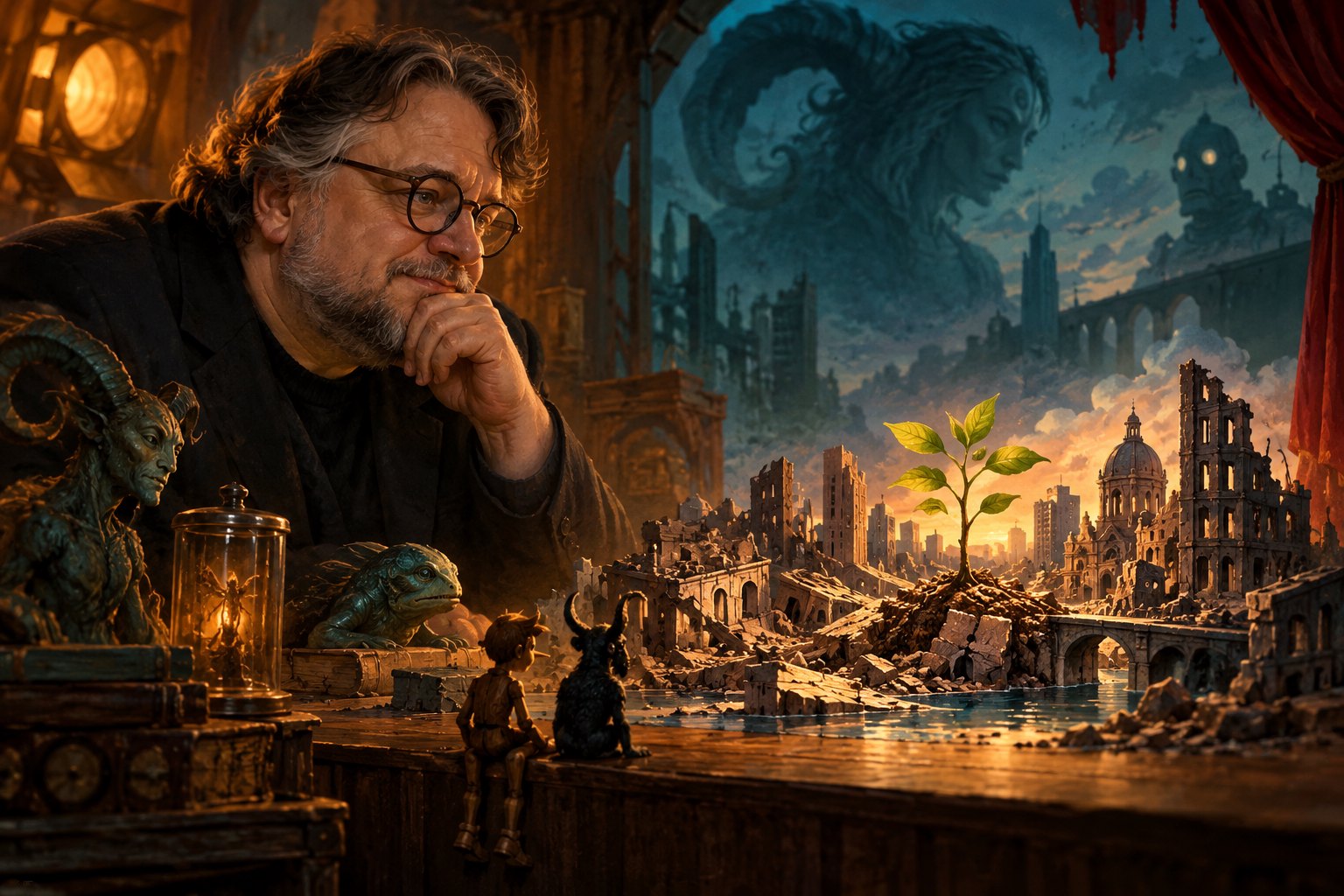
Guillermo del Toro’s concern for the next generation has an unmistakable counterpart in his movies: children entering worlds whose adults have already made dangerous choices. Variety reports that the filmmaker became tearful while saying, “We’re handing down a world in ruins,” and expressing pain over older generations failing the next. The concern is about inheritance—what people receive before they are old enough to choose it.
His remarks offer a compelling reason to revisit Guillermo del Toro’s Pinocchio, the 2022 stop-motion feature he directed with Mark Gustafson. This is a film in which becoming a good father requires more than creating a child, providing instructions, or wanting another chance. It requires recognizing that the child has a life separate from the parent’s needs.
Spoiler warning: The analysis below discusses the film’s major character arcs and ending. The connection between the movie and del Toro’s reported remarks is a critical interpretation, not a claim that he was explaining this particular film.
The world is broken before Pinocchio arrives
The film begins with Geppetto and his son Carlo, whose death in a wartime bombing leaves the woodcarver devastated. That opening makes the familiar fairy tale feel fundamentally different. Before the wooden boy can misbehave, human society has already committed a catastrophe.
From Geppetto’s perspective, Pinocchio’s arrival offers an impossible prospect: life returning to a home organized around absence. From Pinocchio’s perspective, however, the situation is bewildering. He enters a relationship with expectations attached, including comparisons to someone he never knew. He has inherited grief without receiving the experiences that would help him understand it.
That imbalance is the film’s strongest dramatic foundation. Geppetto’s suffering deserves sympathy, but sympathy does not make every demand he places on Pinocchio fair. The movie lets us understand the father without requiring the child to become a remedy for him.
Viewed alongside del Toro’s warning, this is a precise picture of generational failure. Harm does not always travel forward through deliberate cruelty. It can also pass through love that has become unable to imagine a future different from the past.
Geppetto must learn to see the child in front of him
Pinocchio’s exuberance creates a useful obstacle to easy sentimentality. He is curious, disruptive, and difficult to manage. The film does not make acceptance effortless by presenting a perfectly considerate child whom only a villain could reject.
That choice gives Geppetto’s eventual declaration—“Be exactly who you are”—its force. Acceptance has to survive inconvenience. It means responding to a person whose temperament does not match the version of family life the parent wanted.
For me, the film works best when its emotional conflict remains this specific. Geppetto can shape wood with tools, but parenthood requires him to surrender that degree of control. The skills that allow him to make Pinocchio cannot determine who Pinocchio should become.
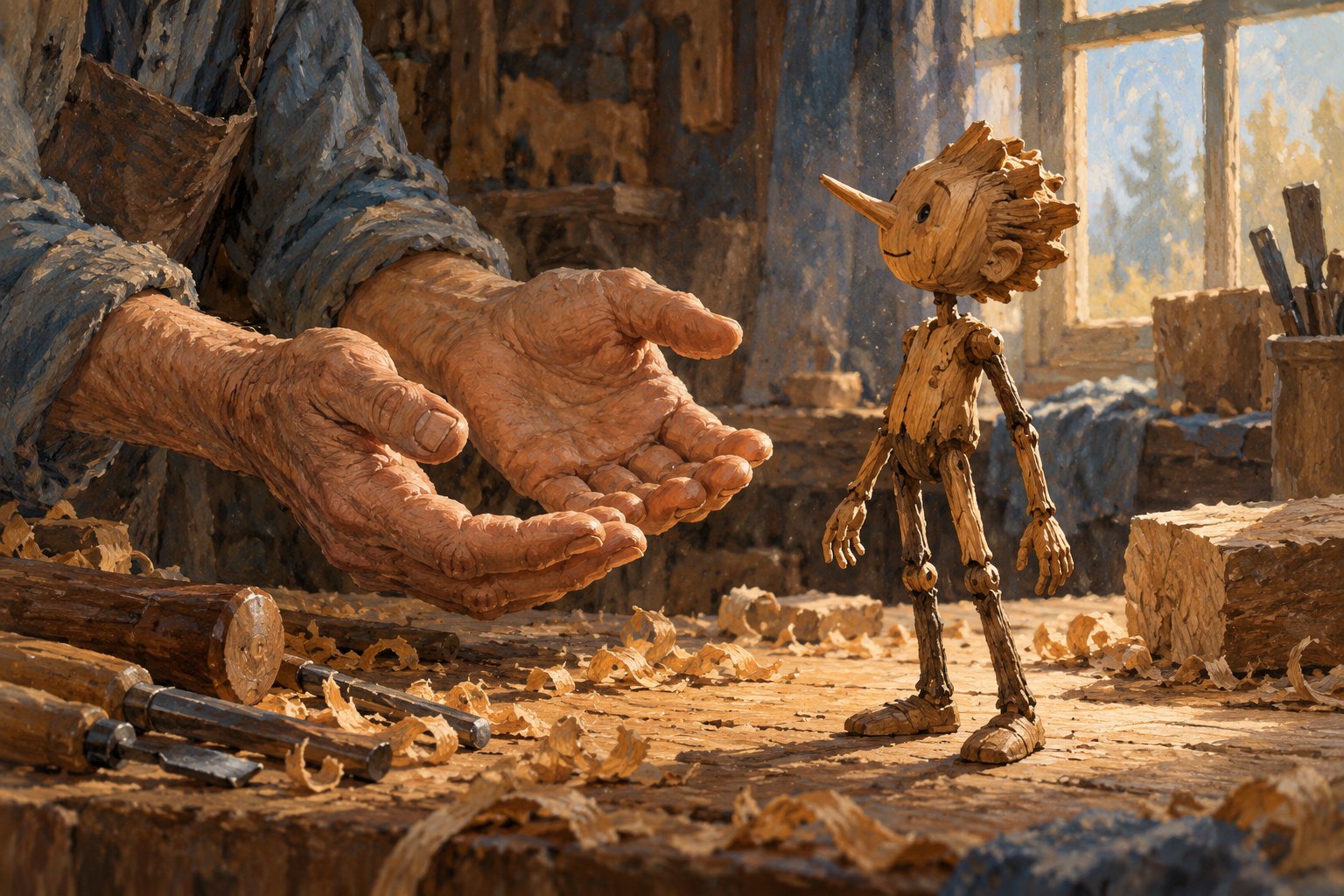
The puppet’s visibly irregular body strengthens that argument. His roughness remains part of his presence rather than an embarrassing stage to be polished away. Stop-motion gives the relationship a tactile tension: a manufactured figure moves with an independence that exceeds the intentions of his maker.
Questions about compassion and belonging also run through our review of the emotional relationships beneath Cats’ spectacle. Here, the physical design supports the emotional argument particularly well: affection must reach the unfamiliar body already in front of us.
Candlewick exposes the danger of obedient sons
The film’s Fascist Italian setting turns a family dispute about behavior into a broader examination of authority. The Podestà, Candlewick’s father, treats discipline and military usefulness as measures of a boy’s worth. Where Geppetto struggles with a private ideal of childhood, the Podestà imposes a political one.
Candlewick initially seems positioned to become another obstacle for Pinocchio. Their developing friendship changes the terms of that relationship. The boys can recognize something in each other that the adults judging them overlook: the fear of being inadequate in a father’s eyes.
When the Podestà demands that Candlewick shoot Pinocchio, obedience becomes a direct moral problem. Following an adult’s instructions would mean betraying a friend. Refusal becomes evidence of judgment.
This is where del Toro’s concern about inherited ruin finds its sharpest cinematic parallel. Adults can describe their demands as preparation for the future while training children to repeat the behavior that damaged the world. A young person’s resistance may be the first interruption in that cycle.
The military passages are deliberately blunt, and I find them less emotionally intricate than the scenes between Geppetto and Pinocchio. Yet their bluntness has a purpose: the consequences of authority become impossible to hide behind reassuring language about duty.
The film’s moral clarity comes with a dramatic cost
Pinocchio encounters multiple adults who evaluate him according to what he can supply. Count Volpe sees commercial opportunity; the Podestà sees military potential. These encounters make the puppet’s vulnerability legible, but their succession can also make the middle of the film feel crowded.
My reservation is that the supporting conflicts sometimes explain the theme more insistently than the central relationship needs. Geppetto’s disappointment can wound because it arrives inside a recognizable bond. The more overtly exploitative adults leave less room for uncertainty.
Still, the repetition reveals a meaningful pattern. A child can move between institutions and keep encountering the same assumption: his value depends on usefulness to someone more powerful. The settings change while the demand remains.
That concern also informs our analysis of children’s choices and adult power in The Magician’s Nephew. Fantasy becomes most revealing when extraordinary situations clarify pressures that children cannot easily name.
The ending asks adults to change while there is time
Pinocchio’s decision to surrender immortality to save Geppetto brings the father-son relationship to its most painful point. The child accepts vulnerability for the parent’s sake. Geppetto’s recognition arrives at the frightening edge of being too late.
“I love you, exactly as you are” resolves the father’s central failure more directly than any physical transformation could. Pinocchio remains wooden. The relationship becomes possible because its terms change.
The final movement then allows loss back into the story. Pinocchio outlives his companions; affection cannot preserve them indefinitely. Sebastian’s closing words, “What happens, happens, and then we’re gone,” give the ending a plainness that cuts through the elaborate fantasy.
My reading is that the film distinguishes unavoidable loss from preventable harm. Mortality belongs to life. Demanding that children repeat our prejudices, repair our grief, or serve our ambitions does not have to.
That distinction makes del Toro’s reported anguish more than a mood to attach to a dark fairy tale. Pinocchio supplies a demanding response to the fear of failing the next generation: listen before loss forces recognition, allow disobedience to become judgment, and make affection less conditional. The future begins with someone whose life will not belong to us.
Original content by this site's editorial team. Published: October 20, 2026 at 09:40:59 PDT (Los Angeles time)