
Dustin Hoffman makes Benjamin Braddock’s discomfort the engine of The Graduate: every hesitant answer suggests someone afraid of being caught without instructions. Hoffman’s essay Surviving “The Graduate” brings attention back to the actor behind that performance. Revisiting the film, what stands out is how little Benjamin’s eventual decisiveness resolves. He learns to pursue someone before he learns how to understand her.
Mike Nichols’s 1967 film remains, in my view, an exceptionally funny and unsettling account of that distinction. Its romantic momentum is thrilling, but its most revealing moments involve people failing to listen. Hoffman gives those failures a painfully recognizable human shape.
Spoiler warning: This review discusses the affair, Elaine’s wedding, and the ending.
Benjamin has a future everyone else can describe
Adapted from Charles Webb’s novel by screenwriters Calder Willingham and Buck Henry, The Graduate follows Benjamin home from college into a prosperous California household. His parents celebrate his achievements. Their friends have advice. Nobody seems particularly interested in whether achievement has given him a reason to get out of bed.
The famous recommendation, “Plastics,” condenses that environment into one word. It offers a profitable direction while bypassing every question Benjamin cannot articulate. The joke works because the advice is practical on its own terms. Benjamin’s problem is that those terms seem to describe an entire life without explaining why he should want it.
Hoffman plays his politeness as a reflex that has outlived its usefulness. Benjamin answers adults even when their questions make him miserable. He struggles to leave conversations because leaving would require openly admitting that he does not accept their premises. His hesitation becomes a physical obstacle.
Yet his distress exists inside considerable protection. He can drift beside a swimming pool because someone else pays for the pool. The film’s satire grows more interesting when we hold both truths together: his alienation is real, and his freedom to indulge it is unusually comfortable.
Hoffman turns embarrassment into comic suspense
Benjamin’s first encounters with Mrs. Robinson, played by Anne Bancroft, turn uncertainty into a negotiation he is spectacularly unprepared to conduct. “Mrs. Robinson, you’re trying to seduce me” sounds like an accusation assembled from evidence he wishes would disappear.
The formality matters. He continues addressing her through her married identity even as their relationship crosses every boundary that title represents. His vocabulary belongs to his parents’ social world; his behavior is moving somewhere that vocabulary cannot comfortably follow.
At the hotel, ordinary transactions become ordeals because Benjamin imagines that everyone can identify his intentions. Hoffman’s pauses make the audience anticipate a disaster that often amounts to nothing more than another routine question. The comedy depends on the enormous distance between what the clerk needs to know and what Benjamin fears he already knows.
For me, this is the performance’s lasting achievement: Hoffman makes inexperience legible without making it automatically lovable. Benjamin can be vulnerable, self-absorbed, funny, and unpleasant within the same exchange. His discomfort attracts our attention; it does not settle our judgment.
Mrs. Robinson has already experienced a narrowing future
From Benjamin’s perspective, Mrs. Robinson initially seems to possess everything he lacks: certainty, sexual confidence, and the ability to issue instructions. Bancroft gives that authority a weary edge. Her composure often feels like a method of preventing unwanted conversation.
Their discussion of her past changes the relationship’s emotional scale. We learn that she studied art and that pregnancy preceded her marriage. Suddenly, the woman managing Benjamin’s initiation also represents a future shaped by decisions whose consequences lasted far longer than their original circumstances.
The film does not need an extended flashback to establish that loss. Bancroft’s clipped responses suggest how little she wants to expose. Benjamin asks questions, but curiosity does not necessarily become empathy. He can uncover a painful fact without grasping what living with it might mean.
Her treatment of Elaine remains controlling and destructive. Understanding her disappointment does not erase that behavior. It does, however, complicate the easy picture of an older generation that simply enjoys enforcing restrictions. Mrs. Robinson has been constrained herself, and she passes constraint onward.
That distinction between physical intimacy and emotional recognition also runs through our review of desire and resentment in The Invite. Here, the affair provides Benjamin with experience while leaving his loneliness largely intact.
Elaine exposes the limits of Benjamin’s rebellion
When Benjamin takes Elaine, played by Katharine Ross, to a strip club and deliberately treats her badly, the film makes his evasiveness hurt someone else. He wants to discourage her without explaining why. Instead of accepting an uncomfortable conversation, he manufactures an upsetting evening.
Her tears interrupt his strategy. He apologizes, and their connection begins to develop. This is an important shift because Elaine briefly becomes someone whose feelings he must acknowledge, rather than another complication to manage.
But the romance does not eliminate that problem. After Elaine learns about the affair and returns to Berkeley, Benjamin pursues her with a certainty that can feel less like maturity than a new defense against doubt. He has found a destination and assumes arriving there will give his life coherence.
This is also where the film has its greatest limitation. Elaine receives less interior space than Benjamin or her mother. We see the pressures surrounding her more clearly than we understand her independent ambitions. Ross supplies emotional responsiveness, but the story repeatedly asks her to carry Benjamin’s hope of renewal.
Watching critically means noticing both the excitement of his pursuit and the burden it places on her. A person cannot become a complete answer to another person’s unfinished life.
The wedding escape ends before the difficult part begins
Benjamin reaches the church as Elaine’s wedding is concluding. His arrival does not neatly prevent the ceremony from happening. Elaine must choose to leave after the expected sequence has already unfolded, making her departure more disruptive than a conventional last-minute interruption.
Her reply to her mother, “Not for me,” gives her a concentrated moment of authority. Whatever Benjamin imagines he is rescuing, Elaine makes a decision of her own. She refuses the claim that an established arrangement has exhausted her choices.
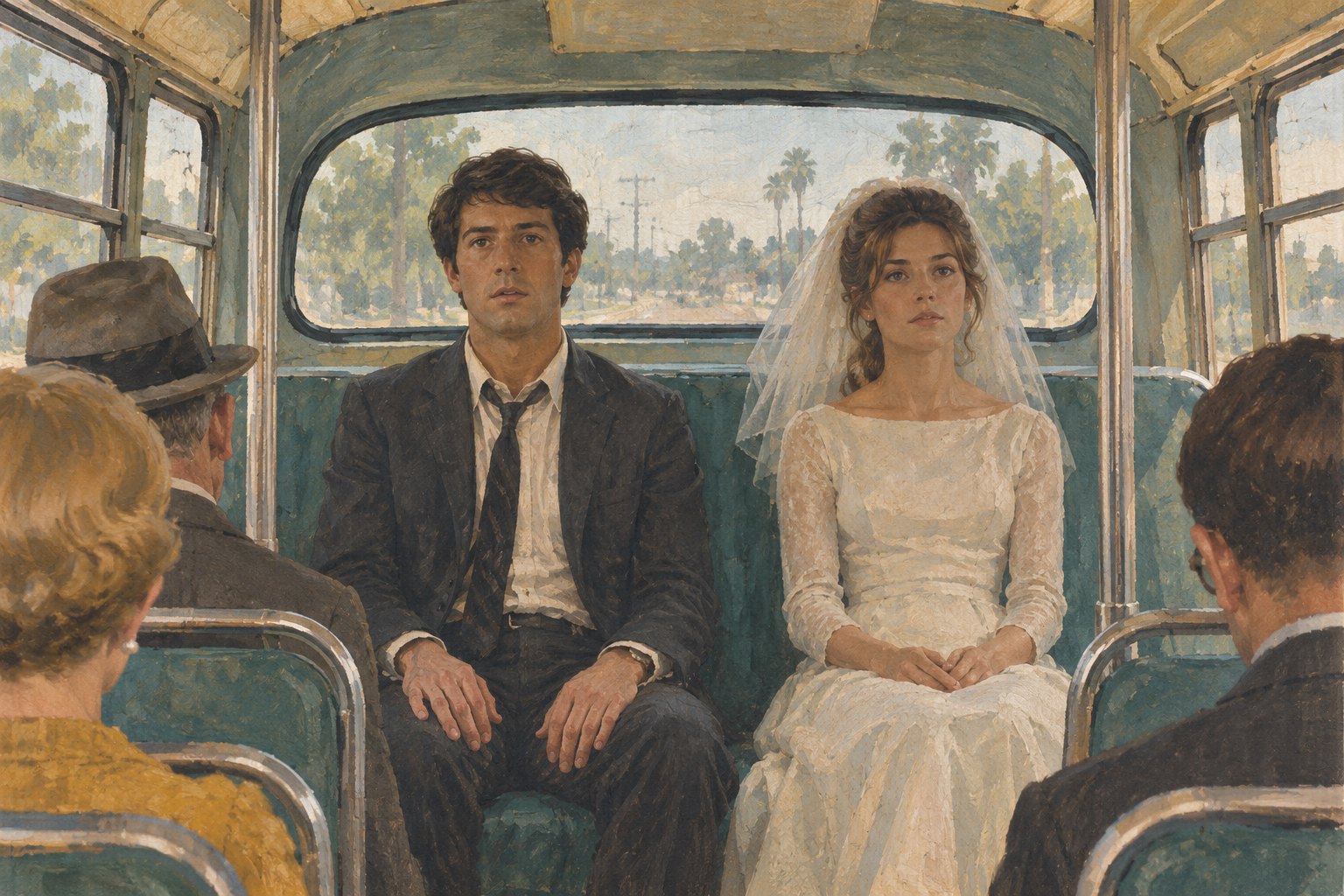
Then Nichols lets the exhilaration subside. On the bus, Benjamin and Elaine’s expressions change as the immediate excitement drains away. The continuing shot creates room for a question that a quicker ending could avoid: what do these two people actually know about the life they now intend to share?
I do not read their silence as proof that the relationship will fail. It is evidence that escape has not answered everything. They have made a consequential choice, and the film allows the weight of that choice to arrive.
What surviving The Graduate means for its characters
The film’s deeper concern is the temptation to confuse opposition with identity. Benjamin knows that his parents’ expectations feel wrong. He mistakes that knowledge for an understanding of what would feel right. Mrs. Robinson knows what she has lost, but that knowledge does not make her generous toward Elaine’s possibilities.
The ending gives Benjamin and Elaine an opening rather than a completed transformation. Their next challenge would require less spectacle: listening, accepting responsibility, and discovering whether shared defiance can become mutual care.
This is the kind of unresolved emotional detail that gives substance to the lasting value of rewatching older movies. Hoffman’s Benjamin can seem painfully familiar on one viewing and infuriating on another. The performance holds both responses. The Graduate endures because it lets him get away while leaving the harder work of growing up unfinished.
Original content by this site's editorial team. Published: November 2, 2026 at 14:17:04 PST (Los Angeles time)