
Drake Maye’s decisions and New England’s defensive execution are the central subjects of the Patriots’ After Further Review coverage following their Week 7 loss to the Chicago Bears. The useful question is how those two areas contributed to the result. A loss establishes what happened to the team; evaluating individual responsibility requires a closer look at what each player could see, attempt, and control.
Here, film means football game footage. This is an analytical viewing guide to that review’s subjects, rather than a play-by-play verdict on Maye’s performance. No specific missed read, coverage mistake, or protection failure should be assigned without the corresponding evidence. The distinction matters because a convincing explanation can sound authoritative long before it has earned that authority.
Start With Maye’s Options, Then Judge His Choice
The quarterback attracts attention because the ball makes his decisions visible. Yet the final throw is only the last part of a sequence. For a useful assessment of Maye against Chicago, begin with the formation, follow the defense’s movement after the snap, and establish when a passing option becomes available. Only then does the decision to throw, move, or wait become meaningful.
A receiver appearing open in a paused image does not automatically establish a missed opportunity. The opening may develop after the quarterback has committed elsewhere. A defender outside the frame may threaten the passing lane. Pressure may prevent the quarterback from setting his feet. These are possibilities to investigate, not explanations to assume whenever a play fails.
The opposite caution is equally important. A completion does not automatically validate the decision. An unnecessarily difficult throw can succeed; a well-timed throw can fall incomplete. My preferred standard is whether the choice made sense at the moment it was made, followed by whether the execution gave it a reasonable chance.
Separate Timing, Placement, and Movement
Timing concerns when Maye releases the ball relative to the receiver’s route and the defense’s response. Placement concerns where the ball arrives relative to the receiver and nearby defenders. Movement concerns how Maye manages the space around him before throwing. Those categories interact, but treating them separately helps prevent a vague judgment from swallowing several different problems.
Consider a hypothetical pass that forces a receiver to stop. The issue could be inaccurate placement, a late release, or pressure that disrupts the throwing motion. Describing the catch alone cannot settle the cause. A useful film note should identify the visible sequence and explain which interpretation it supports.
Perspective matters here much as it does in character-focused criticism. Our discussion of how perspective shapes judgment in Possible Love asks viewers to consider the limits of what a person knows. On a football field, the parallel is practical: the viewer’s elevated replay angle provides information the player does not possess in the same form.
Review the Defense as a Connected Unit
The defensive portion of the Bears review deserves its own attention. A quarterback-centered account can leave the impression that every game is a referendum on one player. Defensive possessions involve their own chains of decisions, and the defender closest to the ball at the finish is not necessarily the player who created the opening.
On a running play, examine how the defensive front occupies space, how the next defenders respond, and whether the pursuit closes off an escape. On a passing play, examine how the rush and coverage work together. Pressure that arrives after a receiver becomes available may have little effect; coverage that initially holds can become vulnerable if the passer has time to wait.
Distinguish Positioning From the Finish
A missed tackle and an unfavorable tackling situation are related but distinct. One concerns the attempt itself; the other concerns how the defender arrived there. A player approaching with little support faces a different problem from one meeting the ball carrier in a contained space. Neither circumstance eliminates accountability, but they call for different explanations.
Coverage requires similar care. Footage can show separation, movement, and reactions. It does not always reveal the defensive call or the rules governing an exchange between defenders. When responsibility remains uncertain, the precise observation is more useful than an invented assignment: describe where the opening developed and which movements preceded it.
For New England’s review, the strongest defensive conclusions would connect several observations into a repeatable mechanism. One difficult possession can raise a question. Repeated examples under comparable conditions can support a broader diagnosis. Without that repetition, a sweeping declaration about the defense risks outrunning the evidence.
Make Quick-Hit Notes Specific Enough to Check
Short observations can be valuable, particularly when they direct attention toward details that disappear during live viewing. Their weakness is compression: a brief note may skip the distinction between an observed action and an inferred intention. Readers should be able to tell which is which.
A useful quick-hit note answers four questions:
- What was visible? Identify the movement, spacing, or action before attaching a judgment.
- When did it happen? Place the observation within the play’s sequence.
- Why might it matter? Explain how it affected an available option or the resulting space.
- What remains uncertain? Acknowledge a hidden assignment, missing angle, or competing explanation when relevant.
This structure makes criticism more demanding, not softer. It allows a reader to inspect the reasoning rather than accept the writer’s confidence. Applied to Maye, it can distinguish a concern about pocket movement from a concern about decision speed. Applied to the defense, it can separate an individual execution issue from a coordination problem.
Watch the Whole Sequence Before Choosing the Story
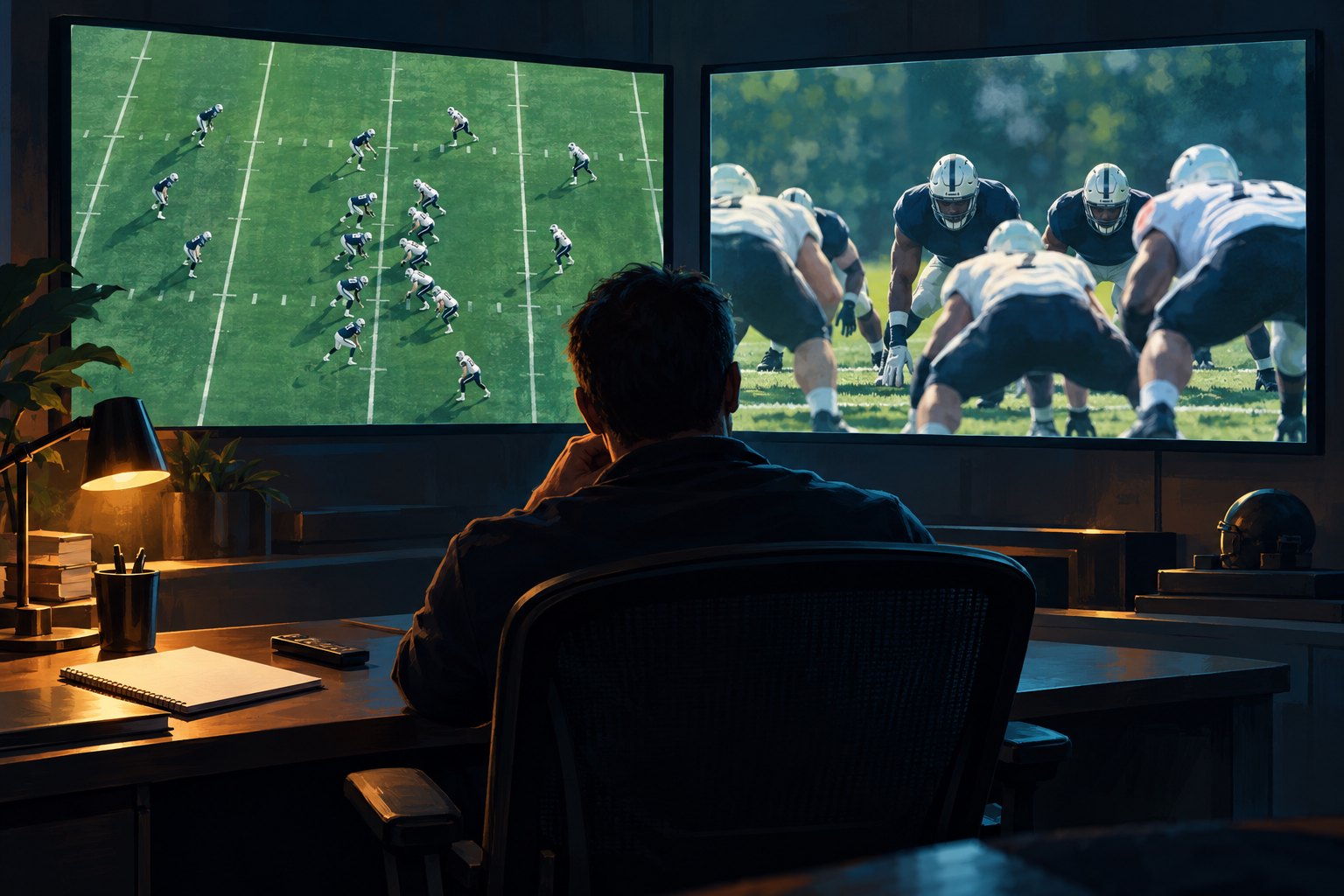
Football replays and movie scenes share one important feature: framing directs attention. Follow the ball exclusively and much of the action explaining its path disappears. Watch only a spectacular finish and the ordinary movements that enabled it can seem irrelevant.
Our examination of the small visual details that give Wildwood’s world meaning approaches images through close attention to their surroundings. Football viewing benefits from that same patience, although its evidence concerns competitive decisions rather than scripted characters.
For the Bears game, a disciplined viewing sequence would begin at normal speed, return to the pre-snap alignment, and then follow one player or relationship through the entire play. A final normal-speed viewing restores the time pressure that slow motion removes. Pausing can clarify position; it can also make a fleeting opportunity look comfortably available.
The Deeper Question Is Responsibility
The most useful interpretation of a Maye-and-defense review is an account of shared responsibility. Maye deserves scrutiny for his choices and execution. His teammates deserve equally specific assessments of theirs. Chicago’s actions must remain part of the explanation, too: an opponent can create a difficult problem without every unsuccessful response amounting to an obvious blunder.
The Week 7 loss supplies the outcome. Careful film analysis should explain the relationships beneath it—what was available, what changed, and which decisions shaped the next moment. The strongest review leaves readers able to see those relationships for themselves. That is more illuminating than simply giving the loss a main character.
Original content by this site's editorial team. Published: October 23, 2026 at 20:39:10 PDT (Los Angeles time)