David Bowie’s shelved concert film is being revived for an immersive live show, according to Pitchfork. For viewers, the significant development is that a previously withheld performance film is becoming material for a new presentation. That creates two reasons for interest: the chance to encounter the footage and the chance to see what a different setting brings out of it.
It also creates a useful distinction. Recovering a film and adapting it into an event are separate artistic achievements. The first makes an image available; the second decides how we experience it. This is a critical preview, not a review of the completed show. Its central question is how the revival might preserve the relationships within a performance while changing the frame around them.
A shelved film does not come with a ready-made verdict
The word shelved gives an archival discovery immediate dramatic appeal. It suggests something interrupted, withheld, or waiting for its moment. But release history cannot establish artistic quality. An unseen film is not automatically a lost masterpiece, and an earlier decision against releasing it does not settle its value for a later audience.
For this Bowie revival, the productive approach is to keep curiosity separate from a verdict. There is an appealing story in the return itself, but the eventual film criticism must happen at the level of shots, musical passages, pacing, and relationships. What does a camera notice? How long does it let us look? What does an edit encourage us to believe about the person performing?
Those questions give this development a different emphasis from our earlier discussion of Bowie’s concert experience and its premiere context. Here, the issue is what happens inside the image when an archival work acquires a new form.
Bowie’s screen presence is something the film constructs
A concert film offers a distinctive kind of character study. Its central figure is a real performer making observable choices, while the camera selects which choices become visible. A close-up can make a public gesture feel private. A distant view can place that same gesture within the physical effort of holding a room.
That makes perspective especially important. Watching Bowie as the subject of a concert film means considering both his performance and the film’s account of it. A sustained shot might allow a viewer to follow the development of an expression. A cut might redirect attention before that expression resolves. Neither technique is inherently more truthful; each gives the audience different evidence.
The limit is equally important: an expression does not grant access to a performer’s thoughts. Concentration, theatrical distance, and fatigue can resemble one another on screen. A responsible reading describes what is visible before assigning a motive. The revived footage deserves that patience, particularly when familiarity with Bowie’s public image makes interpretation feel effortless.
The musicians belong inside the portrait
One risk in a star-centered concert presentation is that everyone around the singer becomes atmosphere. Yet the surrounding musicians can provide the clearest view of how a performance works. Their timing, attention, and exchanges establish the conditions in which a vocal phrase or physical gesture acquires force.
Consider a hypothetical editing choice: a singer turns toward another musician before an instrumental entrance. Keeping both people in the frame lets the viewer observe a relationship. Cutting immediately to the singer’s face might retain intensity while losing the exchange that produced it. This is an example of how concert editing works, not a description of a confirmed moment in the Bowie footage.
For the revival, a revealing portrait would allow musical relationships to remain legible. Viewers need opportunities to hear an instrumental part develop and see how the people onstage respond. Attention to that work can deepen the central performer’s presence by showing the collaboration around it.
Immersion changes where the audience looks
An immersive presentation can make the room itself part of the experience. That possibility carries a basic challenge: viewers still have limited attention. Expanding the visual field does not automatically expand what a person can absorb within a musical phrase.
In a presentation using several visual surfaces, for example, simultaneous images could reveal complementary details. They could also compete. If a face, an instrument, and an audience reaction all demand attention at once, the viewer effectively performs part of the editing by choosing where to look. This is a consideration for immersive concert design generally, rather than a claim about the finished staging.
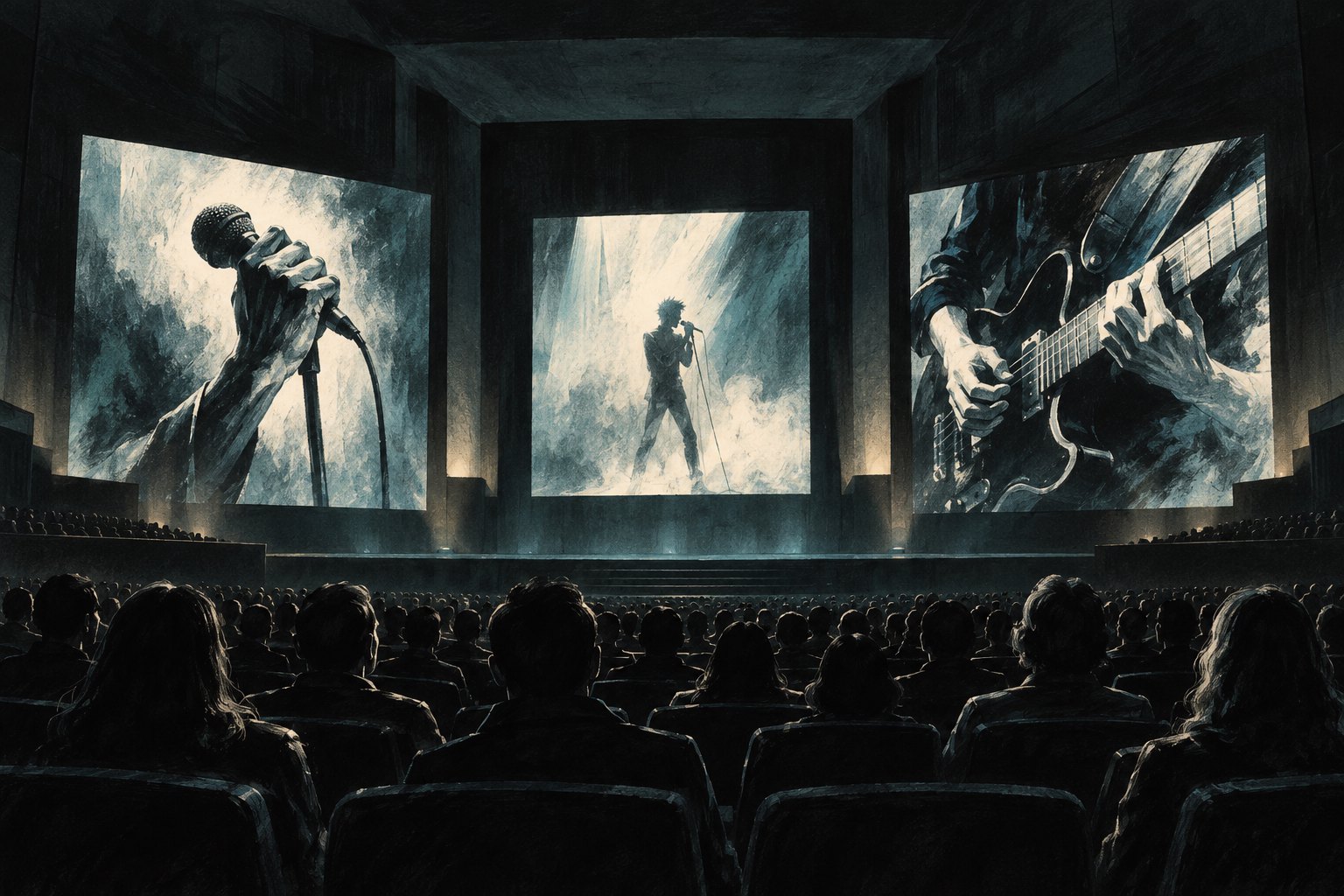
My preference is for a presentation with a clear rhythm of attention: moments of abundance followed by moments when one image can hold the room. Visual restraint can make a later expansion more powerful. It also gives the performer time to register as a person whose movements unfold, rather than a succession of instantly recognizable poses.
Listen for continuity, not just impact
Sound offers another way to assess the adaptation. A forceful presentation may produce immediate excitement, but musical clarity requires distinctions within that force. Can the listener follow a part as it enters, develops, and recedes? Does a quieter passage retain its place in the performance’s overall shape?
Transitions matter here. The space between musical peaks helps establish scale, anticipation, and release. If every passage feels equally monumental, the audience may lose the contrast that makes a particular moment exceptional. The most persuasive concert presentation lets intensity vary.
The same principle applies to the relationship between sound and image. A visual change can sharpen a musical event, but constant visual activity can pull attention away from listening. When the revival becomes available to judge, the useful question will be whether its presentation makes the performance easier to follow across time.
What to look for when the show arrives
A few concrete observations can turn an enthusiastic response into an informed assessment:
- Follow one complete passage. Notice whether the editing lets a musical idea develop or repeatedly redirects attention.
- Watch the surrounding performers. Look for relationships that explain how the central performance takes shape.
- Notice changes in scale. Ask what a close-up reveals that a wider image cannot, and what it leaves outside the frame.
- Separate the footage from its presentation. Identify whether a memorable effect comes from the recorded action, the editing, or the room around you.
These are also useful habits for reading criticism afterward. As our discussion of how to examine a film critic’s judgments suggests, an assessment becomes more persuasive when its conclusions can be traced to specific observations.
A new encounter with an earlier performance
The deeper interest in this revival lies in the meeting of two moments: the performance captured by the camera and the present audience encountering its reconstruction. The footage carries decisions made then; the new show adds decisions made now. Recognizing both allows viewers to appreciate the event without treating its form as inevitable.
For me, the strongest possible outcome would be a presentation that makes Bowie’s performance more available to sustained attention. The excitement of recovery can bring people into the room. What deserves to hold them there is the visible, audible work: a phrase taking shape, musicians responding, and a camera preserving something that a new audience can finally examine for itself.
Original content by this site's editorial team. Published: October 27, 2026 at 11:43:25 PDT (Los Angeles time)