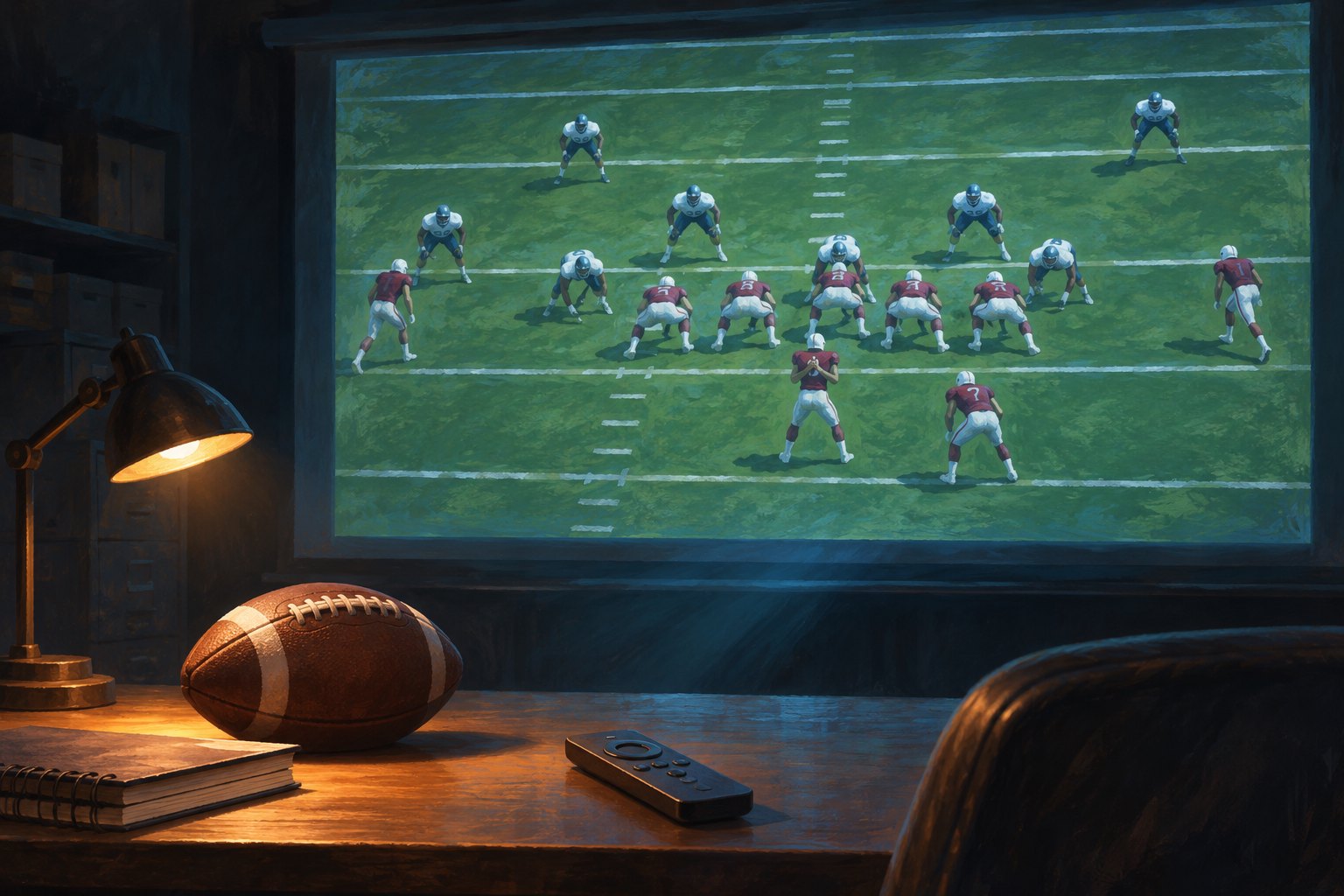
Darrell Dickey’s preview of LaNorris Sellers and South Carolina is a football film-study subject: the central interest is how recorded action can help viewers understand a player. KBTX News 3 identifies Dickey, Sellers, and South Carolina as the focus of its preview. For readers arriving through the phrase “film study,” the distinction matters. This is sports analysis, rather than a narrative movie with a screenplay, fictional characters, or a conventional plot.
The announcement establishes that focus, but it does not establish Dickey’s specific conclusions, the plays he examines, or the predictions he makes. What follows is an independent viewing guide prompted by the preview, not a review of the segment’s unseen footage. Its central question is straightforward: when Sellers appears on screen, what would make an interpretation convincing?
Start With the Decision, Not Just the Result
The most useful way to approach a Sellers breakdown is to separate what happened from why it happened. An exciting outcome can draw attention immediately. Explaining the action requires a closer look at the options available before that outcome became inevitable.
Consider a hypothetical passing play. A completed pass might reflect an excellent decision under pressure, a well-designed opportunity, a receiver’s adjustment, or several contributions working together. An incompletion could involve a sound choice that failed in execution. Neither result, by itself, gives a complete account of the decision.
These are analytical possibilities, not descriptions of plays in Dickey’s preview. They establish a useful standard for watching it: look for an explanation that connects visible circumstances to an action. Praise becomes more informative when it identifies a particular choice. Criticism becomes more persuasive when it shows a realistic alternative.
My editorial preference is for analysis that makes its reasoning inspectable. A viewer should be able to return to the image and understand why the commentator reached a conclusion, even if some uncertainty remains.
Sellers’ Perspective Is Different From the Viewer’s
A camera can offer information that a player cannot access in the same way. From an elevated position, viewers may see spacing across the field. From behind a line of bodies, a player experiences moving obstructions, narrowing angles, and an unfolding sequence rather than a complete diagram.
That difference is especially important when judging an apparent missed opportunity. Something visible on a replay may have become visible only after the useful moment had passed. A player’s orientation also matters: an opening elsewhere in the frame does not automatically mean it was available to someone facing another direction.

For a Sellers-focused preview, the productive question is therefore not merely whether the audience can spot an opening. It is whether the footage helps establish when that opening existed and how it related to his position. This approach does not excuse every decision. It makes the judgment more precise.
There is a useful connection here to character-centered film criticism. Understanding a character’s choice requires attention to what that character knows at that moment. With a real athlete, the obligation to avoid invented motives is even stronger. Images can show movement and timing; they do not provide unrestricted access to thought.
What the Camera Leaves Outside the Frame
Any discussion of Sellers also has to account for South Carolina as a collective subject. A frame centered tightly on one player can make an action feel individual even when its possibilities depend on people outside the shot.
Imagine footage that follows the ball closely. It may communicate urgency beautifully while offering little evidence about movement farther downfield. A wider angle might explain those relationships more clearly, yet make a small physical adjustment harder to notice. Each view can be useful; each has limits.
That is why the strongest visual explanation often needs more than one scale of attention. The viewer needs enough breadth to understand relationships and enough detail to follow the decisive action. When a breakdown moves between those views, the important question is whether the transition clarifies the same moment.
This concern with what an image allows us to perceive also runs through our discussion of why the qualities of a moving image matter. For football study, the practical test is simple: does the presentation help us see something relevant, or does it merely make the footage more striking?
Replay Can Explain Timing—and Distort It
Slowing an action down gives viewers time to notice relationships that were difficult to follow at full speed. It can reveal the order of movements, the development of space, and the point at which an option changes. Those are substantial benefits.
But slow motion also changes the experience of a decision. An instant becomes a stretch of time that feels available for deliberation. A freeze-frame can make several possibilities appear equally accessible even though they existed for different lengths of time.
A useful habit when watching the Sellers preview is to compare any slowed sequence with its full-speed version, if both are available. First identify the detail the replay emphasizes. Then ask whether the original pace changes your understanding of its difficulty. The two views should inform each other.
Editing introduces another question: how much of the action comes before and after the highlighted moment? A clip beginning too late may hide the circumstances that shaped the choice. One ending immediately after a dramatic movement may leave its practical consequence unclear.
A Practical Checklist for Watching Dickey’s Preview
Viewers do not need to turn the segment into a technical examination. A few questions can help distinguish an explanation from an impression:
- What is visibly established? Identify the movement, spacing, or timing that the footage actually shows.
- What is inferred? Separate observable action from claims about intention, responsibility, or anticipation.
- What remains outside the shot? Notice when an interpretation depends on something the camera does not reveal.
- Does the claim match the evidence? One example can illuminate a moment without establishing a consistent tendency.
- Does the conclusion concern this play or a future performance? Explanation and prediction require different levels of confidence.
The last distinction matters because this is a preview. Past footage can support expectations, but an expectation remains an interpretation. Our coverage of the difference between forecasts and measured results addresses the same reasoning problem in film coverage: a plausible projection should retain its conditional status.
The Deeper Value of Studying Sellers on Screen
The appeal of Dickey’s announced subject is the opportunity to look beyond the immediate impact of an athletic moment. Sellers supplies the individual focus; South Carolina supplies the broader context. A worthwhile analysis should help viewers understand how those levels interact without treating every team outcome as a verdict on one person.
My view is that the best football film study changes the viewer’s next viewing experience. Afterward, attention shifts from simply following the ball to noticing how an opportunity develops, what constrains a choice, and which parts of an explanation remain uncertain.
That is the standard worth bringing to this preview. The deeper reward is not the feeling that replay makes every decision obvious. It is a more disciplined appreciation of action under pressure—and a clearer understanding of how much a moving image can explain when someone reads it carefully.
Original content by this site's editorial team. Published: November 4, 2026 at 22:05:00 PST (Los Angeles time)