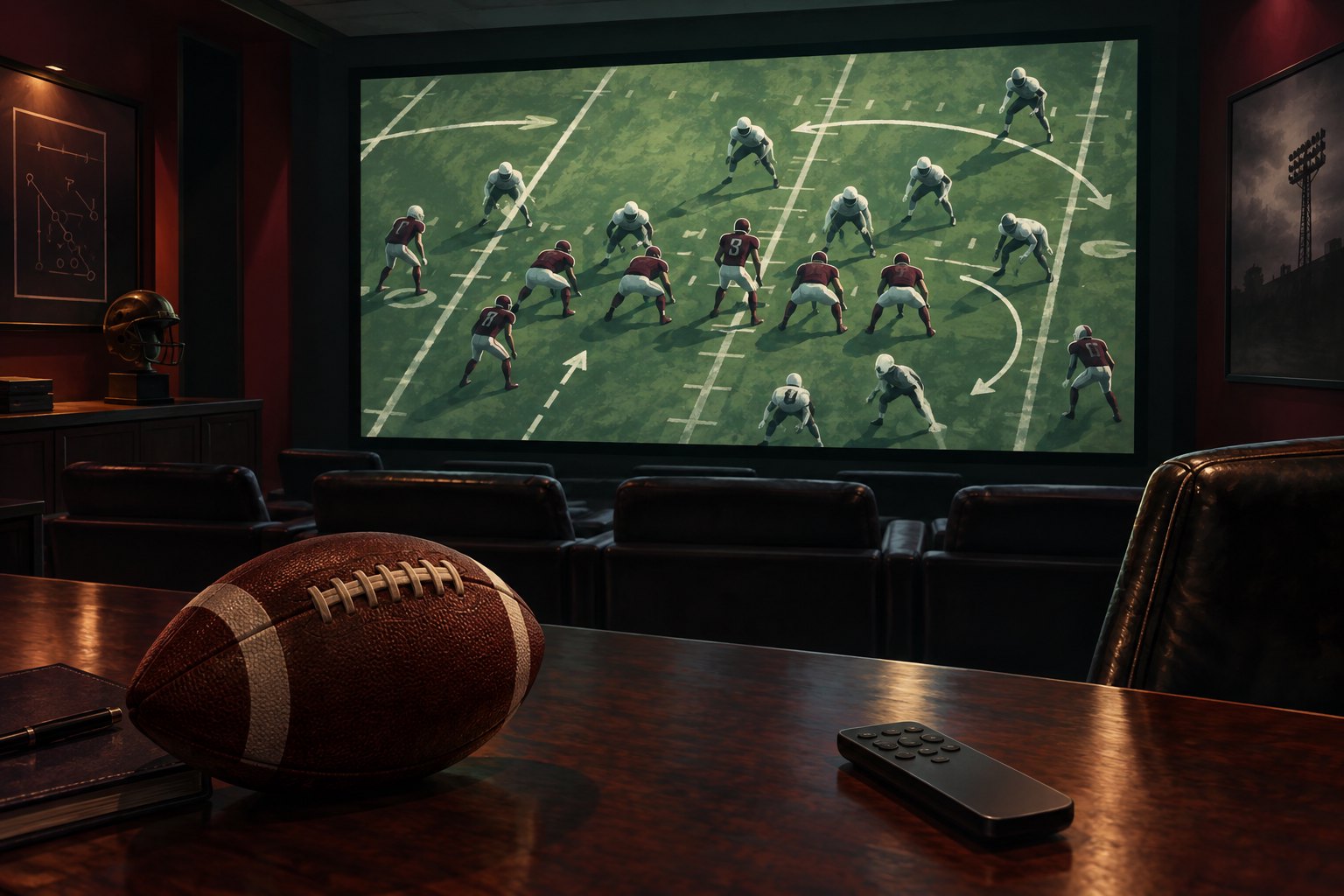
Darrell Dickey’s examination of A&M’s offensive struggles following its loss to Missouri addresses the question that matters after a disappointing performance: how did the offense break down? KBTX News 3 identifies that as the subject of its Film Study coverage. Understanding the answer requires more than replaying the final moment of an unsuccessful play.
Here, film study means football footage analysis. There is no fictional protagonist, screenplay, or cinematic plot to review. Yet the subject rewards a habit familiar to attentive moviegoers: watching how actions connect across a frame, and asking whether the most conspicuous person actually explains everything that happens.
This is commentary on how to approach the breakdown, rather than a transcript or a play-by-play account of Dickey’s conclusions. The reported focus establishes A&M’s offensive difficulties after the Missouri loss. It does not, by itself, establish which assignments failed or what Dickey said about individual snaps. Those distinctions are essential to a useful reading.
Start With the Breakdown, Not the Blame
A failed offensive play supplies an ending immediately. The explanation arrives more slowly. Viewers can see that a play did not work while still lacking the information needed to say why. The ball attracts attention, so the player holding or receiving it often becomes the center of the story.
For anyone approaching Dickey’s A&M analysis, the first useful question is therefore specific: where did the play stop functioning as intended? That point might precede the most visible mistake. It might also coincide with it. The footage has to establish the relationship rather than merely encourage an impression.
Consider a hypothetical passing play. A receiver appears open after the quarterback has already moved away from pressure. A frozen image can make the missed opportunity look obvious. A continuous replay may show that the receiver became available only after the throwing platform disappeared. Alternatively, the sequence may reveal that the opportunity existed earlier and went unused. The same ending can support different explanations depending on timing.
These are possibilities to investigate, not claims about what happened against Missouri. Their value is methodological: they turn a general complaint about the offense into a question the pictures might answer.
The Quarterback’s Perspective Has Limits
Watching from an elevated camera position provides a privilege unavailable to a player surrounded by moving bodies. The viewer can survey several areas of the field at once. A quarterback must acquire information while maintaining footwork, anticipating pressure, and deciding whether a throw remains viable.
That difference should encourage precision, not automatic sympathy. A difficult decision can still be a poor decision. But a fair assessment identifies what information was available at the relevant moment, rather than judging an earlier choice through a later, clearer image.
Film criticism asks a related question when evaluating character decisions: what could this person reasonably know? Our discussion of perspective and who gets to own a screen story explores why the position from which we watch matters. In football analysis, that concern becomes concrete. The camera’s overview and the player’s sight line are different kinds of information.
Applied to A&M’s offensive struggles, the useful standard is neither to excuse the quarterback nor to make him the explanation for everything. It is to identify the decision, its available alternatives, and the evidence supporting the judgment.
Watch the Players Away From the Ball
Offensive football depends on coordinated work. A receiver’s route, a blocker’s positioning, and a quarterback’s release have to fit within the same developing sequence. Looking only at the ball can hide the relationship among those actions.
A productive second viewing follows someone else. Watch the protection before looking at the pass. Watch a receiver’s movement before following the catch attempt. Notice what the defense changes as the play develops. This approach does not guarantee access to the assignment, but it can reveal where an initial explanation is incomplete.
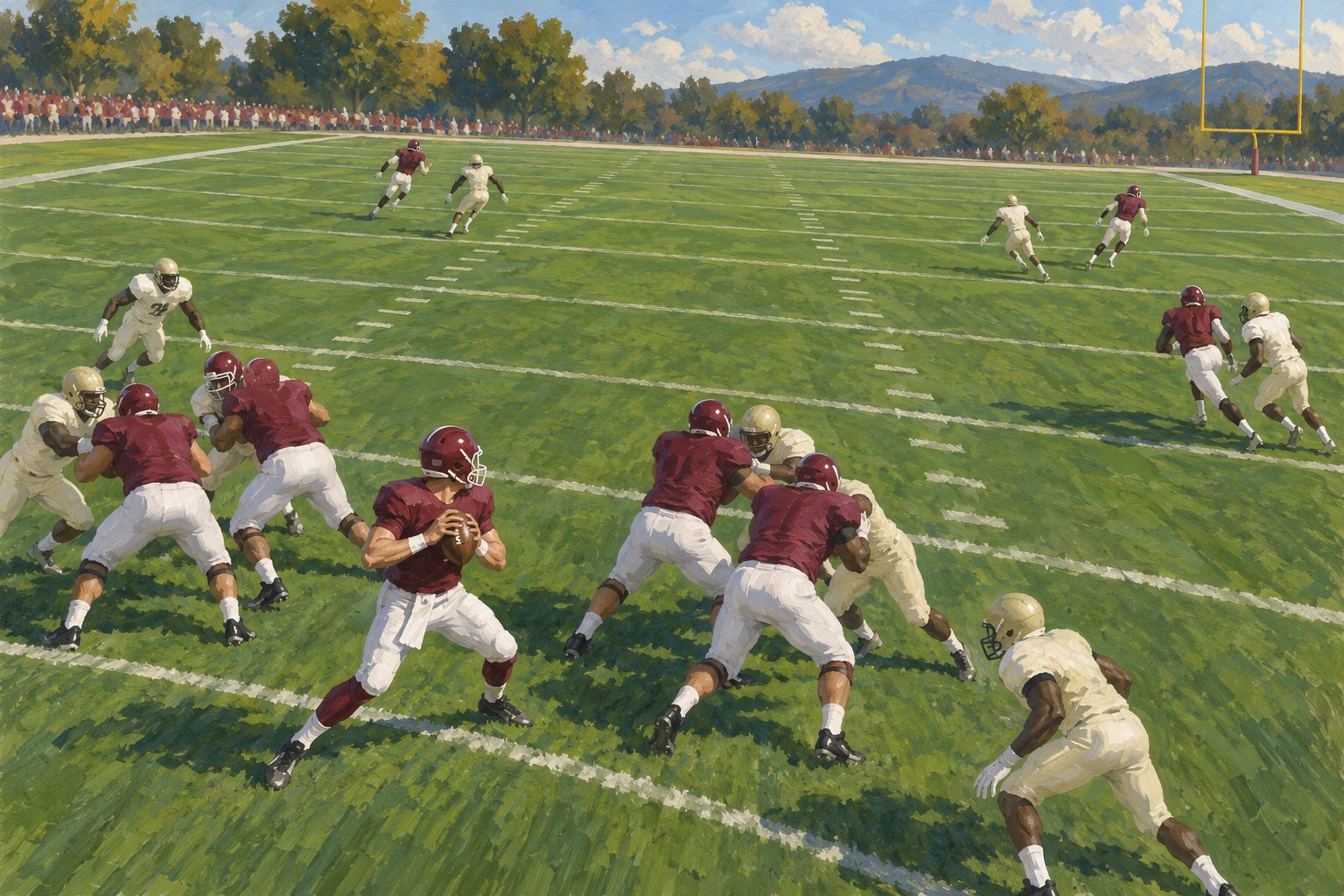
Timing is particularly easy to flatten into vague language. Calling an offense disconnected names an impression. Showing that one action occurred before another necessary action was ready begins to explain a mechanism. For a viewer, that is the difference between hearing a verdict and understanding a play.
The defense also belongs in the explanation. Missouri cannot be treated simply as scenery for an A&M failure. Any persuasive account must leave room for an opponent forcing an unfavorable choice or disrupting an otherwise workable idea. Which of those things happened on a particular snap requires evidence from that snap.
What the Camera Can—and Cannot—Prove
A replay contains visible actions, but it does not automatically contain the complete play call. Movement may suggest an assignment without proving it. Two players ending up in conflicting positions can reveal a problem while leaving uncertainty about which player departed from the plan.
This is where explanatory language matters. An observation describes what appears on screen. An inference proposes why it happened. A confident diagnosis needs additional support. Keeping those categories separate makes analysis stronger because readers can see where the certainty comes from.
Framing creates another limit. A tight shot may clarify contact near the ball while excluding the routes farther downfield. A wider view may show spacing but obscure a small technical detail. The most dramatic angle is not necessarily the most informative one.
That concern also runs through our examination of how documentary framing shapes interpretation. Images can provide evidence while still guiding attention selectively. In a football breakdown, a pause, crop, or replay should help explain a claim rather than substitute for its proof.
A Practical Way to Follow Dickey’s Analysis
The most useful viewing routine is straightforward. It slows down judgment without making the game inaccessible:
- Watch the whole play first. Establish the sequence before isolating one movement.
- Identify the exact claim. Distinguish a comment about a decision from one about timing, protection, or execution.
- Locate the supporting moment. Ask which visible action makes that explanation persuasive.
- Check the surrounding action. Look for pressure, coverage, or another player’s movement that changes the interpretation.
- Look for recurrence. A single example can explain one failure; a broader diagnosis needs a pattern.
This last step matters especially after a loss. A memorable mistake can dominate the viewer’s recollection without representing the entire offensive performance. Conversely, several modest-looking errors may reveal a recurring problem that a highlight package would overlook.
The Deeper Value of Studying a Loss
My view is that the best reason to watch Dickey’s A&M breakdown is the opportunity to replace an emotional summary with a more precise account of cause and effect. Disappointment is understandable. It is also a poor substitute for an explanation.
Useful film study makes responsibility more specific. It asks what failed, when it failed, how other players affected the outcome, and how confidently the footage supports the conclusion. That approach can sharpen criticism without reducing an athlete to a single unsuccessful moment.
The larger lesson is about attention. The player at the center of the image is not always the beginning of the explanation. Following A&M’s loss to Missouri, looking beyond that center is the most productive place to start.
Original content by this site's editorial team. Published: October 14, 2026 at 20:04:17 PDT (Los Angeles time)