Dakota Johnson’s cottage wardrobe in Verity offers an appealing entry point into the movie: clothes that invite attention without needing the spectacle of a red-carpet gown. Glamour’s assessment places the wardrobe above everything else in the film. That is a subjective verdict, but it raises a worthwhile critical question. When we remember what a character wears, are we admiring the outfit, understanding the person, or responding to an image of a life we would like to inhabit?
My view is that the distinction matters more than deciding whether the clothes deserve first place. Costume can create an attachment that dialogue later complicates. It can make a stranger feel familiar before we have enough information to judge them. The discussion around Johnson’s Verity wardrobe becomes more interesting when it moves from what we would buy to what we are prepared to believe.
Spoiler-free costume commentary: This article considers the wardrobe-focused response to Verity, rather than offering a scene-by-scene review or an assessment of its ending.
What “cottage wardrobe” asks us to imagine
The phrase carries an entire atmosphere. It suggests retreat, privacy, slower routines, and a degree of freedom from public presentation. Those associations belong to the language of fashion; they do not establish what a movie’s characters actually experience. Still, they influence the expectations we bring to an image.
That is the first useful distinction for a viewer. A setting can look restful while the person occupying it feels anything but relaxed. Similarly, an outfit can appear comfortable without demonstrating that its wearer is comfortable. Treating those things as interchangeable flattens both costume and performance.
For me, the strongest way to approach Johnson’s wardrobe is to keep that uncertainty open. Does an approachable appearance encourage us to imagine access to a character’s private self? Are we reading familiarity as sincerity? These are questions about our response, not claims that a particular garment solves the story.
“Cottage style” is an efficient description for browsing clothes. As film criticism, it needs another step: attention to the person inside them.
Familiar clothes can make a character feel knowable
An extraordinary costume announces distance. We recognize a ceremonial dress or elaborate uniform as belonging to a particular world. Ordinary-looking clothing works more quietly. It can bring a screen figure into the same imaginative space as someone we might know.
That sense of recognition is powerful because it feels unforced. We may consciously evaluate a character’s words while accepting their appearance almost automatically. A familiar silhouette can suggest everyday competence, restraint, or ease, even though none of those qualities is guaranteed by the clothes themselves.
This is where wardrobe analysis can sharpen a character-centered reading of Verity. Rather than asking whether Johnson looks stylish, ask what assumptions that styling encourages. Then test those assumptions against behavior. Does the character earn the understanding we have already extended?
The method also avoids a common critical shortcut: treating appearance as a reliable moral code. Attractive clothes do not confer innocence, and expensive clothes do not establish cruelty. Our discussion of persuasive self-presentation in Animals approaches a related question through speech: how quickly do we confuse a convincing presentation with a trustworthy person?
The actor wears the clothes; the character gives them meaning
There are two people in any conversation about a star’s screen wardrobe: the performer whose image audiences recognize and the fictional person the film asks us to meet. With Johnson’s name leading the fashion conversation, keeping those identities separate becomes especially useful.
A viewer might want an outfit because it appears connected to the actor’s appeal. That is a legitimate pleasure. But it is different from finding the costume convincing as part of the character’s life. The first response is aspirational; the second requires attention to context.
A practical test is to imagine the garment without the celebrity association. Would it still suggest a particular habit, circumstance, or relationship to the surrounding space? If the answer is yes, there is something to discuss beyond star style.
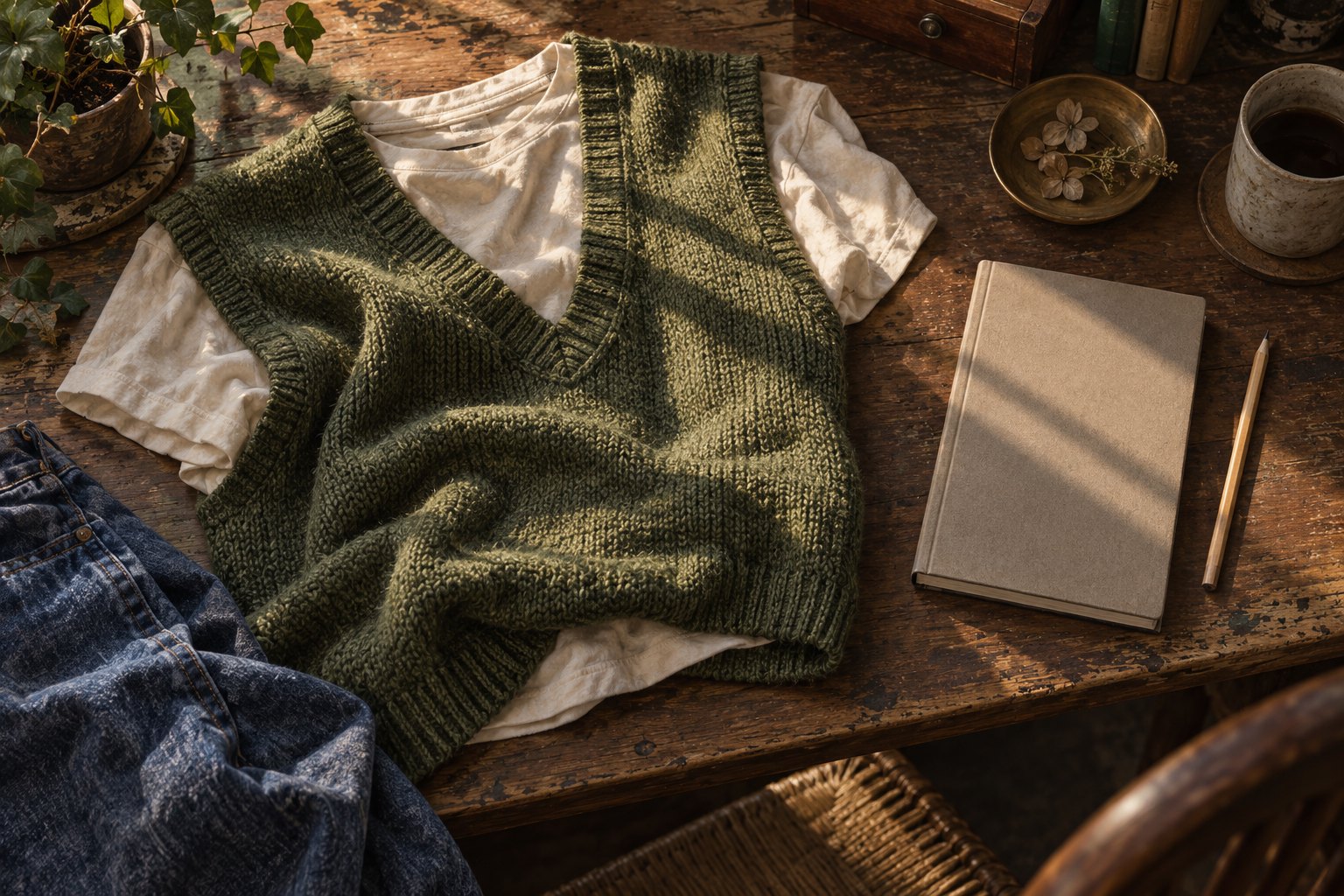
The accompanying illustration is an imagined study of clothing and domestic space, not a film still or a reproduction of a verified costume. That distinction matters here: a mood can help explain an argument, but it cannot provide evidence about what appears on screen.
How to watch the wardrobe without reducing it to a shopping list
On a viewing, three points deserve attention. None requires identifying a designer or knowing the price of a garment.
- Movement: Notice how the wearer sits, reaches, walks, and occupies space. Clothing participates in a performance through its weight, fit, and restrictions.
- Repetition: Watch whether familiar pieces recur. Repetition can establish routine and continuity; a departure from it becomes meaningful only in context.
- Relationships: Compare the character’s appearance with the people and rooms around them. Visual belonging and emotional belonging are not necessarily the same.
These observations are more useful than assigning a fixed meaning to every color. A pale garment does not automatically signify purity. A dark jacket does not automatically signal danger. The relevant question is what changes around a costume, and whether that change affects how we understand its wearer.
The same attention to accumulated detail informs our character-focused discussion of sustained dread in Sinister. A striking impression can attract attention immediately; a relationship between details gives that impression staying power.
Does memorable wardrobe make a better movie?
Calling the wardrobe the best part of Verity can be praise for visual craft, criticism of the surrounding drama, or simply an expression of personal enjoyment. Those meanings should not be collapsed into one conclusion.
My preference is to judge costume by what it contributes. Does it make the character feel more specific? Does it reward attention without demanding it? Does it work with the performance rather than distracting from it? A beautiful outfit may accomplish all three, but beauty alone does not answer those questions.
Nor can clothing settle questions about narrative logic, emotional credibility, or a film’s ultimate meaning. Costume is one part of the dramatic argument. Appreciating that part becomes more precise when we resist making it responsible for everything else.
The deeper question is why we feel close to someone
The most productive interpretation of the attention surrounding Johnson’s Verity wardrobe concerns familiarity. We often experience recognizable style as a small invitation: this person belongs to a world we understand. From there, it is easy to feel that we understand the person, too.
Good character criticism pauses at that leap. It allows pleasure in the clothes while remaining curious about the wearer. For viewers drawn to Verity through its cottage aesthetic, that is a rewarding way to watch: notice when visual affinity becomes emotional allegiance, and ask what the character actually does to deserve it.
The wardrobe conversation is worth having because appearance shapes attention. Its richest possibility is to help us recognize how much of our response begins before a character has explained anything at all.
Original content by this site's editorial team. Published: October 9, 2026 at 09:58:59 PDT (Los Angeles time)