The Dallas Cowboys’ 37–20 victory over the Washington Commanders supplies the central question for the team’s official Tape Talk coverage: what can a closer look at the game explain that the final score cannot? Dallas finished 17 points ahead. Understanding how individual decisions contributed to that result requires a different kind of attention from simply watching the scoring plays.
Here, film means football footage. Tape Talk is a game-analysis feature, and the useful connection to movie criticism lies in how we read images: where the frame directs our attention, whose perspective we adopt, and how knowing the ending changes our judgment. This commentary offers a viewing framework for the Cowboys–Commanders breakdown rather than a play-by-play verdict.
What 37–20 tells us—and what it leaves open
The result establishes the winner and the margin. On its own, it cannot establish whether Dallas controlled every phase, whether Washington repeatedly created opportunities it failed to finish, or whether a handful of sequences disproportionately shaped the outcome. Those are separate claims that require separate evidence.
That distinction matters because a decisive-looking score encourages a tidy story. Viewers can begin interpreting every Cowboys action as a step toward an inevitable victory and every Commanders response as evidence of inevitable defeat. The players experienced neither certainty. Each snap presented an unfinished situation.
My preferred approach is to treat the result as the starting point for inquiry. When a breakdown identifies something Dallas did well, ask what is visible before the successful outcome. When it identifies a Washington mistake, ask which realistic alternatives were available at that moment. This makes praise more specific and criticism more fair.
Watch from the player’s position before judging from above
A wide camera angle gives the audience an advantage that no single player possesses: simultaneous access to several moving relationships. That can make an opening seem obvious long before it would have been usable from field level. Watching intelligently means accounting for that difference.
The passer: an opening has a deadline
When examining a passing sequence, follow the relationship between the thrower’s available space and the developing route. A receiver appearing open in a paused image does not, by itself, prove that the pass should have gone there. The relevant questions concern timing, visibility, pressure, and whether the throwing opportunity existed before the defense could respond.
For this Cowboys–Commanders review, that is a question to bring to the footage, not a claim about a particular missed or completed throw. The distinction prevents a still frame from becoming an unsupported accusation.
The blocker: look for the action outside the spotlight
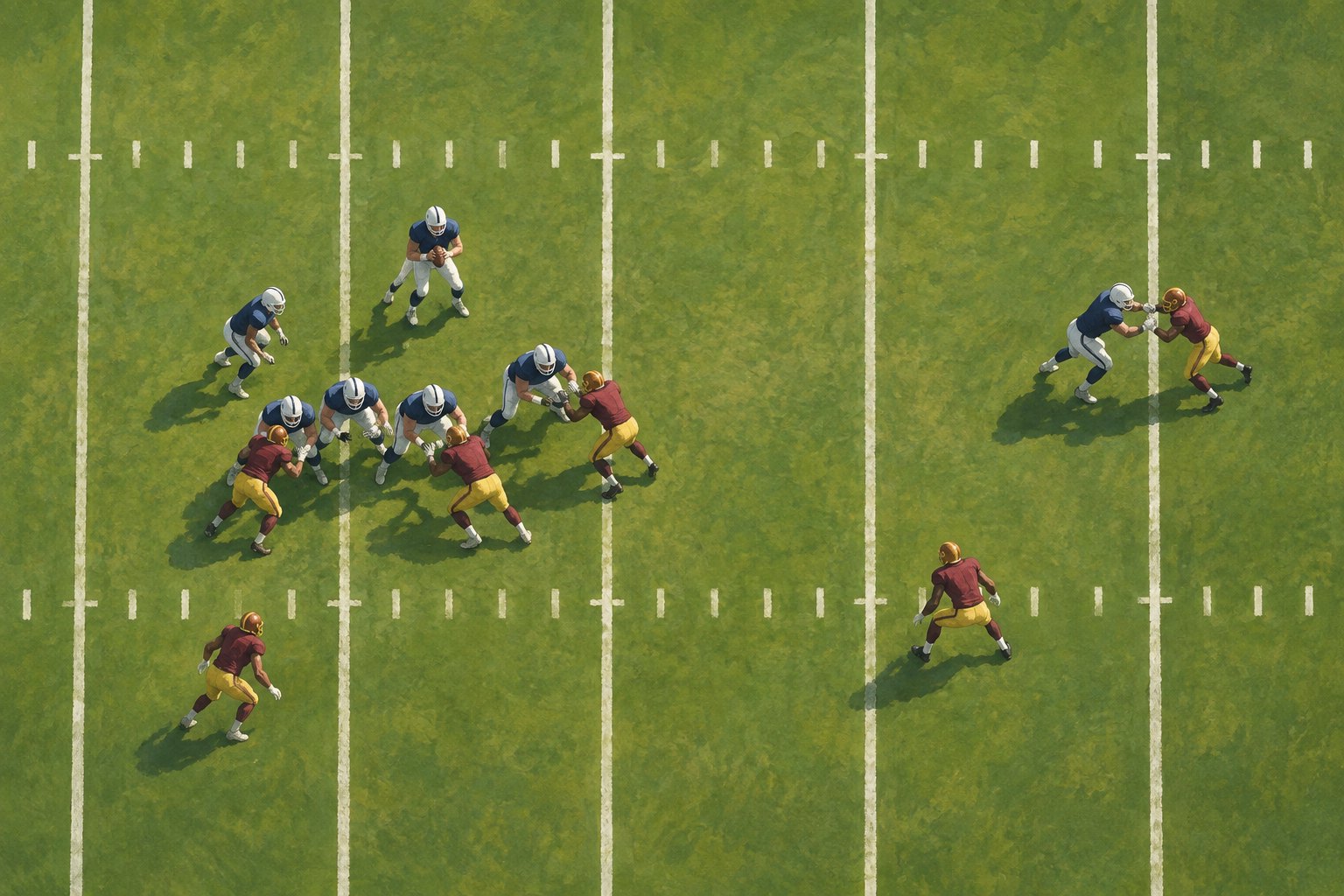
The ball naturally attracts attention, but it may be the least informative place to look on a second viewing. Follow a blocker’s initial movement, the defender’s response, and the space that remains available. A small positional advantage can be easier to understand when the replay is watched without chasing the ball.
This resembles watching the supporting performer in a crowded movie scene. Attention shifts from the person delivering the obvious payoff to the person helping make it possible. In football, however, the interpretation must stay grounded in observable movement rather than imagined intention.
The defender: distinguish a difficult choice from a clear error
Washington’s players should remain active participants in the analysis. A defender may face competing threats, and following one can expose another. Before describing a movement as a mistake, examine what changed around that player and whether the footage reveals the relevant responsibility.
The same standard applies to Dallas. Winning the game does not make every defensive choice correct. Conversely, a completed play against a defender does not automatically identify that defender as the person responsible. A useful breakdown explains the connection instead of relying on the outcome.
The camera determines which explanations are possible
A tight shot can reveal a physical contest while hiding the route that influenced it. A wider view can show spacing while making hand placement or eye direction difficult to read. Different angles answer different questions; none deserves unlimited authority.
This is where screen criticism becomes particularly useful. Framing selects evidence. If a player leaves the image, the viewer loses access to part of the action even though the play continues. An explanation should acknowledge that missing information before assigning a precise cause.
Our commentary on what missing camera coverage means for viewers explores a related principle in a different setting: what an image lets us know depends partly on what could be recorded. For Cowboys–Commanders footage, the practical lesson is to check the boundaries of the frame before accepting the certainty of the narration.
Replay can clarify a decision or distort its difficulty
Slow motion is useful for identifying sequence: who moved first, when space narrowed, and how contact developed. It also gives the audience time the players never had. A decision that looks leisurely across several replay seconds may have required an almost immediate response.
A sensible viewing sequence is simple:
- Watch the complete play at normal speed to establish its pace.
- Replay it while following one player or one area of the field.
- Pause only to test a specific observation about position or timing.
- Return to normal speed before judging how manageable the decision was.
This method helps preserve the difference between identifying an available option and proving that a player reasonably could have used it. It also makes the Cowboys’ successful actions more interesting: execution gains meaning when the viewer appreciates its time constraints.
Read a team-produced breakdown with clear expectations
Tape Talk comes from the Cowboys’ official editorial coverage. That gives the feature an identifiable viewpoint. Readers can appreciate its Dallas focus while still asking whether a particular explanation accounts for Washington’s actions and whether the selected examples justify a broader conclusion.
A successful snap can demonstrate that something worked once. Establishing a recurring strength requires comparison. Likewise, a failed snap may reveal a problem without showing how frequently it occurred. The strongest analysis makes those differences easy to follow.
This is also why enthusiasm and evaluation should remain separate. Our discussion of how to interpret divided early reactions to Digger considers the gap between an immediate response and a developed judgment. Here, satisfaction with a Dallas victory is understandable; explaining the performance demands a more precise vocabulary than satisfaction alone.
The deeper story is how the result becomes understandable
The most rewarding way to approach Tape Talk’s Cowboys–Commanders breakdown is to resist making the ending explain everything that came before it. Dallas won 37–20. The footage’s additional value lies in showing relationships within that result: movement and response, opportunity and timing, individual execution and collective dependence.
For me, that is the strongest connection between close film analysis and close football viewing. A second look can redistribute attention toward people and actions overlooked the first time. The final score remains fixed, but the viewer’s understanding can become more generous, more exact, and less dependent on whoever happened to hold the ball.
Original content by this site's editorial team. Published: September 24, 2026 at 07:58:36 PDT (Los Angeles time)