
Elijah Higgins makes a block; Roy Lopez and Darius Robinson shed double teams. Those are the actions highlighted by the Arizona Cardinals’ Film Room feature, and together they offer a useful reason to watch away from the football. One player’s task involves keeping an opponent occupied. The other two are highlighted for escaping that kind of control. The shared subject is how a small contest between bodies can change the space available to everyone else.
This is football film study, with real athletes and assignments rather than fictional characters and a screenplay. The discussion below examines the significance of the feature’s stated focus. It does not assign an opponent, score, play design, or statistical result to these moments, or claim a viewing-based assessment of the complete footage.
Higgins’ Block: Look Beyond the Collision
A block can look impressive because the contact is forceful. Its practical value, however, depends on what that contact allows the offense to do. A defender moved several steps may still remain in the relevant path. A defender moved only slightly may lose the angle needed to interfere. Distance alone is an incomplete measure of success.
For Higgins, the useful viewing question is therefore about the relationship between his position and the developing play. Where is the opponent before contact? Where can that opponent go afterward? How long does Higgins preserve the separation that matters? These questions turn an isolated physical action into something readable.
Start with the feet. They can help reveal whether a blocker is arriving under control or reaching from an unstable position. Then follow the hips and shoulders: does the player remain between the opponent and the space being protected? Finally, watch the moment the players separate. The ending matters because a defender recovering early may still influence the play.
These are general evaluation criteria, not assertions about Higgins’ specific technique in this feature. The stated highlight establishes the block as a subject worth examining; it does not, by itself, establish the assignment or explain every movement.
My preferred way to assess this kind of contribution is to follow the teammate who benefits. Does someone gain a usable route through traffic, a clearer path, or more time? That shift in attention makes blocking interesting even when the blocker never becomes the center of the broadcast.
Lopez and Robinson: Escaping Two Blockers Is Only Part of the Story
The defensive counterpart is equally dependent on context. Shedding a double team means getting free of an engagement involving two blockers, but the phrase alone does not tell us how the engagement developed or what happened after the escape. A viewer needs the sequence, not merely the final image of a defender standing clear.
Two blockers can apply pressure from different angles. Their contact may overlap briefly or continue together. One may eventually move toward another assignment. Those possibilities matter because they change what the defender must solve. Remaining balanced under pressure, resisting displacement, and finding a moment to disengage are related challenges, but they are not interchangeable.
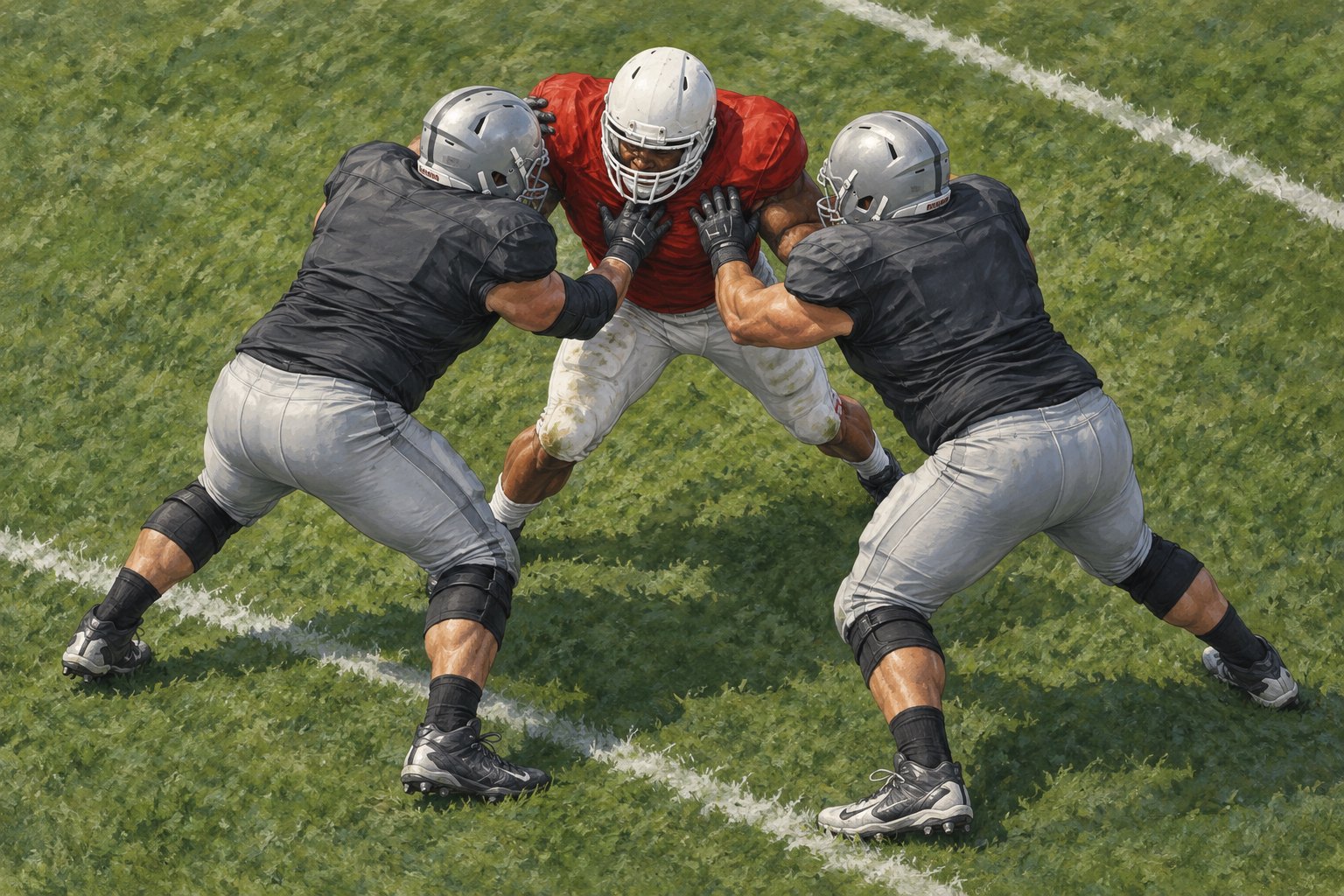
When evaluating the actions highlighted for Lopez and Robinson, separate three stages: the initial contact, the period of control, and the release. A strong finish can draw attention away from ground surrendered earlier. Conversely, a defender who appears stuck may be preventing the blocking pair from advancing where the offense needs them.
The next question is timing. Breaking free while the action remains within reach is different from disengaging after it has passed. That does not make a late escape meaningless, but it changes the claim a viewer can reasonably make about its effect.
Lopez and Robinson also deserve individual readings. Their inclusion under the same double-team theme does not establish that they used the same technique, faced equivalent pressure, or produced matching outcomes. A useful comparison asks the same questions of both players without assuming the answers will match.
The Most Revealing Detail May Belong to a Teammate
The clearest connection between Higgins’ block and the defensive highlights is their effect on other players’ choices. Blocking can narrow a defender’s options. Resisting or escaping a block can restore them. Neither action exists independently of the surrounding formation and movement.
Consider a hypothetical defensive sequence: two blockers remain occupied with one defender while another defender approaches the ball. The first player may contribute without recording the tackle. But that interpretation requires visible evidence that the engagement helped create the opportunity. Simply counting two blockers is not enough to prove a successful defensive play.
The same discipline applies to Higgins. A block and a positive offensive result occurring on the same snap do not automatically establish how much one caused the other. The stronger explanation traces the connection: which route was preserved, which opponent was delayed, and whether the timing matched the teammate’s movement.
That focus on connected responsibilities also informs our analysis of offensive continuity in the Eagles’ film. Here, the question is more local: how does one engagement alter the possibilities immediately around it?
A Four-Pass Method for Watching These Highlights
Repeated viewing is most useful when each pass has a different purpose. Otherwise, a replay can simply reinforce the impression created by its most dramatic instant.
- Watch the complete action at normal speed. Establish when the highlighted engagement occurs relative to the movement of the ball. Resist grading the player immediately.
- Follow only the featured player. Track Higgins through contact and separation. For Lopez and Robinson, track the changing pressure from both blockers and the route out of the engagement.
- Follow the surrounding players. Look for who gains space, who changes direction, and who remains occupied. This is where individual technique becomes a team contribution.
- Return to normal speed. Check whether the advantage visible in slow motion lasts long enough to matter. Keep any conclusion proportional to what the angle actually shows.
If the camera obscures a player’s feet or the engagement begins outside the frame, leave that part unresolved. A clear account of what is visible is more useful than a confident explanation built around missing information.
Why This Subject Rewards Close Attention
For a film-oriented audience, the appeal lies in redirecting attention within the frame. We tend to follow the figure carrying the immediate outcome: the ball carrier in football, the central performer in a dramatic scene. Looking elsewhere can reveal the work that makes that outcome possible.
There is a related storytelling question in our commentary on making teamwork meaningful in G.I. Joe: individual importance becomes convincing through consequences for the ensemble. Football footage offers its own concrete version of that relationship, although real assignments cannot be inferred as freely as fictional motivations.
The strongest interpretive value of this Cardinals topic is its attention to control. Higgins’ highlighted contribution concerns establishing it; Lopez and Robinson’s concern breaking it. The revealing moment is not necessarily the hardest collision or the cleanest escape. It is the instant when that physical contest changes what another player can do. Watching for that connection gives these less conspicuous actions the attention they deserve without turning a handful of highlights into a verdict on an entire performance.
Original content by this site's editorial team. Published: October 2, 2026 at 00:40:16 PDT (Los Angeles time)