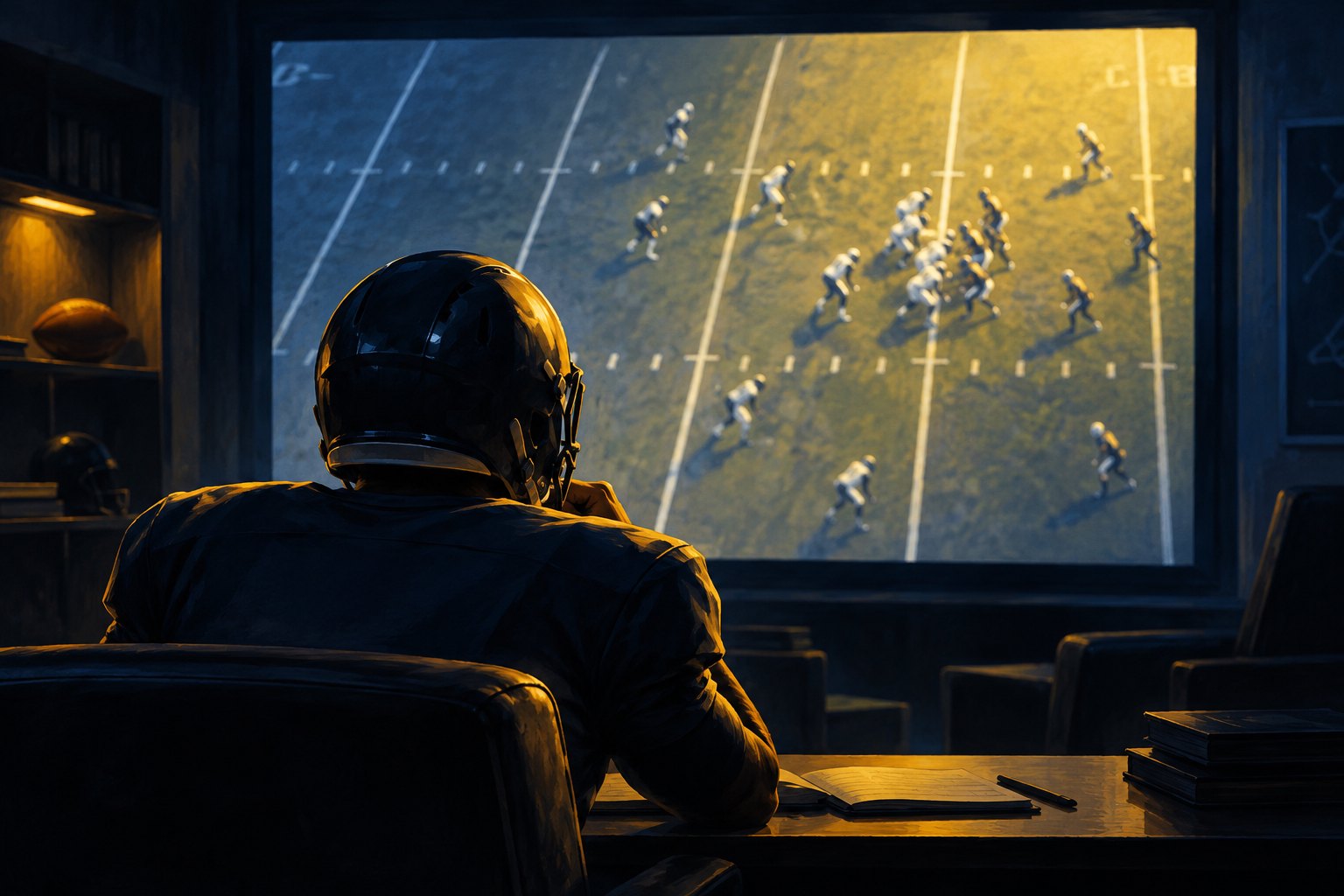
Bryce Underwood’s performance against Minnesota has been framed as a step backward in Maize n Brew’s Michigan football film-room coverage. That assessment raises a useful question: does the footage demonstrate declining execution, worse decisions, or simply a less successful performance? Those possibilities deserve separate consideration before “regression” becomes the entire story.
The headline establishes the publication’s critical position. It does not, by itself, establish which plays support that position or how Underwood performed relative to an earlier baseline. This article examines the judgment and the evidence it would require; it does not offer an independently verified, play-by-play grade of the Minnesota game.
Here, “film room” means studying football footage. There is no movie plot to review or scripted dialogue to interpret. Still, the subject poses a familiar challenge for anyone interested in visual criticism: how much of the story belongs to the images, and how much arrives through the explanation placed around them?
Regression Requires a Meaningful Comparison
A disappointing performance describes an outcome. Regression describes a change. To argue that Underwood went backward against Minnesota, an analyst needs to identify something he previously did more reliably and show where that ability became less dependable.
That comparison should be specific. Perhaps the question concerns the timing of a throw, the stability of a throwing platform, or the response to an initially unavailable receiver. These are examples of categories to investigate, not claims about what Underwood actually did in this matchup. Naming the category matters because different problems demand different explanations.
A comparison also needs reasonably similar circumstances. A clean throwing lane and an obstructed one present different tasks. A receiver breaking into open space does not offer the same opportunity as a tightly contested route. Treating unlike situations as interchangeable can turn a change in difficulty into an apparent change in ability.
My view is that “regression” becomes useful criticism only when it identifies a repeatable problem against an established standard. Otherwise, it risks giving disappointment a technical-sounding name.
Watch the Decision Before Watching the Result
The most revealing moment in a passing play may occur before the ball leaves the quarterback’s hand. Once viewers know the outcome, every preceding movement can start to look inevitable. An unsuccessful throw makes hesitation seem obvious; a completion can make a questionable choice look assured.
A more disciplined reading separates three questions: what information was available, what choice the quarterback made, and how well he executed it. Those questions should guide any assessment of Underwood against Minnesota, even when they produce a less tidy verdict.
What Was Actually Visible?
A receiver who appears open in a paused image may not have been available when the quarterback needed to commit. Space can emerge after a defender reacts or after the passer has already begun throwing elsewhere. The relevant issue is whether a viable opportunity existed at the decision point, not whether a promising patch of grass appears later.
Camera position matters, too. A view centered on the pocket can show pressure while leaving routes outside the frame. A wider view can clarify spacing while making smaller mechanical details harder to judge. When the necessary information is missing, uncertainty belongs in the analysis.

Was the Choice Sound, Even if the Play Failed?
Consider a hypothetical pass delivered toward an available receiver that goes uncaught. The failed result alone cannot tell us whether the quarterback chose poorly, placed the ball poorly, or did his part adequately. Conversely, a completed pass can still involve an unnecessary risk. Outcome and process overlap, but they are not identical.
For Underwood, a persuasive critique would explain precisely where the decision or execution deteriorated. “The play failed” is the beginning of an inquiry, not its conclusion.
Keep the Other Players in the Frame
Quarterbacks naturally attract attention because so many offensive actions pass through them. That visibility also makes them convenient protagonists. Once a performance becomes a story about one player struggling, teammates and opponents can fade into scenery.
A useful Minnesota breakdown would keep those other participants active in the explanation. Protection affects the time available. Route spacing affects the options. Defensive movement affects whether an initial impression remains accurate. None of these considerations automatically excuses the quarterback; each helps locate responsibility.
The questions should work in both directions. Did pressure force an adjustment, or did delayed action allow pressure to matter? Did the defense remove an option, or did the quarterback overlook one? Without the relevant sequence and context, choosing an answer would be speculation.
That attention to competing perspectives also informs our character-focused review of Best of the Best. The connection is interpretive: centering one participant can clarify a story while obscuring how other people shape the choices available.
Repeated Replays Are Not Repeated Evidence
A single mistake shown at full speed, in slow motion, and from several angles remains one mistake. Repetition can help explain its mechanics, but it does not establish how frequently the problem occurred. That distinction is essential when assessing a claim about Underwood’s development.
A convincing argument would place selected examples alongside the broader performance, including sequences that complicate the conclusion. If a criticism concerns delayed decisions, were there comparable situations handled promptly? If it concerns accuracy, did the same issue appear under similar conditions more than once?
This is where editing influences judgment. A sequence of unsuccessful plays can create a powerful impression without showing whether it represents the whole. Our discussion of lead and supporting framing in Artificial’s Oscar campaign explores another way emphasis directs attention. In football analysis, the practical response is to ask what surrounds the selected footage.
A Practical Way to Evaluate the Minnesota Claim
Readers looking for substance behind the regression assessment can use four checks:
- Identify the alleged change. Look for a precise claim about timing, mechanics, recognition, or another observable feature.
- Ask for the baseline. A claim of decline needs earlier evidence showing more dependable performance in comparable situations.
- Follow the complete sequence. Watch what develops before the throw and distinguish visible information from assumptions about assignments.
- Test the pattern. Consider counterexamples and avoid treating several replays of one sequence as separate incidents.
These checks do not predetermine a favorable verdict for Underwood. They make a negative verdict more useful if the evidence supports it. Criticism gains force when it explains the problem clearly enough that a reader could recognize either its recurrence or its correction.
Underwood’s Performance Is Not a Finished Character Arc
The deeper issue is the appeal of a complete story. A quarterback moves forward, encounters resistance, and appears to slip backward: the structure feels immediately legible. But a satisfying narrative is not necessarily an accurate account of development.
Maize n Brew’s framing puts Underwood’s Minnesota performance under scrutiny. The strongest response is to demand specificity rather than rush toward either defense or condemnation. What changed? Under what conditions? How often? Compared with what?
My editorial judgment is that those questions carry more value than the label alone. If the footage demonstrates a recurring deterioration, “regression” can describe something meaningful. Until the relevant comparisons are established, it remains a critical assessment to examine—not a settled account of who Underwood is or where his football career is heading.
Original content by this site's editorial team. Published: October 8, 2026 at 03:10:05 PDT (Los Angeles time)