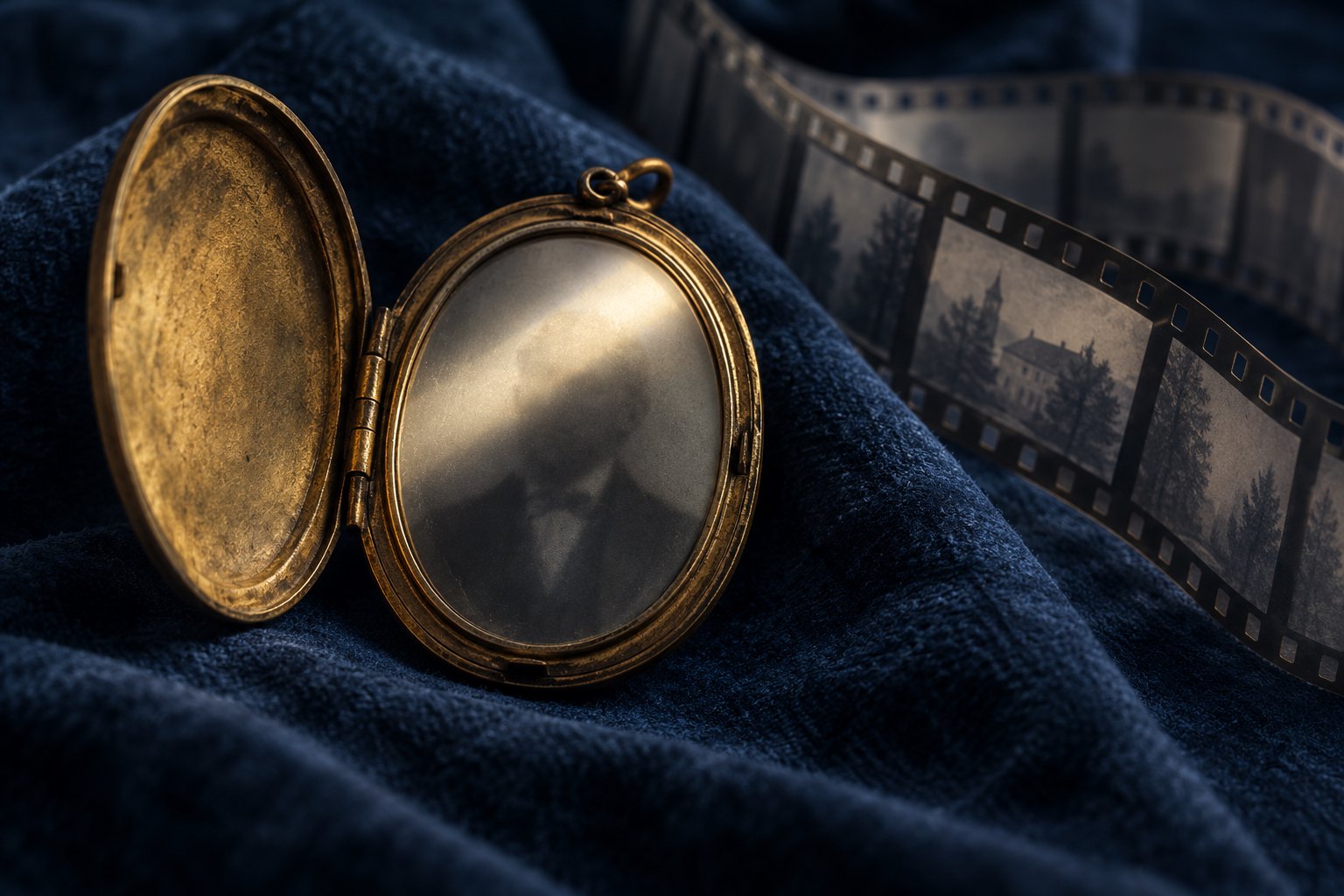
Does a nineteenth-century photograph show Joseph Smith’s face? Brother Joseph Again: Exploring the Visual Image of Joseph Smith Jr. presents researchers who believe it does. The compelling question is how that confidence becomes an argument an audience can evaluate. Recognizing someone, feeling connected to him, and establishing the identity of a photographed subject are different achievements.
The film’s official materials identify Patrick Bishop and Joseph Brickey as its central researchers and advertise a theatrical opening on October 9. They describe an investigation combining historical research and forensic inquiry. Those statements establish the project’s purpose; they do not independently authenticate its conclusion. [The film’s official research synopsis](https://brotherjosephagain.com/)
Scope and spoilers: This is critical commentary on the documentary’s reported investigation and character perspectives, including its reported conclusion, rather than a review based on a complete screening. Judgments about its editing, performances, score, or pacing would require viewing the finished film.
The researchers are the story’s human center
A film about an unidentified face has an unusual dramatic structure. Its historical subject cannot answer questions. The people doing the looking must carry the emotional action: deciding what matters, testing a possibility, and confronting the distance between an object and the person they hope it reveals.
According to Peggy Fletcher Stack’s reporting, Brickey and Bishop investigate the photograph through family history, photographic research, and comparisons involving portraits and death masks. The documentary also presents Brickey’s new artistic representations of Smith. One reported line captures the investigation’s tentative starting point: “I certainly see things that invite investigation that this could be the same man.” [The Salt Lake Tribune’s account of the documentary](https://www.sltrib.com/religion/2026/10/08/new-film-makes-case-that-an-1844/)
For an artist, the problem of likeness is especially interesting. A portrait can seem emotionally persuasive before its identification has been established. Expression, posture, and apparent temperament encourage viewers to imagine a life behind the eyes. My reading is that this makes Brickey’s position dramatically rich: artistic sensitivity may help formulate questions, while also making a particular answer deeply attractive.
That tension deserves sympathy. Investment in a subject is often what sustains painstaking work. The critical issue is whether a documentary allows viewers to understand where its participants’ attachment ends and its reproducible reasoning begins. An audience should be able to appreciate their commitment while reaching a different conclusion.
A resemblance is the beginning of an argument
The quoted phrase “invite investigation” sets a useful standard. Something worth examining has cleared a lower threshold than something established beyond reasonable historical dispute. Moving between those thresholds requires explanation. A film should make that movement visible rather than let the accumulation of suggestive material do the work silently.
Consider the difference between compatibility and identification. A face might share features with a proposed subject without those similarities uniquely identifying him. Likewise, eliminating one alternative would narrow a field of possibilities without necessarily resolving it. These are principles for assessing the argument, not findings about the photograph.
Visual comparisons create a particular challenge for cinema. Putting two images next to each other immediately invites recognition. The viewer begins matching features almost automatically. Yet the persuasiveness of that experience depends on choices about scale, angle, lighting, and which comparison images appear. A satisfying explanation would expose those choices and explain their limits.
The same scrutiny belongs to artistic reconstruction. A newly made likeness can help an audience visualize a hypothesis. Its vividness should not automatically count as additional confirmation of the hypothesis that produced it. Otherwise, a proposed identification generates an image that appears to validate the original proposal. The distinction matters precisely because a convincing face is so easy to remember.
The institution’s caution matters
The Church of Jesus Christ of Latter-day Saints stated in June 2026 that it had accepted the locket by donation but could not determine who appears in its daguerreotype. Accepting custody and authenticating a sitter are separate decisions. [The church’s statement on the locket](https://newsroom.churchofjesuschrist.org/article/historic-locket-donation-restoration-joseph-smith)
That position should not be inflated into a rejection of the researchers. It should also prevent the film’s confidence from being casually described as institutional confirmation. Unresolved identification is a meaningful status in its own right. It leaves room for further inquiry without requiring either celebration or dismissal.
For documentary viewers, this creates a productive way to watch: keep track of who is making each claim. Is a statement an investigator’s interpretation, a documented observation, or an institution’s assessment? Film can place all three in a smooth narrative sequence, but they carry different kinds of authority.
This question connects with our commentary on the limits of explaining a subject through personality. A compelling human portrait can organize difficult material beautifully. It can also make confidence in a person feel like confidence in every conclusion associated with that person.
Three questions to carry into the screening
Viewers do not need specialist training to ask useful questions about the case. The most revealing ones concern the relationship between evidence and conclusion:
- What supports the identification independently? Ask whether different comparisons provide separate evidence or depend on the same initial assumptions.
- What would count against the preferred answer? An explanation gains credibility when it identifies circumstances under which its conclusion would change.
- What remains unresolved when the emotional story ends? Personal fulfillment and historical certainty do not have to arrive together.
These questions leave plenty of room for wonder. They simply give that wonder somewhere useful to go. The pleasure of an investigative documentary can come from understanding a difficult problem more clearly, even when the available evidence does not settle it completely.
A related concern runs through our analysis of evidence and responsibility in The Social Reckoning: bringing information before an audience begins another process of judgment. Public visibility does not finish the argument.
The deeper subject is the desire to recognize
Stack reports that Brickey describes the project as allowing him to “personally know Brother Joseph again.” That short phrase suggests a conclusion about relationship as well as appearance. The aspiration is intimacy with someone separated from the researchers by history.
My interpretation is that this is the documentary’s most resonant underlying question: what do we believe a face gives us? A photograph seems to promise access beyond biography and inherited imagery. It invites the feeling that a historical figure has become an individual who might return our gaze. That feeling can be powerful even while the identification remains contested.
The strongest way to approach Brother Joseph Again is to hold both possibilities open: the investigation may offer evidence worth serious consideration, and the researchers’ emotional resolution may exceed what a viewer considers proven. Respecting that distinction gives the people their humanity and the historical question its necessary independence. A face can bring the past closer without bringing every argument to an end.
Original content by this site's editorial team. Published: October 10, 2026 at 08:17:11 PDT (Los Angeles time)