Bride of Frankenstein makes a devastating discovery: creating another person cannot guarantee that person will love you. James Whale’s 1935 horror sequel builds toward a promised companion, then allows her first encounter with her intended partner to overturn the entire project. Its electricity and Gothic spectacle remain delightful, but the emotional charge comes from watching loneliness become vulnerable to manipulation—and finally become dangerous itself.
For a movie-night selection, it offers an unusually rich combination of grotesque comedy, tenderness, and a genuinely troubling ending. My judgment: it remains essential viewing because its sympathy for the creature never completely resolves the question of what he owes other people.
Spoiler warning: This review discusses the full plot, including the Bride’s awakening and the ending.
The creature survives, but belonging remains out of reach
The sequel resumes after the burning windmill of Frankenstein. Both the creature and Henry Frankenstein survive. Boris Karloff returns as the creature, Colin Clive plays Henry, and Ernest Thesiger enters as Doctor Pretorius, whose proposal for a female creation draws the scientist back toward his experiments. These credits and the continuation’s basic chronology are documented in the [AFI Catalog](https://catalog.afi.com/Film/5831-BRIDE-OF-FRANKENSTEIN?cxt=filmography).
Karloff’s great achievement is making physical strength coexist with emotional uncertainty. His creature can overwhelm other bodies, yet he cannot reliably make himself understood. An extended hand may request help or anticipate resistance. His movements carry the exhausting awareness that any encounter might become another confrontation.
The film also refuses to make him harmless. His suffering exists alongside lethal violence. That distinction matters: pity becomes dramatically meaningful when it requires acknowledging the damage someone causes. We can understand his terror without treating every response to that terror as justified.
His acquisition of speech sharpens the problem. Language gives him a way to ask for recognition, but it also makes rejection comprehensible. He begins to name what he lacks. Karloff makes those small verbal advances feel enormous because each word offers a possible bridge to another person.
The blind hermit provides the film’s strongest answer
The creature’s encounter with the blind hermit, played by O. P. Heggie, supplies the emotional standard against which the laboratory should be judged. The hermit offers shelter and companionship, helping him learn to speak. Their temporary refuge ends after hunters arrive and the cottage catches fire. The sequence’s progression is described in [TCM’s account of the film](https://www.tcm.com/articles/35375/bride-of-frankenstein-1935).
What makes this interlude powerful is its reciprocity. The hermit is lonely too. He receives company while providing care, so the creature briefly becomes someone whose presence has value. He does not have to earn a place through scientific usefulness or prove that his appearance conceals a conventionally handsome soul.
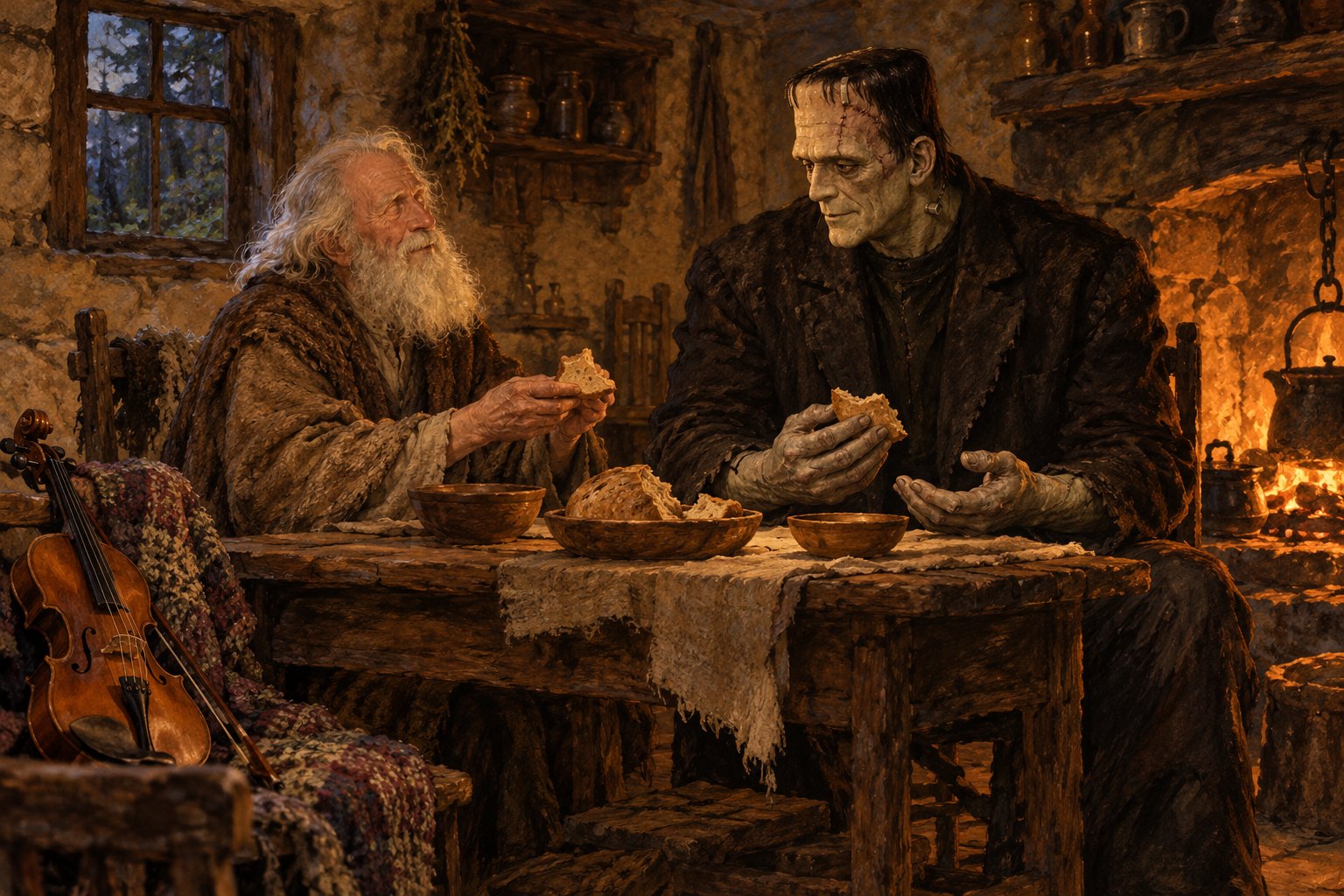
The scene’s sentimentality is direct, and some viewers may find its contrast between the welcoming blind man and hostile sighted visitors too emphatic. Yet its simplicity earns its place. Before the scientists attempt to manufacture a solution to loneliness, the film has already shown companionship developing through ordinary attention.
That makes the loss of the cottage more than another chase sequence. The creature has experienced an alternative to persecution. His subsequent desperation comes partly from knowing that acceptance is possible and having no dependable way to find it again.
Pretorius turns sympathy into a bargaining tool
Thesiger’s Pretorius is entertaining because he approaches the grotesque with such composure. His miniature people in glass containers make scientific mastery look like an eccentric hobby. The comedy also reveals his limitations: living beings become fascinating objects whose circumstances he controls.
His apparent acceptance of the creature therefore requires scrutiny. A person who does not recoil may still exploit. Pretorius offers the prospect of a companion while recruiting the creature into his effort to secure Henry’s cooperation. Elizabeth’s abduction makes the coercion unmistakable.
This distinction between charm and ethical authority also informs our analysis of the would-be savior in Digger: a compelling personality can make domination entertaining without making it benevolent.
Henry, meanwhile, occupies a less comfortable position than that of a scientist simply dragged back against his will. Elizabeth’s danger gives him a powerful reason to comply, but the work also revives his excitement. Clive’s anxious intensity allows fear and fascination to inhabit the same performance.
Elizabeth, played by Valerie Hobson, represents a future Henry might share with someone rather than create for someone. The screenplay nevertheless confines her largely to warning, worrying, and being endangered. That limitation becomes especially revealing beside the Bride: both women’s immediate circumstances are shaped by men pursuing their own urgent objectives.
The Bride’s awakening exposes the experiment’s missing question
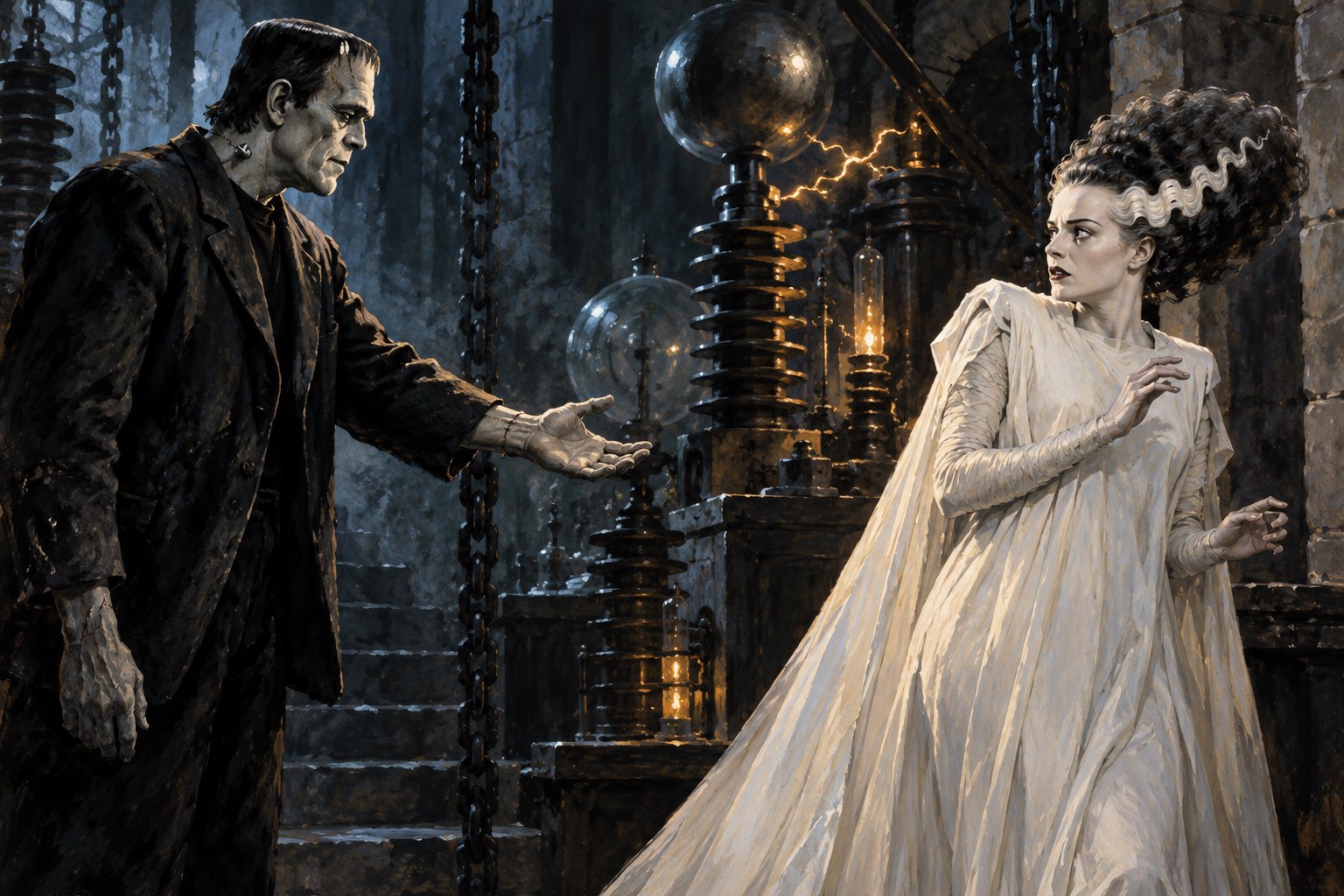
Elsa Lanchester’s Bride appears near the end, after the film has spent much of its running time imagining what she will mean to others. Her entrance abruptly changes the terms. The white-streaked hair and extraordinary silhouette announce an icon, while her uncertain movements suggest a consciousness struggling with an unfamiliar world.
The creature’s tentative “Friend?” is heartbreaking. Her recoil is equally intelligible. When he concludes, “She hate me. Like others,” he interprets her response through everything that has already happened to him. The dialogue and action are recorded in [Filmsite’s scene synopsis](https://www.filmsite.org/bride3.html).
But his interpretation cannot tell us everything about her. She has just awakened. Fear, confusion, and resistance are visible; a developed understanding of the creature is not. Calling her cruel would demand an emotional obligation from someone who has barely begun to exist.
This is Lanchester’s decisive contribution. Her performance gives the Bride a response that exceeds her assigned function. The scientists have successfully animated a body, but they have not produced agreement. Their plan contains no meaningful provision for her preferences.
The imbalance recalls the question raised in our discussion of whose perspective a film allows us to hear. Here, the creature receives an extended emotional history; the Bride receives only moments. A careful reading must resist confusing that unequal access with unequal importance.
What “We belong dead” leaves unresolved
The creature allows Henry and Elizabeth to escape, then destroys the laboratory with himself, Pretorius, and the Bride inside. His declaration, “We belong dead,” gives the ending its terrible finality.
I read that line as an expression of despair that also becomes an assertion of power. The creature has repeatedly been denied control over his existence. Now he claims control over the ending of other lives. His pain remains real, but the Bride’s lack of choice remains real too.
That contradiction is what makes the finale endure. We are invited to mourn him without receiving a convincing reason that she must share his fate. The tenderness of the hermit scene has shown what a livable relationship might require: time, patience, and reciprocal acceptance. The laboratory substitutes expectation and urgency.
The deeper horror is that everyone treats companionship as something that can be arranged around a single person’s need. The creature wants relief; Pretorius wants achievement; Henry wants Elizabeth returned. The Bride arrives as a person inside a plan that has already decided her purpose. Her refusal exposes its failure.
A revealing detail to catch on a second viewing
Lanchester also plays Mary Shelley in the opening framing scene, while the original cast credits conceal the performer of the monster’s mate behind a question mark. The pairing gives a repeat viewing an especially satisfying visual echo.
As an interpretation, that double casting lets the film begin with a woman telling a story and end with a woman resisting the story others have written for her. One commands the narrative; the other barely gets time to react. Between them lies the film’s most unsettling question: what does creating life obligate its creator to respect?
Original content by this site's editorial team. Published: October 16, 2026 at 22:38:09 PDT (Los Angeles time)