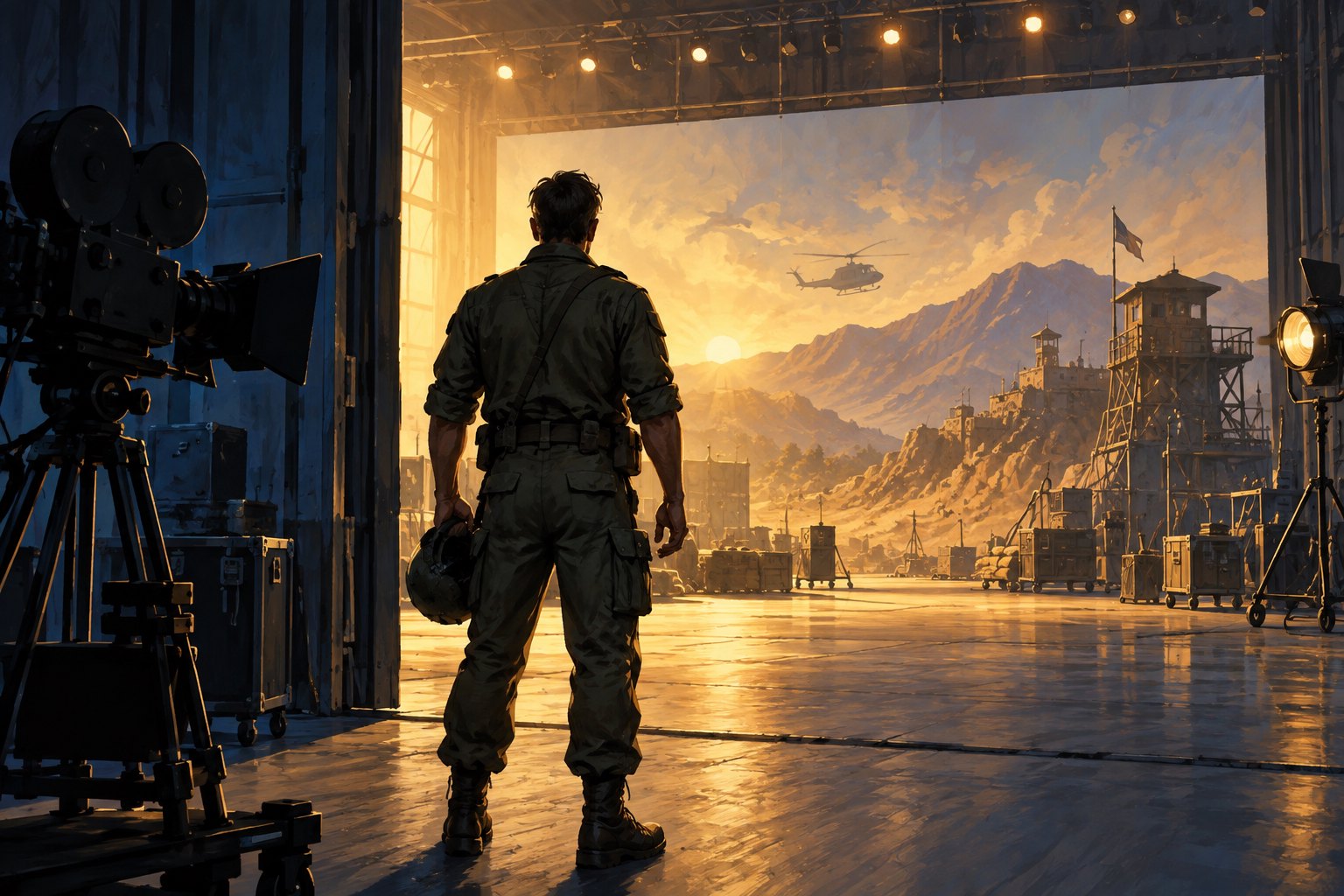
Bradley Cooper will star as Duke in Paramount’s new G.I. Joe movie, with Danny McBride directing, according to Deadline. The pairing immediately gives the project an interesting creative question: how much personality can a leading man bring to a military adventure without pulling attention away from the team that makes it worth watching?
My interest lies in the space between authority and insecurity. A compelling Duke could look entirely comfortable giving an order while still making us feel the responsibility behind it. Cooper’s casting creates an opportunity to explore that tension. McBride’s involvement makes the handling of tone equally intriguing. Neither name, however, tells us what the finished movie will actually do.
This is a spoiler-free casting analysis, not a review of a completed film. The reported actor, role, studio, and director provide the basis for discussion. They do not establish the plot, supporting characters, release date, dialogue, or relationship to earlier adaptations. There are no verified scenes or lines from this production to evaluate here.
What Cooper’s casting puts at the center
A recognizable star arrives with an advantage: the audience already wants to watch him. For an ensemble adventure, that advantage can also become a structural problem. Every reaction shot, close-up, and decisive gesture can quietly encourage viewers to treat the other characters as supporting equipment.
The most promising version of Cooper’s Duke would use that attention generously. A lead performance can make another character interesting simply by listening closely. If Duke pauses because a teammate has noticed something he missed, the scene gives us two pieces of information: the teammate has expertise, and Duke has enough confidence to recognize it.
That is a more useful foundation for leadership than a string of declarations about loyalty. It also gives Cooper something specific to play beyond determination. There is a difference between hearing advice, reluctantly accepting it, and making the person offering it feel trusted. Those distinctions are small enough to register in a face and substantial enough to shape an entire relationship.
This remains a possibility, not a description of the screenplay. But it explains why casting a major actor in Duke’s role can matter artistically. The value comes from the behavior the film makes room for, rather than the prominence of the name on its poster.
Danny McBride’s involvement raises a question of tone
It would be premature to label this G.I. Joe a comedy, a satire, or a deliberately ridiculous action movie. A director’s name is not a genre certificate. Still, the combination of McBride and Cooper invites consideration of how humor might coexist with a story built around dangerous situations and collective responsibility.
My preference would be humor that exposes relationships. Teammates can needle someone because they know his habits. A joke can reveal who feels secure enough to challenge authority, who needs approval, or who uses bravado to avoid admitting fear. In those cases, comedy contributes to the adventure because it helps us understand the people taking part.
Humor becomes less productive when it repeatedly tells the audience that caring would be embarrassing. If every sincere exchange ends with a verbal shrug, the film can train viewers to stop investing in its stakes. Eventually, even an impressive action sequence has little emotional weight.
The opposite extreme would be equally limiting: treating every uniform, command, and sacrifice with such solemnity that nobody feels capable of spontaneous human behavior. The appealing possibility in this pairing is a Duke who can survive being funny without losing credibility. A leader who occasionally looks foolish may be easier to believe than one whose dignity the movie constantly protects.
Duke needs teammates who can change his mind
Viewed from Duke’s perspective, leadership offers a natural conflict between control and dependence. He might want a clear plan and predictable outcomes; an ensemble story becomes interesting when other people bring knowledge, priorities, or objections that complicate that wish. This is a proposed critical lens, not a claim about the new film’s events.
From the teammates’ perspective, the crucial issue would be whether their judgment matters. Characters become thin when their only functions are to admire the lead, disobey him foolishly, or require rescue. They become people when their decisions alter what he can do next.
A useful ensemble does not require equal screen time. It requires distinct contributions. One person might understand a practical problem that another cannot; someone else might recognize the human cost of a choice. The dramatic payoff comes when those differences influence the outcome. Duke’s importance could emerge through his ability to bring those perspectives together.
That concern also informs our discussion of how casting becomes meaningful through character choices in Crime Novella. A cast announcement identifies performers. The eventual film must establish why their characters need one another.
Action should make Duke’s decisions visible
The action offers another opportunity to define this version of Duke. A sequence can show a character’s physical competence while revealing almost nothing about his values. To learn something more, we need to understand what he notices, what he prioritizes, and what his choice costs.
For Cooper, that would make the moments around an action beat especially valuable: the assessment before a decision, the response when circumstances change, the look exchanged afterward. Editing that preserves those moments can connect spectacle to character. Editing that rushes past them can reduce the lead to a face between impacts.
Clear geography matters for the same reason. If viewers understand where teammates are and what each person is trying to accomplish, they can recognize an act of trust without explanatory dialogue. The audience should be able to see why one character depends on another.
None of this requires the film to abandon exuberance. An extravagant adventure can sustain precise relationships. Indeed, the more heightened the surrounding world becomes, the more useful those recognizable exchanges may be in giving the audience something to hold onto.
What would make this pairing pay off?
The reported casting is a reason for curiosity, not an advance verdict. Our examination of the storytelling questions behind a darker Star Trek movie touches a related issue: a franchise’s creative direction becomes meaningful through the experience it gives its characters, beyond a change in surface tone.
For this G.I. Joe, I would look for a Duke whose confidence can be tested without the story treating uncertainty as weakness. I would also look for humor that grows out of familiarity, and action in which the team’s different abilities remain legible.
The deeper opportunity is to make leadership a relationship. Authority can be announced instantly; trust takes exchanges, mistakes, and responses. If Cooper and McBride build their Duke around that distinction, the character could offer more than a commanding presence. He could make the people around him worth following, too.
Original content by this site's editorial team. Published: October 1, 2026 at 13:46:47 PDT (Los Angeles time)