
Behemoth! places Pedro Pascal’s classical cellist inside a familiar predicament: reaching middle age with an established skill and an unsettled sense of self. Tony Gilroy’s music drama, as described in Variety’s review, offers a premise with an unusually sharp pressure point. A musician can know precisely how to improve a difficult passage while having no comparable method for deciding what the rest of his life should become.
This is spoiler-free commentary on the reported premise, rather than a firsthand review of the complete film. Its focus is the tension between artistic competence and personal uncertainty. Specific scenes, dialogue, and the ending are outside its scope.
When a profession becomes an entire identity
The most compelling possibility in Pascal’s role is that his character’s accomplishment might make his crisis harder to understand, even to himself. When a person has spent years developing a demanding skill, work can become the answer to almost every question about identity. What do you do? What matters to you? What justifies the sacrifices? For a musician, one word can answer all three.
That arrangement works until the questions change. Being able to perform does not necessarily explain why a particular future is worth choosing. A midlife crisis can emerge from that mismatch without requiring professional collapse. Someone may remain capable, employable, and admired while losing confidence in the story those achievements once told.
This is an interpretive possibility within Behemoth!’s premise, not a claim about an unverified character arc. It is also what makes the setup more interesting than a general portrait of artistic unhappiness. The profession supplies a specific form of security: there is something this man knows how to do. The crisis asks how far that knowledge reaches.
The cello makes mastery visible
A cello gives a filmmaker more than an attractive object and a source of expressive music. Playing it is physical work. The relationship between posture, finger placement, bow movement, and sound makes concentration visible. Even viewers unfamiliar with classical music can recognize the difference between a body preparing to act and a body resting after an effort.
For an actor portraying a musician, that creates two overlapping demands. The practical behavior must persuade us that the character belongs with the instrument. The performance must also suggest what that familiar activity means to him. Ease could communicate pleasure, routine, pride, or refuge; the surrounding scene determines which interpretation holds.
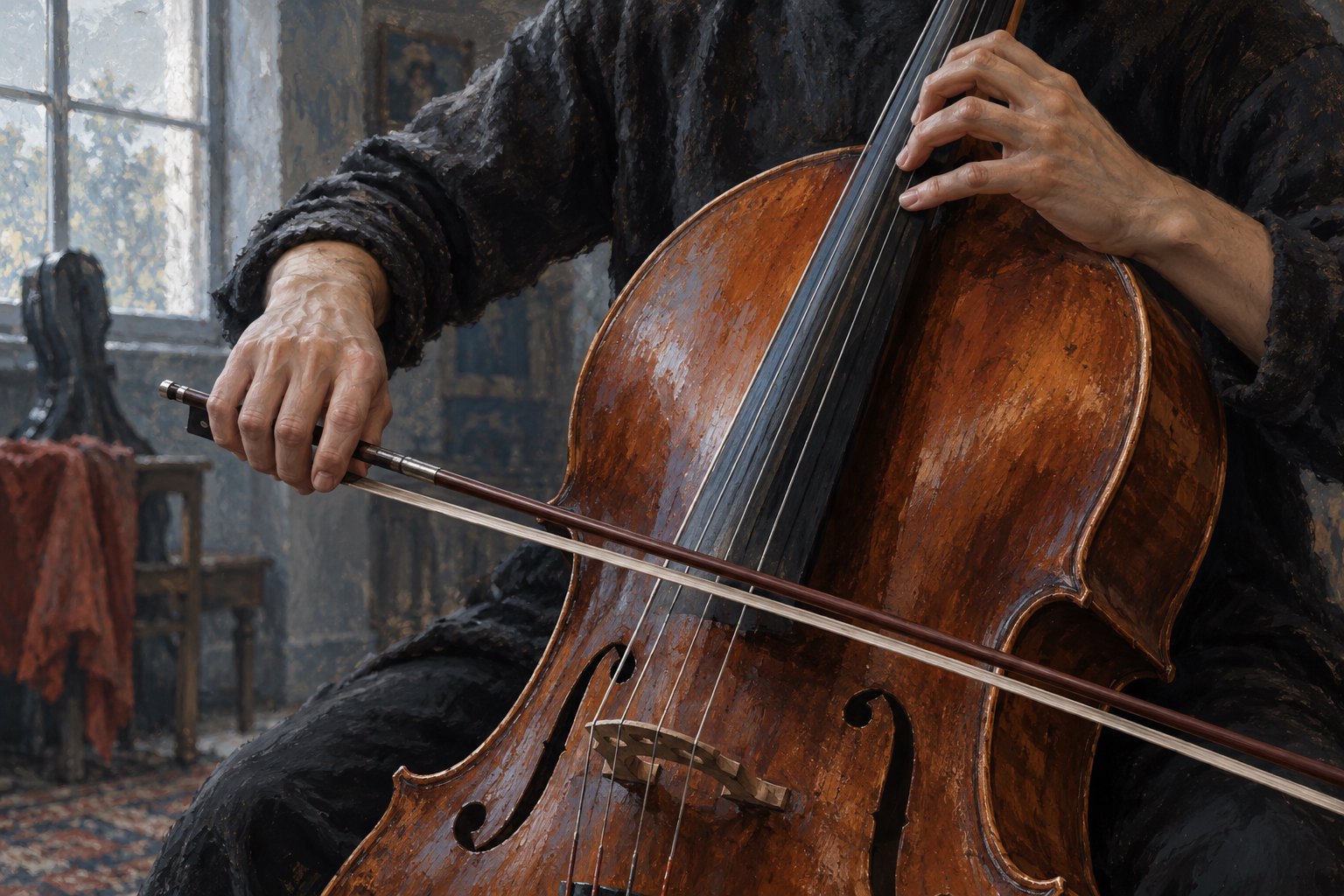
The useful distinction is between demonstrating ability and revealing a person through it. Convincing technique establishes credibility. Character emerges when that technique meets a particular circumstance: a demand, an interruption, an audience, or the absence of one. Those are criteria for assessing Pascal’s work, rather than conclusions about scenes that cannot be established here.
Our discussion of how actors make familiar screen personas revealing explores a related question. A recognizable performer brings associations into a role, but the telling details are often the specific behaviors that make the character feel separate from those associations.
Why charm needs dramatic resistance
A charismatic actor playing a troubled artist presents an appealing invitation to spend time with someone. It also creates a challenge for the drama. Viewers may extend sympathy before the character has done much to earn it. That sympathy can support a complicated portrait, but it can also make dissatisfaction seem inherently profound.
My critical preference is for a film to let a protagonist’s self-description encounter resistance. If someone believes he is misunderstood, what evidence complicates that belief? If he considers himself trapped, which choices remain available? A character becomes more legible when the audience can distinguish his circumstances from his interpretation of them.
Applied to Behemoth!, this means that the cellist’s profession should not settle the question of his depth. Artistic ability establishes one kind of sensitivity. It does not automatically explain his judgment, his priorities, or his understanding of himself. The interesting material lies in the particulars of those differences.
The difference between drifting and standing still
A midlife story does not need a dramatic reinvention to carry weight. Small changes can matter enormously when a film establishes what they cost. Continuing with familiar work might express commitment; it might also express fear. Leaving that work could be brave, impulsive, or simply impractical. The action alone cannot provide the interpretation.
That is why apparent inactivity can be dramatically productive. A character who postpones a decision may be protecting something valuable, avoiding disappointment, or refusing to revise an old ambition. The audience needs enough specificity to understand the postponement. Otherwise, ambiguity becomes a substitute for characterization.
For a musician, repetition offers a particularly useful way into this problem. Practice depends on returning to material already attempted. Personal stagnation can also involve repetition, but the resemblance is deceptive: one process may refine attention while the other prevents change. The premise invites that comparison without establishing which description fits Pascal’s character.
Listen for what the music lets us know
Music introduces another distinction worth keeping in mind: the emotion a viewer experiences is not necessarily an emotion the character understands. A moving performance can make us feel close to someone without proving that he has gained insight into his own predicament.
When watching a drama built around a musician, it helps to consider what a musical passage changes. Does it reveal a preference, sharpen a conflict, establish a working relationship, or affect a subsequent decision? Beauty has its own value, but its dramatic function deserves separate attention.
This emphasis on work and identity complements our earlier Behemoth! commentary on music and personal reconciliation. Here, the central question is what remains of a person’s self-definition when his strongest skill no longer answers his most pressing questions.
A life that cannot be perfected through practice
The deeper interpretive promise of Behemoth! lies in the limits of mastery. A demanding profession encourages persistence, correction, and standards. Those habits can sustain a life. They cannot guarantee that its direction will remain satisfying.
From the cellist’s imagined perspective, that uncertainty could feel especially unfair: years of disciplined effort have produced real ability, yet ability has not eliminated doubt. The humane response is to take the doubt seriously without treating accomplishment as a claim to special exemption from it.
That is the question this premise makes worth pursuing. Can someone remain devoted to a craft while allowing his identity to become larger than the thing he does best? A revealing character study would give that question a particular human shape—one whose answer could not be supplied by applause alone.
Original content by this site's editorial team. Published: October 2, 2026 at 19:17:15 PDT (Los Angeles time)