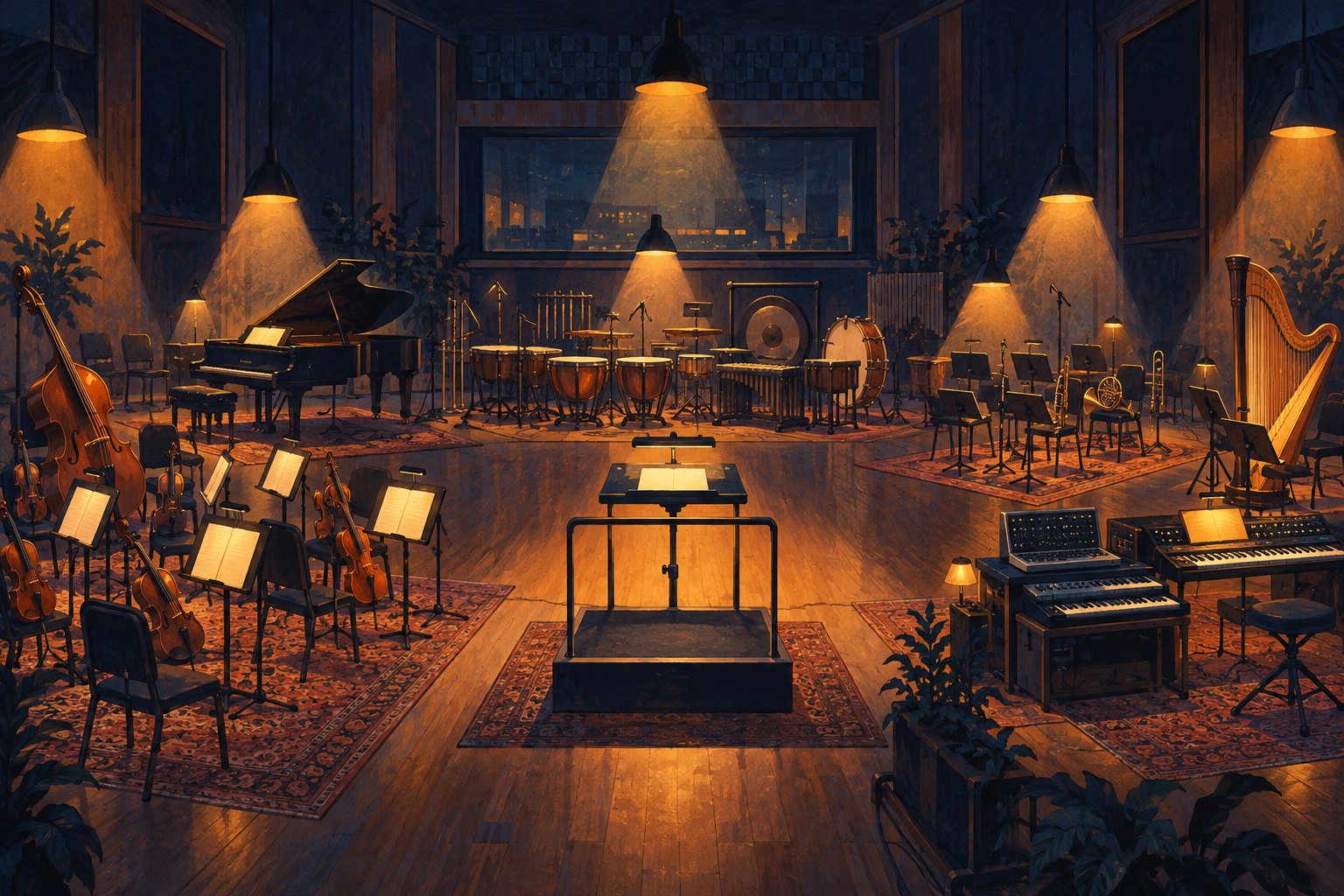
Tony Gilroy’s Behemoth! has an immediately intriguing musical distinction: nine composers contributed to its scoring, according to Variety. That makes the collaboration a compelling subject in its own right. It also raises a practical question for anyone interested in film music: how can so many musical voices serve a single dramatic experience?
The number alone does not explain Gilroy’s reasons, establish how the work was divided, or demonstrate that the result succeeds. Those distinctions matter. A large composing team might create contrast, continuity, or a combination of both. What ultimately counts is whether the music helps viewers understand the people on screen.
This is spoiler-free commentary on the reported collaboration, rather than a review based on a screening. Specific scenes, dialogue, and individual cue assignments are not assessed here. The useful starting point is the creative problem the nine-composer approach presents—and the listening choices that would reveal whether it works.
What the Nine-Composer Credit Actually Tells Us
Variety’s reporting identifies nine composers as central to the music of Behemoth! and frames their respective contributions as worth distinguishing. That establishes a collaborative undertaking. It does not, by itself, establish that every contributor shaped every passage, that their responsibilities were equal, or that nine different musical styles compete throughout the film.
Those are separate possibilities with different dramatic implications. Composers can contribute distinct pieces, share material, or work within boundaries established by a filmmaker. Without verified assignments, attributing a particular instrument, melody, or emotional effect to a particular person would turn an interpretation into an unsupported credit.
For readers seeking a definitive explanation of why Gilroy needed precisely nine composers, the honest limit is straightforward: the reported head count cannot supply that answer. It can, however, direct attention toward something film discussion often overlooks—the relationship between how music is made and what it does inside a story.
Musical Unity Does Not Require Constant Sameness
My critical starting point is that consistency and repetition are different things. A film can use sharply contrasting music while maintaining a clear emotional direction. Conversely, a recurring melody can become dramatically empty if it returns without responding to changes in a character’s circumstances.
Consider a hypothetical musical phrase associated with confidence. Early in a story, an expansive arrangement might make that confidence seem justified. Later, the same phrase played hesitantly could expose it as an increasingly fragile performance. The notes provide recognition; the changed treatment provides interpretation. This is an illustration of a scoring technique, not a description of a Behemoth! scene.
Applied as a listening standard, that distinction makes the nine-composer premise more interesting. The question becomes whether different contributions recognize the same dramatic pressures. Shared purpose can emerge through rhythm, restraint, timing, or the placement of silence, even when the instrumentation changes substantially.
A musical transition should therefore be judged alongside the transition in the story. An abrupt shift may express a meaningful break in perspective. A seamless shift may conceal one. Neither smoothness nor disruption deserves automatic praise.
The Character’s Perspective Is the Essential Test
A character-centered approach begins by asking who seems to own a musical moment. Does the music reflect what someone feels, what they want others to believe, or what the audience can perceive beyond their awareness? These possibilities can produce very different readings of an otherwise identical performance.
Sympathetic music can draw viewers close to a person without making that person trustworthy. A triumphant passage can communicate genuine accomplishment, self-delusion, or both. The actor’s expression, the surrounding action, and the consequences of the character’s choices determine which interpretation has support.
This is why character analysis should resist treating a score as an answer key. Music can invite a feeling without settling a moral question. Our discussion of character motivation and dramatization in Aaron Sorkin’s work explores a related distinction: persuasive storytelling and reliable judgment are not interchangeable.
For Behemoth!, the most revealing eventual analysis would connect musical decisions to specific, verified character behavior. A claim that a cue reveals vulnerability needs more than a melancholy sound. It needs an action, hesitation, relationship, or consequence that gives the sound its meaning.
Three Things to Listen for Beyond the Credits
Where the music begins and ends
The entrance of a cue can shift the emphasis of a scene. Music arriving before a decision may encourage anticipation; music arriving afterward may guide reflection. Its departure can be equally expressive, leaving a character’s words or physical presence suddenly exposed. Notice the boundary as carefully as the melody.
What changes when a musical idea returns
If a phrase recurs, ask what has happened since its previous appearance. Changes in tempo, density, or instrumental color may register a changed relationship to the same memory or desire. Recognition becomes dramatically useful when it lets the audience hear development rather than simply identify repetition.
Whether contrast clarifies the scene
A new musical voice should be evaluated through its effect on attention. Does it distinguish a perspective, sharpen a conflict, or make an emotional contradiction easier to perceive? If its main effect is to announce its own cleverness, the scene may have become a showcase at the expense of the character.
Collaboration Is a Creative Method, Not a Quality Guarantee
Nine composers make an unusual production detail, but that detail should not become a substitute for criticism. An ambitious process can produce an uneven result. An apparently modest approach can produce extraordinary emotional precision. The finished work has to establish the value of the method.
That standard also protects the contributors from a misleading competition. Ranking individual passages solely by immediate appeal could miss the function of a quieter, less conspicuous contribution. Some music needs to command attention; some needs to leave space for a face, a pause, or an unresolved exchange.
The distinction resembles the one in our commentary on judging a film beyond its initial premise: a compelling explanation for making something earns curiosity, while execution earns the verdict.
The Deeper Question: Who Shapes What We Feel?
The collaboration behind Behemoth! invites a broader interpretation of cinematic authorship. Viewers may experience an emotion as something arising naturally from a character, even when that experience depends on choices made across writing, performance, editing, sound, and music. A conspicuous composing team makes one part of that shared work harder to overlook.
My view is that the strongest outcome would preserve both individual musical character and dramatic focus. The audience need not identify each contributor to feel the precision of the collaboration. But the music should give viewers more access to the film’s people—their contradictions, evasions, and changing needs. That is the meaningful promise of nine composers working on one film: more ways of listening, brought into a purposeful relationship with the story.
Original content by this site's editorial team. Published: October 8, 2026 at 10:41:13 PDT (Los Angeles time)