Horror movies and political expression are easy suspects when film festivals seem to lose their purpose. Both can provoke loud reactions, divide audiences, and turn a screening into an argument. But neither establishes that a festival is failing. The more useful question is whether its programming helps people encounter distinctive films—and whether the conversation afterward gives those films a fair hearing.
The Hollywood Reporter’s headline, Horror Movies and Politics Are Killing Film Festivals, frames that anxiety as a blunt accusation. My view is that the diagnosis needs a sharper distinction: a movie’s genre, political commitments, artistic achievement, and usefulness to a festival are separate considerations. Treating them as interchangeable makes criticism less precise.
This is festival commentary, not a review of an individual film. The argument concerns how movies are selected, discussed, and valued; it does not establish that any particular festival is declining.
What would it mean for a festival to be failing?
The word “killing” bundles several possible complaints together. A festival might struggle financially. Its selections might become predictable. Unknown filmmakers might receive little attention. Audiences might find the experience unwelcoming. Those problems require different evidence and different remedies.
A divisive screening cannot, by itself, prove an institutional crisis. Neither can an acclaimed horror selection demonstrate that other genres have been excluded. To make that argument convincingly, we would need to examine programming across editions, screening access, support for emerging filmmakers, and the attention available to less publicized work.
For viewers, however, there is a useful artistic test: does the program make curiosity feel worthwhile? A festival earns its identity through the discoveries it enables. That can include a frightening crowd-pleaser, a difficult political documentary, or a quiet drama whose emotional force takes time to emerge.
Horror deserves scrutiny without having to apologize
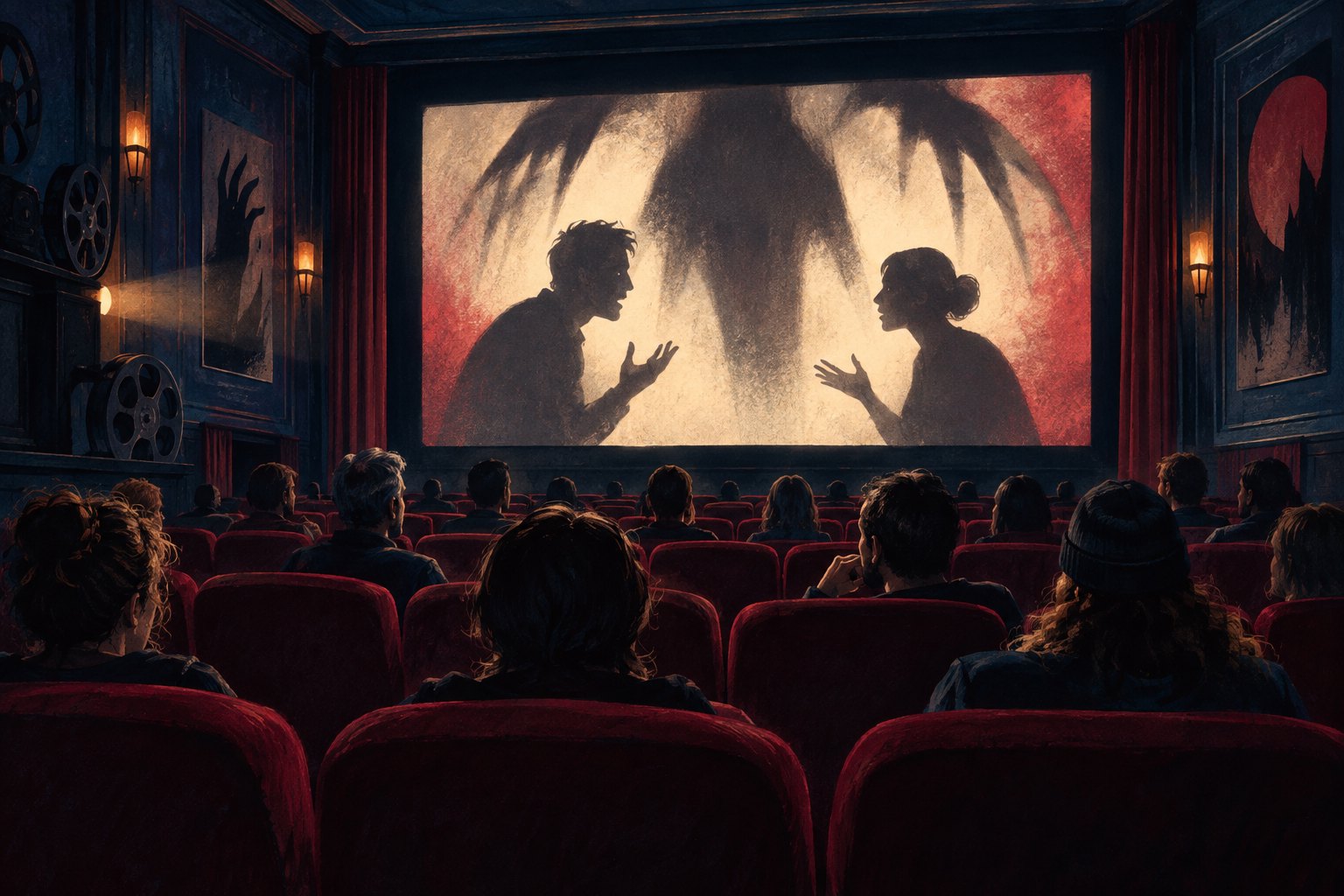
Horror can make audience response unusually visible. A sudden sound produces a jump; an approaching threat makes a room go quiet. These reactions matter because cinema works through bodies as well as ideas. Feeling frightened is not an inferior form of engagement.
But a reaction is only the beginning of an evaluation. A scare can reveal something about a character’s vulnerability, or it can interrupt a scene without deepening it. Graphic violence can change our understanding of what survival costs, or simply provide another escalation. The distinction depends on the filmmaking.
Consider a hypothetical sequence in which a character hears movement behind a locked door. Suspense becomes more specific when opening that door means abandoning someone, confronting a past mistake, or risking the only place that feels safe. The character’s competing needs give the threat emotional shape.
That is why a festival discussion should move beyond whether a film was extreme, entertaining, or metaphorically important. Ask what its fear accomplishes. Does the camera keep us close to the endangered person’s experience? Does the aftermath register? Do we understand more about that person after the spectacle?
Our discussion of the storytelling possibilities of Christmas horror in Bad Toys approaches genre through a related question: how can familiar sources of comfort become dramatically unsettling? A promising concept still needs decisions, relationships, and consequences.
Political meaning should withstand close viewing
Political interpretation is a legitimate part of film criticism. Stories distribute power: someone gets believed, someone controls a room, someone can leave, and someone must stay. Examining those relationships can illuminate the drama without reducing it to a policy statement.
The problem comes when an interpretation becomes an exemption from scrutiny. A film’s worthwhile subject does not settle whether its characters are convincing. Agreement with its apparent position does not explain whether its images, performances, or narrative structure communicate anything complex.
The opposite shortcut is equally weak. Dismissing a film as political before examining it avoids the work of criticism. A story about employment, family, borders, or public institutions may make political conflict inseparable from its characters’ daily choices.
A stronger review starts with what the film allows a character to know and do. Who receives an interior life? Whose suffering exists mainly to motivate somebody else? Can an opponent surprise us? Does a sympathetic protagonist face consequences the movie takes seriously?
These questions also inform our analysis of family panic and political suspense in Animals. Private attachment and public ambition become dramatically interesting when they place incompatible demands on a person. Merely identifying a political theme is the opening of that analysis, not its conclusion.
The real programming challenge is making room

A festival has limited screening slots and an audience with limited time. Programming therefore involves choices about both inclusion and visibility. Giving an unfamiliar film a place matters; giving viewers a realistic opportunity and a compelling reason to see it matters too.
My concern would be a program organized around one approved way of being interesting. That could mean relentless shock, recognizable prestige, immediately legible political significance, or tasteful restraint. Any of these preferences can become restrictive when treated as a universal measure of achievement.
A varied program should allow different rhythms of attention. Some films invite collective excitement. Others ask viewers to notice a hesitation, a repeated gesture, or an uncomfortable silence. Those experiences need not compete for cultural legitimacy, even when they compete for a slot on the schedule.
Festival introductions and discussions can help by being specific. Explaining an unusual use of sound or a shift in perspective gives audiences something to consider. Declaring a work essential before anyone has watched it places a verdict where an invitation should be.
How to read festival praise more carefully
Viewers do not need to reject festival enthusiasm. They need to recognize what a particular claim actually tells them. An energetic response describes a screening; a thoughtful review explains a film.
- Look for scenes and formal details. A critic should be able to explain how editing, performance, sound, or perspective supports the judgment.
- Separate importance from achievement. A subject can deserve attention even when a particular treatment falls short.
- Notice whether characters remain people. Interpretation becomes thin when everyone is discussed solely as a symbol.
- Read disagreement for substance. Two critics may identify the same artistic choice and reasonably disagree about its effect.
- Leave room for your own response. Festival recognition offers a reason to investigate, not an obligation to admire.
A festival should make disagreement more interesting
The deepest issue in the horror-and-politics debate is the temptation to decide a movie’s value before discussing its particulars. Genre can become a mark of inferiority or sophistication. Political meaning can become an accusation or a certificate of merit. Either way, the film disappears behind its classification.
My standard for a worthwhile festival is whether it resists that disappearance. It should create encounters with work that rewards attention, then make room for arguments grounded in what appears on screen. A frightening film can be formally delicate. A restrained drama can be politically furious. Neither needs to arrive with its significance already settled.
Horror and politics belong in that conversation. What deserves resistance is the habit of letting a category do the judging. The best reason to attend a film festival is still the possibility that a movie will change the question you thought you were there to ask.
Original content by this site's editorial team. Published: October 8, 2026 at 20:41:08 PDT (Los Angeles time)