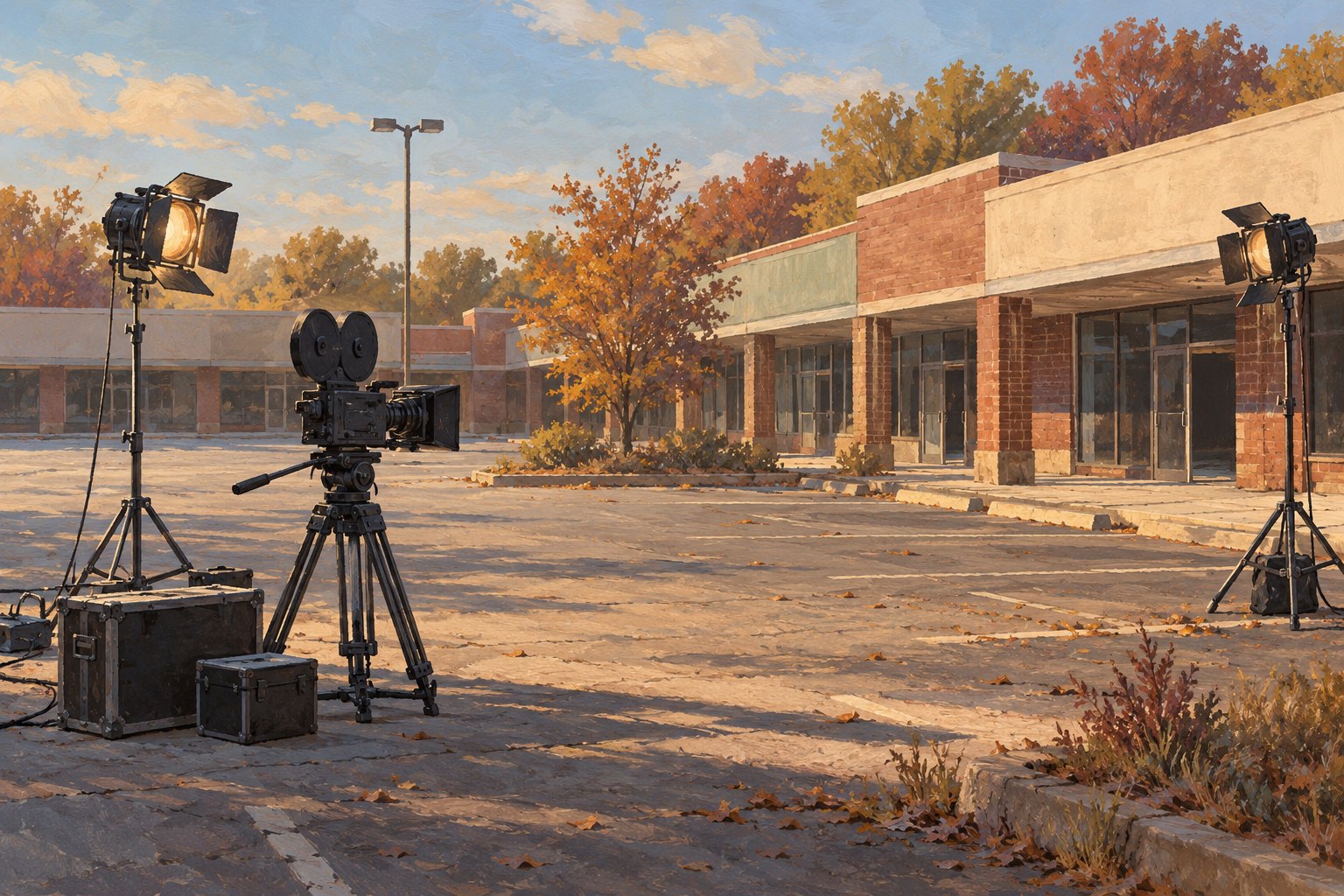
An abandoned mini mall in New Jersey, associated with plans for an apartment complex containing more than 200 units, is now serving as a movie set, according to a report from the real estate publication Realtor. That is an intriguing change of use. It also leaves an essential question open: what does filming mean for the property’s longer-term future?
The reported premise establishes the housing plans and the site’s use as a movie set. It does not, by itself, establish that the apartments were permanently canceled, that filmmaking caused a delay, or that the property has become a permanent production facility. Those distinctions matter before a story about cameras arriving becomes a story about homes disappearing.
For film audiences, the location presents another question worth considering: how does a place built for everyday transactions become somewhere we believe fictional people live, work, or confront one another? An ordinary commercial property can offer compelling material. Its dramatic value depends on what filmmakers do with it.
What the change of use actually tells us
The scale of the proposed housing gives this story its weight. More than 200 apartments represent a substantially different future for a property than a filming assignment. One involves residential development; the other establishes a production use whose duration and relationship to those plans remain unconfirmed here.
It would be premature to describe this as a contest that the movie industry won. A location can accommodate filming without that activity explaining why a development has not proceeded. Establishing a causal relationship would require information about the project’s approvals, financing, schedule, and any agreement governing the shoot.
Likewise, the phrase movie set does not identify what audiences will eventually see. It does not establish whether the building plays a shopping center, whether only part of it appears, or whether its exterior will remain recognizable. The town, production title, cast, and filming arrangements cannot responsibly be filled in from the headline alone.
This is therefore a location commentary, rather than a review of an identifiable finished film. There is no verified basis here for assessing performances, recounting scenes, quoting dialogue, or identifying Easter eggs. The useful critical starting point is the transformation of the property itself.
Why an ordinary shopping strip can hold the eye
My interest in this location begins with its familiarity. A mini mall belongs to the architecture of errands: entering, waiting, buying, leaving. Viewers can understand those basic movements without an elaborate explanation. A filmmaker can then build tension by interrupting an expectation that the space has already established.
Consider the possibilities as hypothetical examples, not descriptions of this production. A wide view of a storefront might make someone crossing the foreground appear exposed. A shot from inside might turn the same window into a boundary between a person and the world outside. A doorway can suggest access in one scene and exclusion in another.
None of those effects requires an extraordinary building. They require decisions about where the camera stands, how long the shot lasts, and whose experience organizes our attention. The building supplies physical relationships; the filmmaking makes those relationships emotionally legible.
An abandoned property also invites assumptions about its past. Empty commercial space can suggest interruption or loss to a viewer, but those associations are interpretations. They do not establish why this particular mall became vacant, what its former businesses experienced, or how nearby residents understand it. A responsible account should preserve that difference.
A location becomes meaningful through a character
The familiar claim that a setting is another character can obscure more than it explains. Buildings do not automatically acquire dramatic depth because they look weathered or unusual. The stronger question is whether the space changes what a character can do—and whether the character’s experience changes how we perceive the space.
In an imagined scene, someone returning to a former workplace might notice a small feature that a visitor ignores. Someone seeking privacy might experience broad windows as a problem. Someone waiting for another person might measure the room by its entrances. These are different relationships to an environment, even when the walls stay exactly the same.
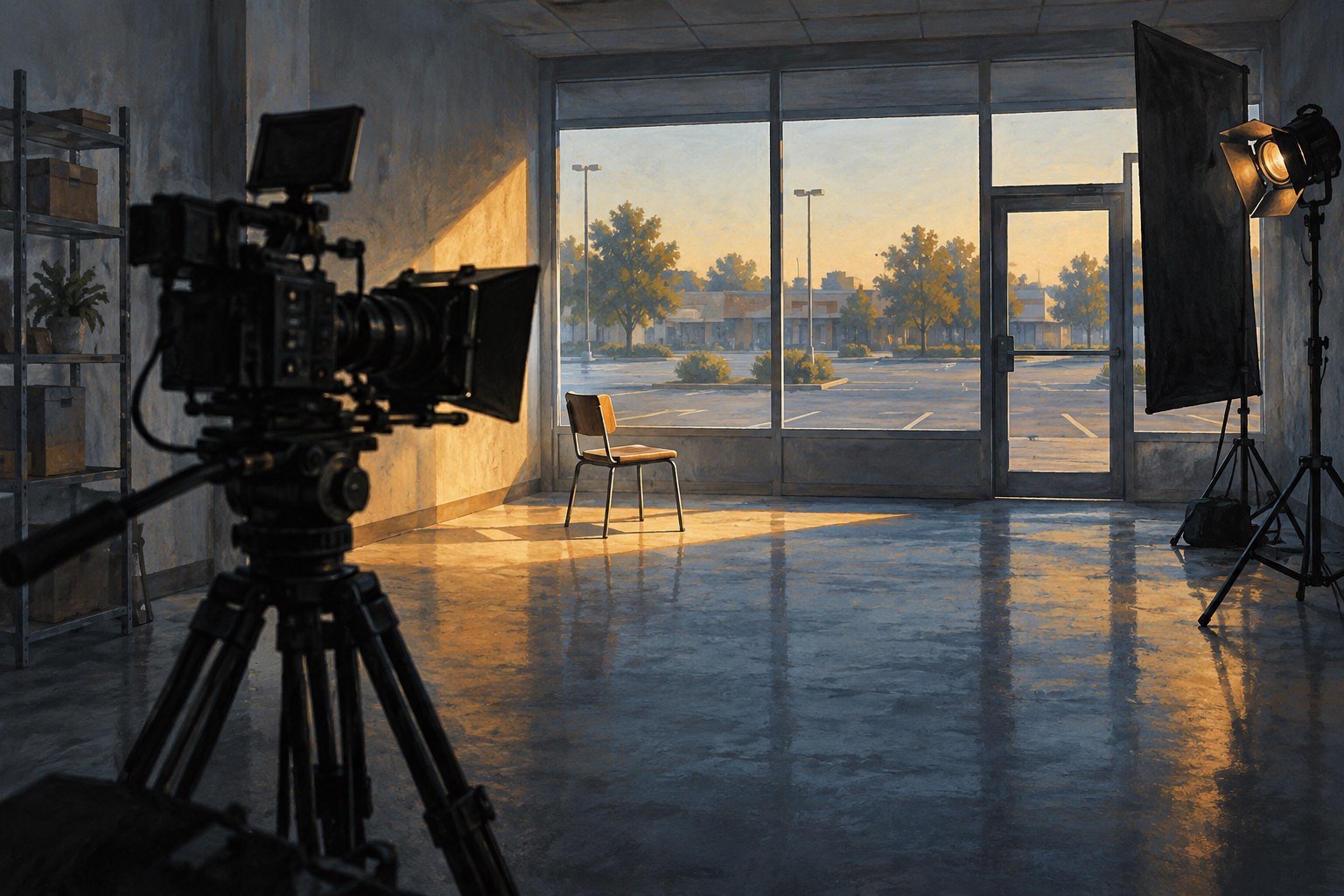
That is the standard I would bring to any eventual film using this New Jersey property: does the location help reveal a particular person’s predicament? Attractive images alone would not settle the question. The meaningful detail is often something an actor must negotiate, such as distance from an exit or the absence of somewhere to sit.
Our character-focused reading of choice in Pretty Woman approaches film through a related concern: what a person can accept, refuse, or leave. That perspective offers a useful way to examine a commercial setting without reducing it to decoration.
What to watch for when the location reaches the screen
If the production is identified and the relevant footage becomes available, a close reading should begin with observable choices. Four questions would make a practical starting point:
- Whose view shapes the scene? Notice whether the camera discovers the space alongside a character or shows information that the character cannot see.
- How does the layout affect behavior? Watch whether entrances, windows, and distances influence movement or merely occupy the background.
- What does sound contribute? Listen for whether the scene emphasizes activity, quiet, proximity, or separation, and how that changes the apparent space.
- Does the location acquire meaning over time? A return visit can reveal whether earlier actions have altered our response to an otherwise unchanged room.
These questions keep film analysis tied to the work itself. Knowing where something was shot can deepen appreciation, but recognition is only a beginning. A familiar storefront might host a crucial exchange or appear briefly between scenes; those uses deserve different critical attention.
The same care applies to judging the production’s significance. Our commentary on how film events define success explores the distinction between an event’s reception and its artistic achievement. Here, the arrival of filmmaking activity and the eventual quality of the film also require separate judgments.
The property has a life beyond the frame
The housing proposal gives this story an unresolved dimension that a striking location photograph cannot answer. A finished film might preserve an image of the property, disguise it completely, or make it briefly recognizable. None of those outcomes would establish what should happen to the land afterward.
That tension is what makes the New Jersey mini mall worth discussing. Cinema can make an overlooked place newly visible, while showing only a carefully selected portion of its reality. The frame may contain a convincing fictional world; beyond it remain questions about ownership, development, and everyday use.
The most interesting eventual result would be a film that gives the location specific dramatic purpose. Until there is footage to assess and fuller reporting about the property, the defensible conclusion is narrower: a site linked to substantial housing plans has found a use as a movie set. What that means for its characters—and for its neighbors—remains to be established.
Original content by this site's editorial team. Published: October 11, 2026 at 10:10:58 PDT (Los Angeles time)