
A Long Winter finds its most unsettling question inside an apparently reassuring idea: a family has built a home together. Does that mean everyone wanted the same life? Andrew Haigh’s drama, featured at the Virginia Film Festival, follows a young man searching for his missing mother while confronting the possibility that the place he loves has made someone else desperately unhappy.
The film’s emotional premise is stronger than a simple equation between cold weather and cold relationships. Its family members inhabit the same mountain household but experience radically different versions of it. For Mike, familiarity offers comfort. For his mother, Louise, isolation has become oppressive. For his father, Lester, the home represents an achievement whose value he struggles to question.
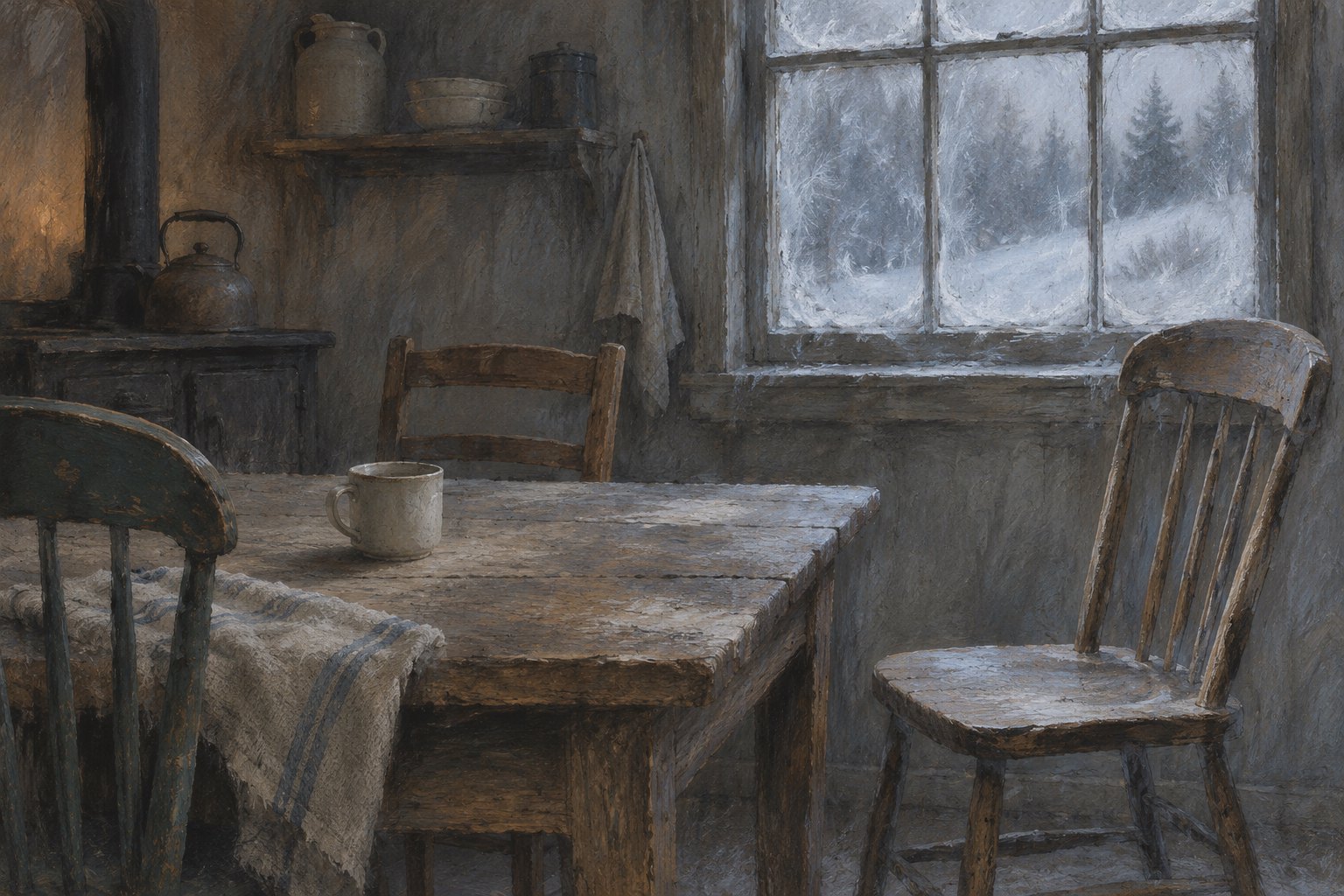
Spoiler note: This article discusses the central disappearance, family conflict, and themes of sexual awakening. It does not reveal the resolution. The illustrations are conceptual artwork, not images from the film.
A family divided before the disappearance
Adapted from Colm Tóibín’s story, Haigh’s film takes place in Colorado in the early 1950s. Fred Hechinger plays Mike, whose brother Tommy, played by Kit Connor, leaves for the Korean War. Caitríona Balfe plays Louise, and Ebon Moss-Bachrach plays Lester. When Louise disappears as winter takes hold, Mike’s attachment to his family becomes inseparable from his search for her.
These circumstances establish two different kinds of separation. Tommy’s departure has a destination and a recognizable explanation. Louise’s absence leaves the family without comparable certainty. Mike must respond to someone leaving while also trying to understand what life at home meant to her before she went missing.
That distinction matters. A disappearance can turn a character into a question the plot must answer. Here, the more searching question concerns how well the people closest to Louise understood her while she was present. Finding someone and knowing someone are different tasks.
Mike: the comfort and cost of wanting things to stay the same
A line featured in the film’s trailer makes the attachment to stability explicit: “Some people want change, but I like things the way they are.” It is an ordinary preference with difficult implications. Enjoying a familiar life is not inherently selfish. The problem begins when one person’s comfort makes another person’s distress difficult to recognize.
Mike’s search can therefore be read in two ways. It expresses love for his mother, and it carries a desire to recover the household he understood. Those motives can coexist without making his concern insincere. Someone can desperately want a loved one back while still needing to learn why that loved one was unhappy.
This is the most compelling angle through which to consider his character. The search demands physical persistence, but his deeper challenge is interpretive: can he revise his understanding of home without experiencing that revision as a betrayal?
Hechinger’s role places that conflict at the center of the story. Mike is neither simply an innocent observer nor the person responsible for every fracture in the family. He occupies the uncomfortable position of someone whose preferred way of life has depended on arrangements he has not fully questioned.
Louise deserves more than the role of missing mother
Louise’s unhappiness and drinking are essential to the family dynamic described in festival accounts. Treating those details only as preparation for her disappearance would flatten the character. Her distress already matters before it creates a crisis for the men around her.
From her perspective, the mountain home carries a different meaning. Distance can promise peace to someone who chooses it; it can restrict someone whose needs are not being met. The same household can shelter one person while narrowing another person’s world.
A fair reading must also resist treating her disappearance as a definitive statement of intention. Absence does not provide unrestricted access to a person’s motives. The uncertainty surrounding Louise should make us more attentive to her established unhappiness, not more confident about explaining everything she thinks.
The trailer’s remembered reassurance, “Folk always find a way to cope,” becomes particularly troubling in this context. Coping describes endurance. It does not establish that a situation is fair, fulfilling, or sustainable. A family can mistake someone’s ability to continue for evidence that nothing needs to change.
Lester: providing a home without understanding its occupants
Lester’s position raises the film’s hardest question about responsibility. What happens when a person understands himself as a provider but cannot adequately recognize the dissatisfaction of those he provides for?
His investment in the household need not be fraudulent for its consequences to be damaging. Effort and sacrifice do not guarantee understanding. A home becomes an expression of control when the person most invested in maintaining it treats other people’s different desires as errors to be corrected.
That reading gives the father-son relationship particular weight. Mike must encounter his father as both a parent and a fallible man. He can acknowledge Lester’s attachment to the family without accepting that attachment as a complete defense of the life Lester has organized.
The distinction also sharpens the meaning of care. In our discussion of hospitality and loneliness in Planes, Trains and Automobiles, welcoming another person requires recognizing a need beyond one’s own inconvenience. Haigh’s family drama presents a harsher version of that test: sharing a roof does not automatically mean making room for another person’s life.
Desire complicates the search for stability
Festival descriptions connect Mike’s search with an emerging awareness of his own desires and sexuality. That development belongs to the same emotional argument as Louise’s unhappiness. Both involve the distance between the life a household makes available and the life an individual may need.
It would be reductive to treat self-discovery as a convenient remedy for grief. New feelings do not settle the questions surrounding a missing parent. They can instead make the present harder to inhabit, because they introduce possibilities at precisely the moment Mike wants to recover what feels familiar.
The trailer poses a concise challenge: “Is this your dream?” The question separates inheritance from choice. Loving a place, loving the people there, and wanting to remain there forever are three different commitments. Mike’s emotional growth depends on being able to distinguish them.
Why the winter matters beyond atmosphere
The mountain setting gives those conflicts material consequences. Isolation is more than a state of mind when weather makes searching difficult and distance limits access to other people. Winter restricts movement while leaving thought and worry painfully active.
There is a useful connection to our analysis of landscape, loss, and shared ambition in Everest: The Other Side: physical effort can give grief a task without giving it a solution. Searching allows Mike to act. It cannot, by itself, resolve his changing understanding of his parents.
For viewers, that distinction sets the right expectation. The central disappearance supplies urgency, but the character drama concerns what uncertainty exposes. Approaching the film solely as a mystery risks overlooking the family disagreements already visible before any answer arrives.
The deeper chill: endurance is not the same as belonging
My reading of A Long Winter centers on the danger of confusing continuity with happiness. A household can keep functioning while one member becomes increasingly isolated within it. Familiar routines may conceal differences rather than reconcile them.
That is why the story’s strongest interpretive question extends beyond whether a family can survive a crisis. Can its members recognize that the life they shared was never experienced equally? Mike’s love becomes more demanding when it requires him to understand his mother separately from what she means to him.
The lasting chill lies in that recognition. Home can be sincerely cherished and still require change. Loving the people inside it means allowing their desires to challenge the story we have been telling about our life together.
Original content by this site's editorial team. Published: November 3, 2026 at 08:41:27 PST (Los Angeles time)