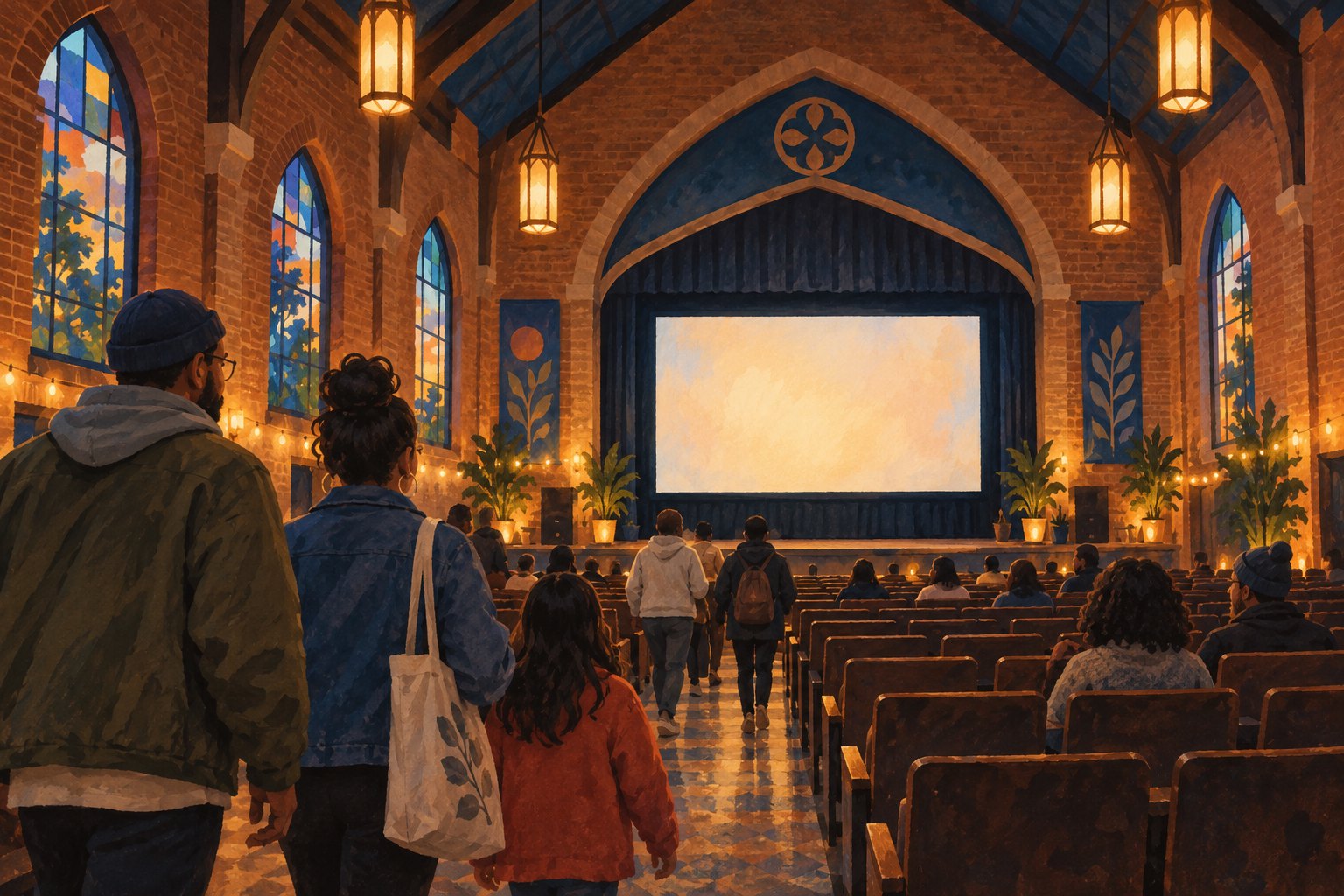
A Humboldt Park church is returning to its earlier purpose as a movie theater while also becoming a community hub, according to Block Club Chicago. That combination gives the project a significance beyond the prospect of another place to catch a film. It raises a worthwhile question for moviegoers: what makes a cinema belong to its neighborhood?
The reported direction establishes the central story—a return to exhibition paired with a shared community purpose. It does not, by itself, establish an opening date, ticket prices, a screening calendar, or the finished audience experience. Those details matter before anyone plans a visit. For now, the most useful critical response is to consider what this kind of space could offer and what would make its promise convincing.
This is commentary on a cinema project, rather than a review of a film or a completed venue. Its potential deserves attention without turning anticipation into a verdict.
A return to cinema should honor the whole building’s history
The idea of a church returning to its movie-theater roots has an appealing narrative shape. A building comes full circle; an earlier identity becomes visible again. But that framing can make everything between its first screenings and its next ones sound like an interruption.
A more generous interpretation would recognize both uses as meaningful chapters. A place of worship is not simply an auditorium waiting for a projector. Its significance comes from the people who gather there, their relationships, and the occasions they remember. A cinema conversion can acknowledge that history without treating religious and moviegoing experiences as interchangeable.
For the Humboldt Park project, honoring those layers could take forms such as inviting recollections from former congregants or presenting a carefully researched account of the building’s changing uses. These are possibilities, not announced features. The principle is straightforward: recovering a theatrical past should not require editing out a religious one.
That approach would also make the venue more interesting. A building with several identities offers a richer sense of place than a restoration story concerned only with its earliest purpose.
The screen matters, but so does the attention around it
From a film critic’s perspective, a neighborhood theater’s strongest argument is the quality of attention it can make possible. A screening asks people to spend time with the same sequence of images, at the same pace, without individually skipping a difficult scene or pausing an uncomfortable silence.
That shared duration can sharpen character-focused viewing. When a protagonist hesitates before answering, the pause becomes something the room experiences together. Another viewer’s laugh might expose the vanity in a speech that initially sounded sincere. A quiet audience can give a small gesture room to register.
None of this guarantees a better interpretation. Crowds can distract, and an audience’s most audible reaction is not necessarily its most thoughtful one. Still, the possibility of encountering a film alongside unfamiliar responses is part of cinema’s appeal. A local theater can make that encounter a recurring habit.
Presentation will be essential. Clear dialogue, a properly framed image, comfortable sightlines, and control of competing light all help viewers follow a character’s experience. An atmospheric building cannot compensate for a whispered exchange that nobody can hear. Our commentary on how a planetarium setting changes the viewing experience considers a related issue: the room helps shape how a film reaches its audience.
A community hub needs ways for people to participate
The community component is the most consequential part of the Humboldt Park proposal. It also needs the most concrete definition. People can occupy the same room without having much opportunity to influence what happens there.
One useful test would be whether residents have a clear way to suggest screenings, propose events, or offer feedback. Another would be whether a newcomer can understand the venue’s calendar without already belonging to a circle of regulars. Welcoming language helps, but understandable procedures make participation easier.
Post-screening discussions could contribute, provided they leave room for different levels of film knowledge. The most productive opening question is often specific and accessible: when did your opinion of the main character change? That invites close observation without requiring anyone to perform expertise.
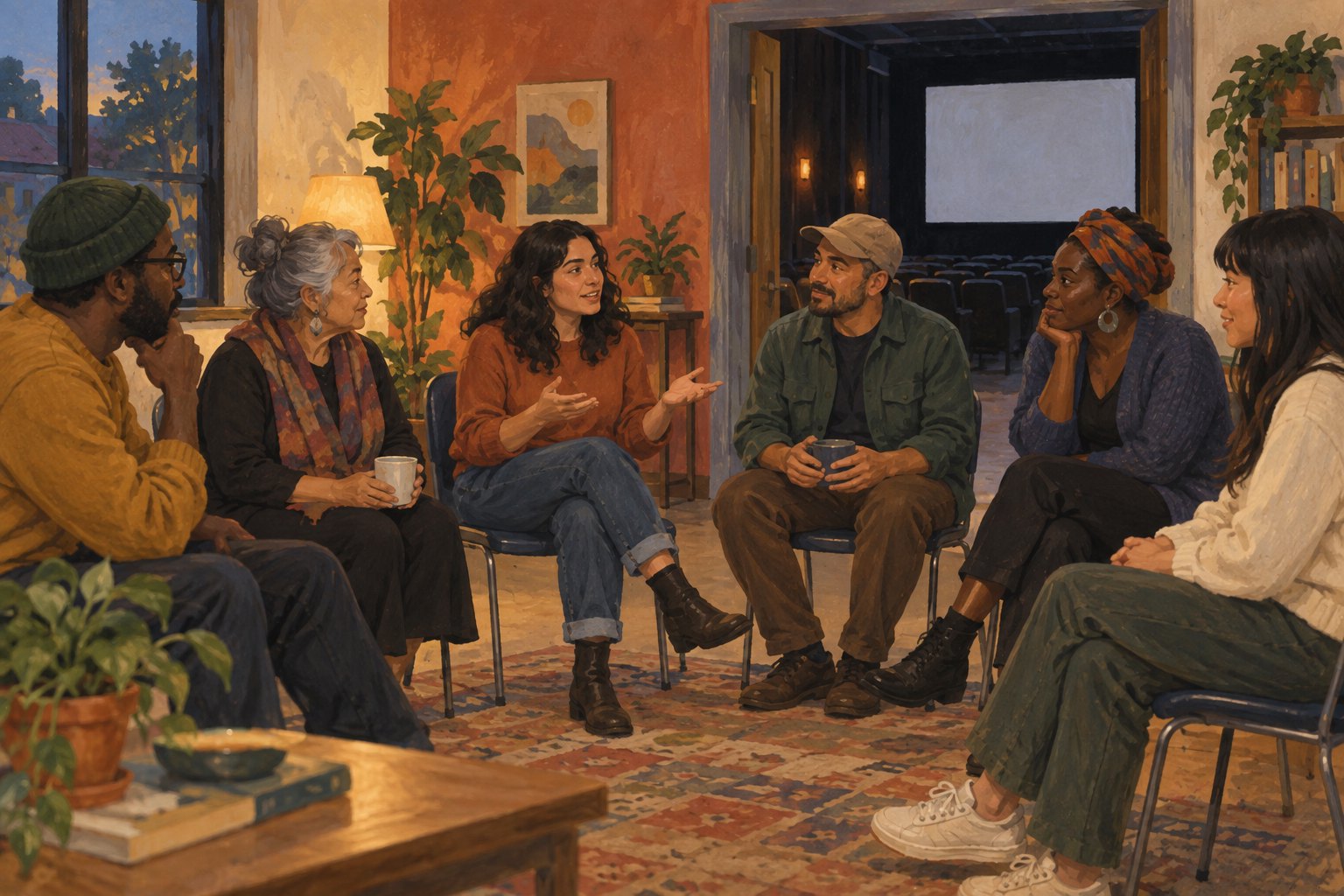
A good moderator can help people distinguish between what a film shows and what they infer. Someone might describe a character as selfish; another might point to a scene suggesting fear. The disagreement becomes useful when both return to the movie rather than compete to deliver the final judgment.
These are recommendations for what community-oriented exhibition could support. They should not be mistaken for services or programs already confirmed for this project.
Programming should create reasons to return
A memorable opening event can attract attention. A coherent calendar gives people reasons to come back. For a neighborhood venue, the editorial challenge is to combine discovery with enough familiarity that choosing a screening does not feel like taking an uninformed gamble.
A possible approach would pair an accessible favorite with a less familiar film exploring a related relationship or conflict. A family disagreement, an uneasy friendship, or a character’s changing relationship to home could provide the connection. The pairing would give viewers something to notice while allowing the films to remain distinct.
Clear descriptions would be just as valuable as clever selections. Audiences should know whether an event includes a discussion, whether subtitles are involved, and whether the evening is appropriate for younger viewers. Such information respects the practical decisions behind a night out.
Our guide to building a thoughtful film-festival shortlist explores a similar principle: a useful program gives viewers a reason to choose, not merely a list of titles.
What moviegoers should look for as plans develop
Before treating the Humboldt Park venue as an established destination, readers should look for specific operating information. The most useful details will answer ordinary questions:
- When can people attend? A confirmed opening and dated screening schedule turn a proposal into a visit.
- What will an evening cost? Ticket prices and any additional charges should be easy to understand.
- How accessible is the experience? Entrance, seating, restroom, captioning, and listening-access information should be available where applicable.
- What does community use involve? Public information should explain who can propose activities and how those proposals are considered.
These are standards for evaluating the project as it develops, not claims that particular arrangements have been made. They also offer a better measure of usefulness than the appeal of the conversion story alone.
The real promise is a place people use together
My view is that the Humboldt Park project’s strongest possibility lies in connecting the focused experience of watching a movie with the open-ended experience of talking afterward. One gives people a common subject; the other allows that subject to become a conversation.
Returning a screen to a former theater can recover a function. Building a welcoming, reliable place around that screen requires continuing choices about presentation, programming, access, and whose voices receive attention. If those choices support the people nearby, this return to cinema could become more than an architectural full circle. It could give the neighborhood another reason to gather.
Original content by this site's editorial team. Published: October 1, 2026 at 01:41:42 PDT (Los Angeles time)