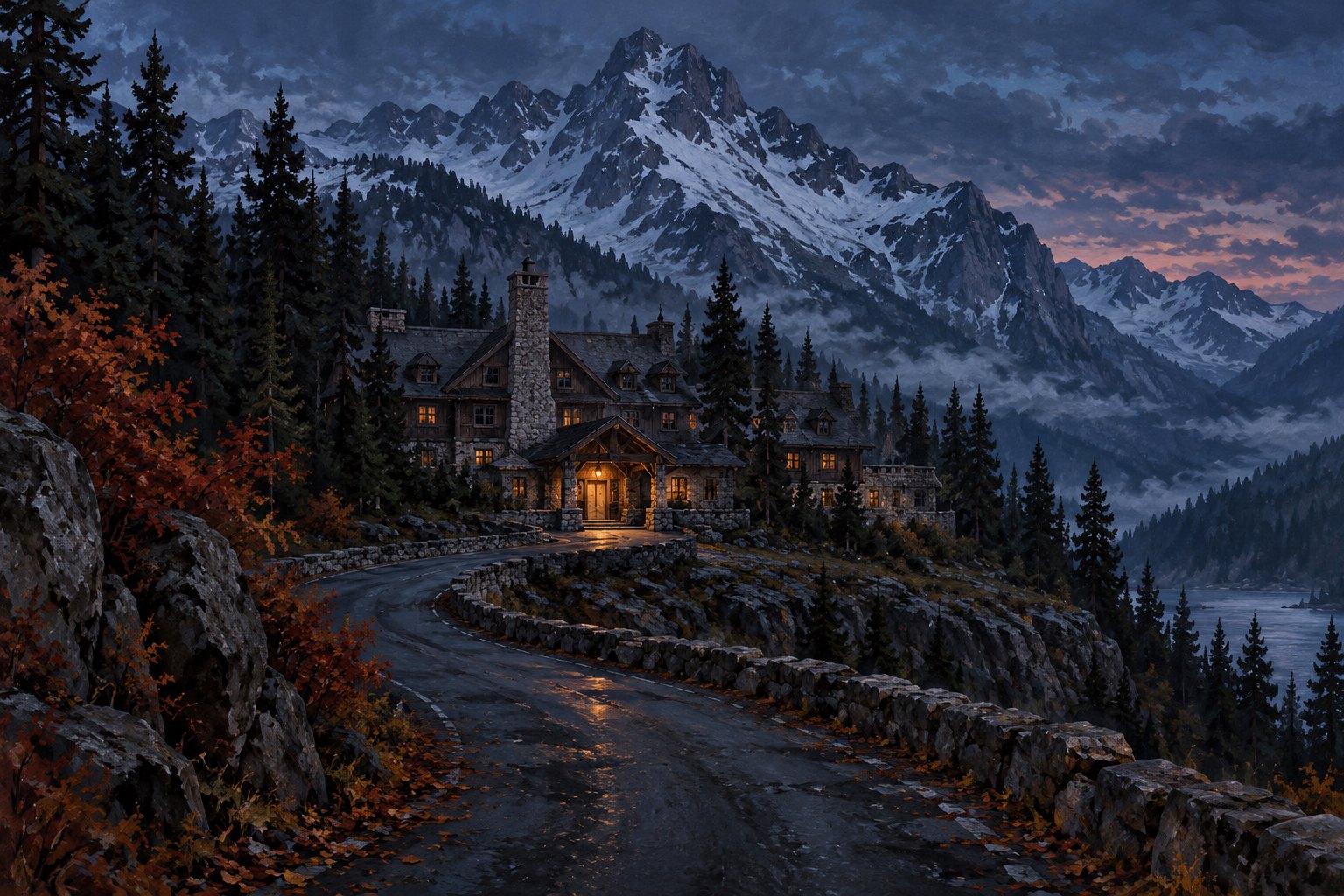
A mountain lodge, a summer camp, a suburban house, a schoolhouse, and a steep city staircase: horror rarely needs an obviously sinister address. Timberline Lodge, Camp No-Be-Bo-Sco, the Myers house in South Pasadena, the Potter Schoolhouse in Bodega, and Georgetown’s Exorcist steps offer five memorable connections between real places and frightening movies. Their Halloween appeal comes from remembering what the characters experienced there.
These are our five selections for a location-minded horror rewatch. They also illustrate an essential distinction for anyone considering a visit: a filming location may supply only one piece of a fictional setting. The movie connects spaces that reality keeps separate.
Spoiler warning: The following discussion includes major developments and endings from The Shining, Friday the 13th, Halloween, The Birds, and The Exorcist. The accompanying illustrations evoke horror settings rather than document the actual properties.
1. Timberline Lodge, Oregon: The Shining’s promise of refuge
Timberline Lodge on Mount Hood supplied exterior footage for the fictional Overlook Hotel in Stanley Kubrick’s The Shining (1980). The lodge’s own history distinguishes those images from the constructed environments used elsewhere, including the hedge maze and a replica exterior at Elstree Studios in England. Visiting Timberline does not mean stepping into the complete geography of the film. [Timberline Lodge’s production history](https://www.timberlinelodge.com/about-us/history)
That distinction makes the filmmaking more interesting. The mountain exterior promises seclusion; the interior turns seclusion into a condition the family cannot easily escape. Jack Torrance approaches the hotel as an opportunity to work. Wendy must keep everyday family life functioning inside it. Danny encounters warnings that the adults cannot share or understand in the same way.
For me, Wendy’s perspective gives the setting its greatest force. A huge building offers surprisingly little protection once the threat comes from someone inside the family. Jack’s “Here’s Johnny!” converts a familiar entertainment catchphrase into a grotesque announcement of domestic violence. The door matters because it is the last remaining boundary between Wendy and him.
Rewatch focus: Notice how often architectural grandeur reduces the family to small figures. The Overlook looks capable of sheltering hundreds, yet becomes intolerable for three.
2. Camp No-Be-Bo-Sco, New Jersey: Friday the 13th’s deceptive calm
The camp setting of Friday the 13th (1980) was filmed at Camp No-Be-Bo-Sco in New Jersey. Its woods, cabins, and waterfront give Camp Crystal Lake a tangible everyday character. The authorized tour operator states that the property is private and opens to the public only on official tour dates; it is not a place for an unannounced walkthrough. [Crystal Lake Tours’ visitor information](https://crystallaketours.com/contact/)
The original film benefits from approaching the camp through people preparing it for use. Their work and downtime establish a place intended for companionship. Separation then becomes its defining danger: another cabin, another task, another stretch of darkness between people who assume somebody else is nearby.
Alice’s experience also corrects a common franchise shortcut. Pamela Voorhees is the original film’s killer. The adult, hockey-masked Jason familiar from later installments is not stalking these counselors. Alice survives Pamela’s attack, but the final lake sequence destabilizes the relief that survival should bring.
Her closing line, “Then he’s still out there,” leaves the landscape emotionally unfinished. In my reading, the lake becomes frightening because its peaceful appearance can no longer be trusted. Watch the film before looking at location photographs: the contrast between recognizable camp facilities and remembered panic is more effective than any added Halloween decoration.
3. South Pasadena, California: Halloween brings danger home
John Carpenter’s Halloween (1978) places Michael Myers in fictional Haddonfield, Illinois, while using Southern California locations, including South Pasadena. The American Film Institute documents the use of the abandoned house that became the Myers home, along with the production’s efforts to suggest autumn in the Midwest. [AFI’s Halloween production record](https://catalog.afi.com/Catalog/moviedetails/56347)
The Myers house is the recognizable landmark, but the surrounding idea of a neighborhood supplies the deeper unease. Laurie Strode’s day involves school, friends, an errand, and babysitting. Michael’s presence contaminates those ordinary movements before she fully understands the threat.
Carpenter makes looking itself stressful. A distant figure might be important; an apparently empty stretch of frame might deserve another glance. Laurie’s alertness does not give her complete knowledge, and the audience’s additional information does not give us control.
I find this the most immediately Halloween-ready setting of the five because its terror attaches to familiar routines. Rewatch the daylight passages as carefully as the nighttime attacks. The film teaches you to distrust an ordinary street before it turns a house into a trap.
That transformation develops the question raised in our commentary on how filming locations shape a city’s screen identity: recognizable architecture acquires meaning through framing, movement, and the people placed inside it.
4. Potter Schoolhouse, California: The Birds makes waiting unbearable
The Potter Schoolhouse used in Alfred Hitchcock’s The Birds (1963) is in Bodega, the inland community near Bodega Bay. That geographic distinction is useful when identifying the location. Sonoma County Tourism identifies the schoolhouse as one of the production’s surviving landmarks. [Sonoma County’s location guide](https://www.sonomacounty.com/cities/bodega-bay/)
The school sequence works through an imbalance of attention. Melanie Daniels waits while birds accumulate behind her. The audience starts measuring a danger that she has not yet fully registered. The eventual attack on the departing children turns an orderly communal space into an evacuation problem.
Melanie initially enters this coastal world through attraction and a playful delivery of lovebirds. As the attacks spread, her ability to direct encounters collapses. The schoolhouse becomes a particularly cruel setting because adults are expected to recognize danger and organize safety there.
My favorite aspect of the sequence is its patience. Hitchcock makes the background carry the threat. On a rewatch, track the relationship between Melanie’s attention and your own: suspense grows in the interval between seeing something and understanding what it means.
5. Georgetown, Washington, D.C.: The Exorcist’s terrible descent
The steep staircase associated with William Friedkin’s The Exorcist (1973) connects the Prospect Street area with M Street in Georgetown. Georgetown University’s archival guide confirms that the steps and several nearby campus locations appear in the film. [Georgetown’s filming archive](https://guides.library.georgetown.edu/exorcist_movie)
The stairs acquire their strongest meaning through Father Damien Karras. His struggle involves grief, doubt, and responsibility toward the possessed Regan. At the climax, he demands that the demon enter him, then throws himself through the window and falls down the steps.
I read that descent as the film’s decisive movement from argument to action. Karras cannot make suffering intellectually manageable, but he can act to protect someone else. The brutal physical setting gives that choice a consequence no theological discussion can soften.
Unlike the Overlook’s vastness or Crystal Lake’s deceptive openness, this location frightens through concentrated vertical space. Its dramatic power depends on understanding whose body falls and why.
What these places reveal—and two details to catch
Together, these movies make familiar promises fail: hospitality, recreation, neighborhood security, education, and care. Their locations become frightening through the characters’ changing relationship to them. That is why a photograph of an empty building can revive a whole scene.
It is also why location accuracy alone cannot determine an adaptation’s success, a question explored in our discussion of judging adaptations through character and cinematic choices. A setting matters when the film makes us experience it.
For a final rewatch detail, AFI identifies Halloween’s Sam Loomis as a name borrowed from Psycho—a small connection between two films that make domestic architecture threatening. And Timberline explains that The Shining changed the novel’s Room 217 to the nonexistent Room 237 at the lodge’s request. That number is a documented production choice, rather than evidence that every corridor conceals a secret code.
Before any visit, check current access directly with the property or authorized operator and respect residential boundaries. Then return to the films. The most revealing question is what each character believed the place would offer—and the moment that belief stopped protecting them.
Original content by this site's editorial team. Published: October 12, 2026 at 18:21:28 PDT (Los Angeles time)