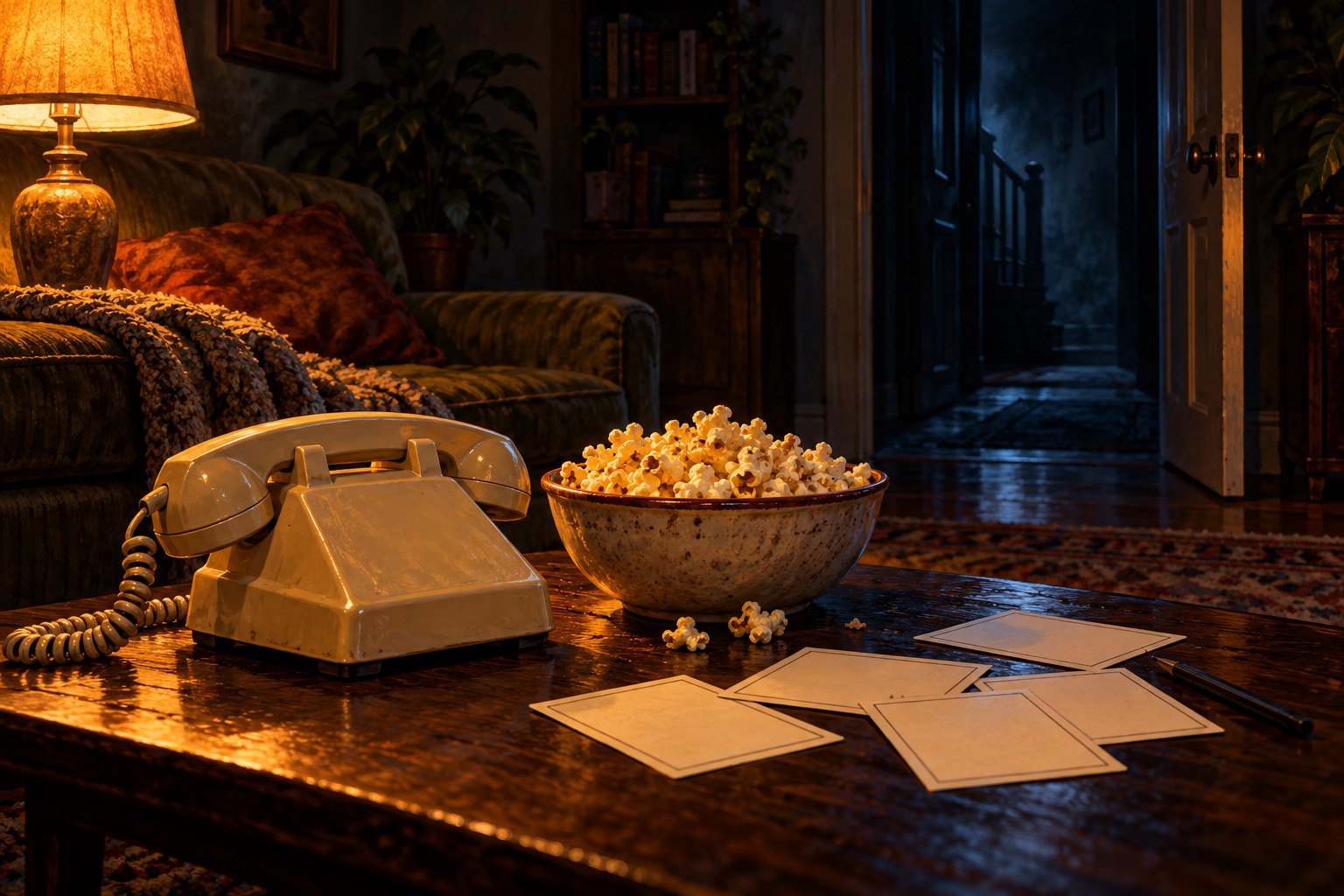
Think you’re final girl material? These 12 horror movie trivia questions test more than your ability to recognize a mask. They move from familiar villains to the details that make Scream such a sharp film about watching horror. Play first, check the answers below, then revisit the uncomfortable question at its center: how useful is movie knowledge when someone else controls the game?
Spoiler warning: The quiz and analysis reveal major developments in Scream (1996), including its killers and ending, plus the original killer’s identity in Friday the 13th.
The Quiz: 12 Questions Before the Phone Rings
Give yourself one point per correct answer. For questions requesting two names, you need both. Specify the original films when playing with friends; remakes and sequels can turn an otherwise straightforward question into an argument.
Round One: Know Your Horror Icons
- Which masked killer stalks the babysitters in the original Halloween?
- Who is responsible for the murders in the original Friday the 13th?
- Which horror villain is associated with a glove fitted with blades?
- Who directed Scream, and who wrote its screenplay?
Round Two: Pay Attention to the Conversation
- Which movie does Casey Becker name as her favorite scary movie during the opening phone conversation?
- What incorrect answer does Casey give when asked to identify the killer in Friday the 13th?
- Which member of Sidney’s friend group explains the rules for surviving a horror movie at the party?
- What four-word promise does he warn people never to say?
Round Three: Survive the Final Act
- Which horror film plays on the television during the party at Stu’s house?
- Which two characters are revealed as the killers?
- Who delivers the line “Not in my movie”?
- What household appliance does Sidney use to incapacitate Stu during their final confrontation?
The Answers: Check Your Survival Score
- Michael Myers. This is also the answer to the caller’s warm-up question for Casey.
- Mrs. Voorhees, Jason’s mother. The original film is the crucial distinction.
- Freddy Krueger. His bladed glove makes him identifiable without requiring a glimpse of his face.
- Director Wes Craven and screenwriter Kevin Williamson. Their combination of suspense and genre commentary defines the original Scream.
- Halloween. Casey recognizes the premise before the conversation becomes threatening.
- Jason. She answers with the franchise’s best-known figure rather than the original murderer.
- Randy Meeks. He turns his viewing experience into a confident survival lecture.
- “I’ll be right back.” Stu immediately treats the warning as something to joke about.
- Halloween. Its presence becomes central to the film’s joke about distracted spectators.
- Billy Loomis and Stu Macher. Both names are necessary for the point.
- Sidney Prescott. Her response rejects the expectation of another inevitable killer comeback.
- A television. The object everyone has been watching becomes part of her resistance.
For a playful scorecard: 0–4 makes you an opening-night newcomer, 5–8 earns observant horror fan status, and 9–12 gives you final girl bragging rights. These are party-game labels, of course. The film itself offers excellent reasons to distrust anyone claiming that expertise guarantees survival.
Casey’s Opening Scene: A Quiz With No Fair Referee
“What’s your favorite scary movie?” sounds like an invitation to connect. That is what makes it sinister. Casey initially occupies a familiar social situation: a stranger is annoying, perhaps flirtatious, and potentially easy to dismiss. The horror develops as she discovers that he knows more about her circumstances than she knows about his.
From Casey’s perspective, answering questions becomes a desperate attempt to recover control. A game suggests conditions, and conditions suggest a possible way out. Yet nothing obliges the caller to honor his promises. His authority comes from coercion, not fairness.
My reading is that the sequence works because it makes the viewer’s pleasure uncomfortable. We may know the correct answer and feel briefly superior, while Casey is struggling to think under terror. Remembering a fact from the safety of a couch is a different task from retrieving it while someone threatens a person you love.
Barrymore’s performance gives that distinction emotional weight. The movement from casual irritation to pleading strips away the cozy idea that a horror fan could simply outsmart the opening scene. The trivia is entertaining; the situation is not a legitimate test of its victim’s intelligence.
Randy’s Rules: Expertise Can Narrow Your Attention
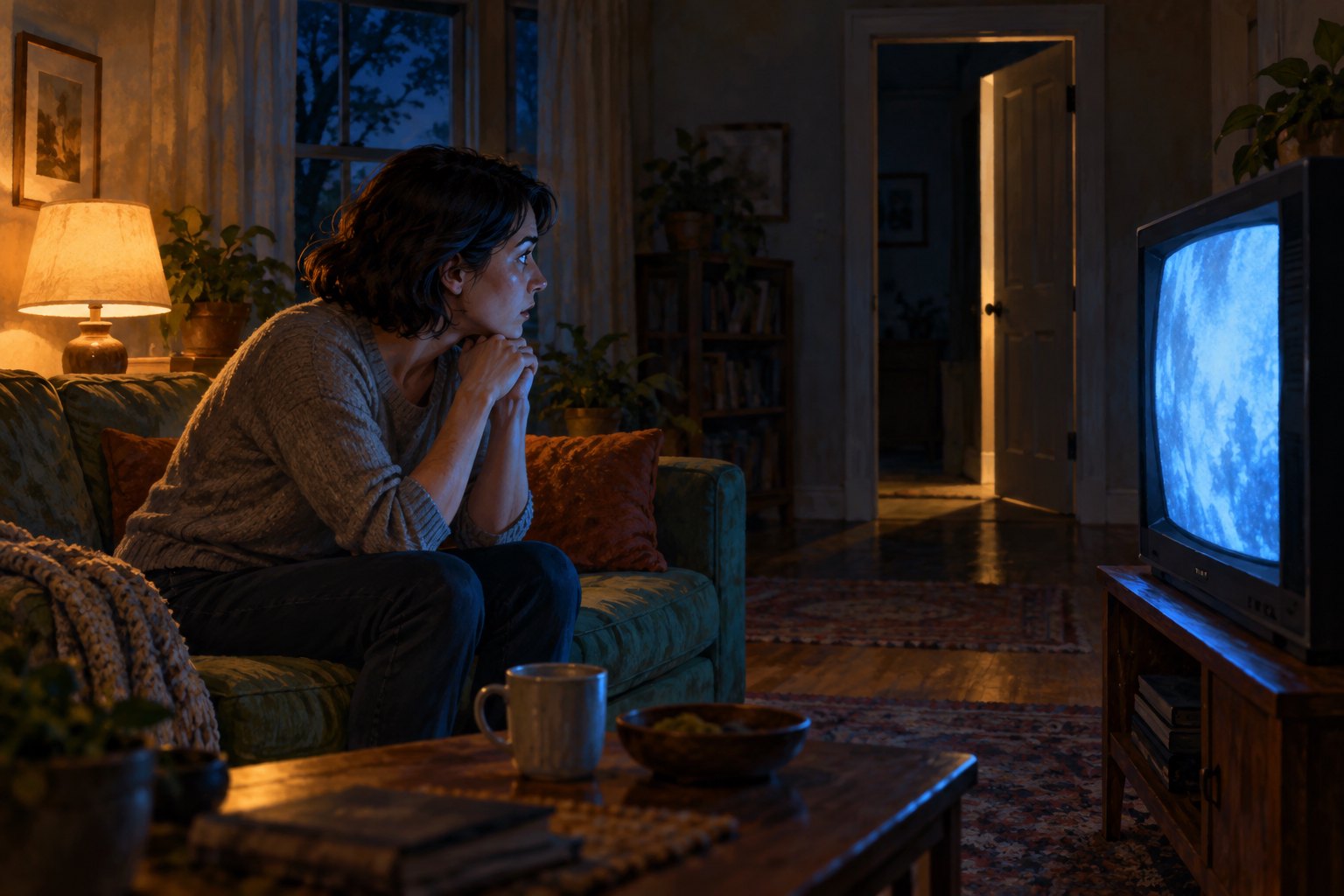
Randy’s appeal is easy to understand. He gives uncertainty a structure. Identify the pattern, follow the rules, and perhaps the frightening world will become predictable. Anyone who enjoys solving a mystery before its characters do can recognize the attraction.
But his attention has limits. Watching Halloween, he can identify danger within the television image while remaining vulnerable in the room around him. Craven makes that gap funny and unnerving at once. The spectator who appears most qualified to explain the situation is still only seeing part of it.
For me, this is where Scream earns its reputation as more than a collection of references. Its commentary changes how a suspense scene functions. We watch the movie Randy watches, watch Randy, and anticipate the threat he misses. Knowing the convention adds another layer of anxiety.
Sidney’s Survival: Adaptation Matters More Than Purity
Sidney gives the film its emotional center because she cannot treat violence as an abstract genre exercise. Her mother’s murder already shapes her relationships and sense of safety. Other people’s explanations of that history keep intruding on her ability to understand her own life.
That distinction between lived grief and someone else’s version of it also informs our analysis of memory and family conflict in Whalefall. In Scream, personal history gives the mystery consequences beyond identifying a culprit.
Sidney also exposes the weakness in Randy’s moralistic rulebook. She has sex and survives. The film refuses to make sexual abstinence the qualification for its heroine’s continued existence. Her decisive qualities are responsiveness, resistance, and the ability to act when an explanation proves false.
Our character-focused review of Split considers another watchful survivor. Both films invite attention to observation under pressure, although their ideas about suffering deserve separate judgments.
The Deeper Answer: Who Gets to Write the Ending?
The most rewarding interpretation of Scream is that horror knowledge becomes dangerous when people confuse patterns with permission. Billy and Stu treat other people as material for a narrative they expect to control. Randy mistakes recurring conventions for dependable laws. Sidney survives by refusing the role that would make everyone else’s explanation tidy.
That is why her final declaration matters. It is a claim to agency, delivered inside a film where other people repeatedly define what her experiences should mean. The best answer is an action that breaks their expectations.
A Reference Worth Catching on a Rewatch
During the television sequence, Randy calls out to “Jamie” while watching Jamie Lee Curtis in Halloween. Randy himself is played by Jamie Kennedy. The doubled name makes the warning bounce between the movie on television and the character watching it. It is a compact joke with a serious implication: recognizing danger in somebody else’s story does not guarantee you will recognize it in your own.
Original content by this site's editorial team. Published: October 17, 2026 at 17:19:52 PDT (Los Angeles time)