Full spoilers for Zach Cregger’s Resident Evil follow.
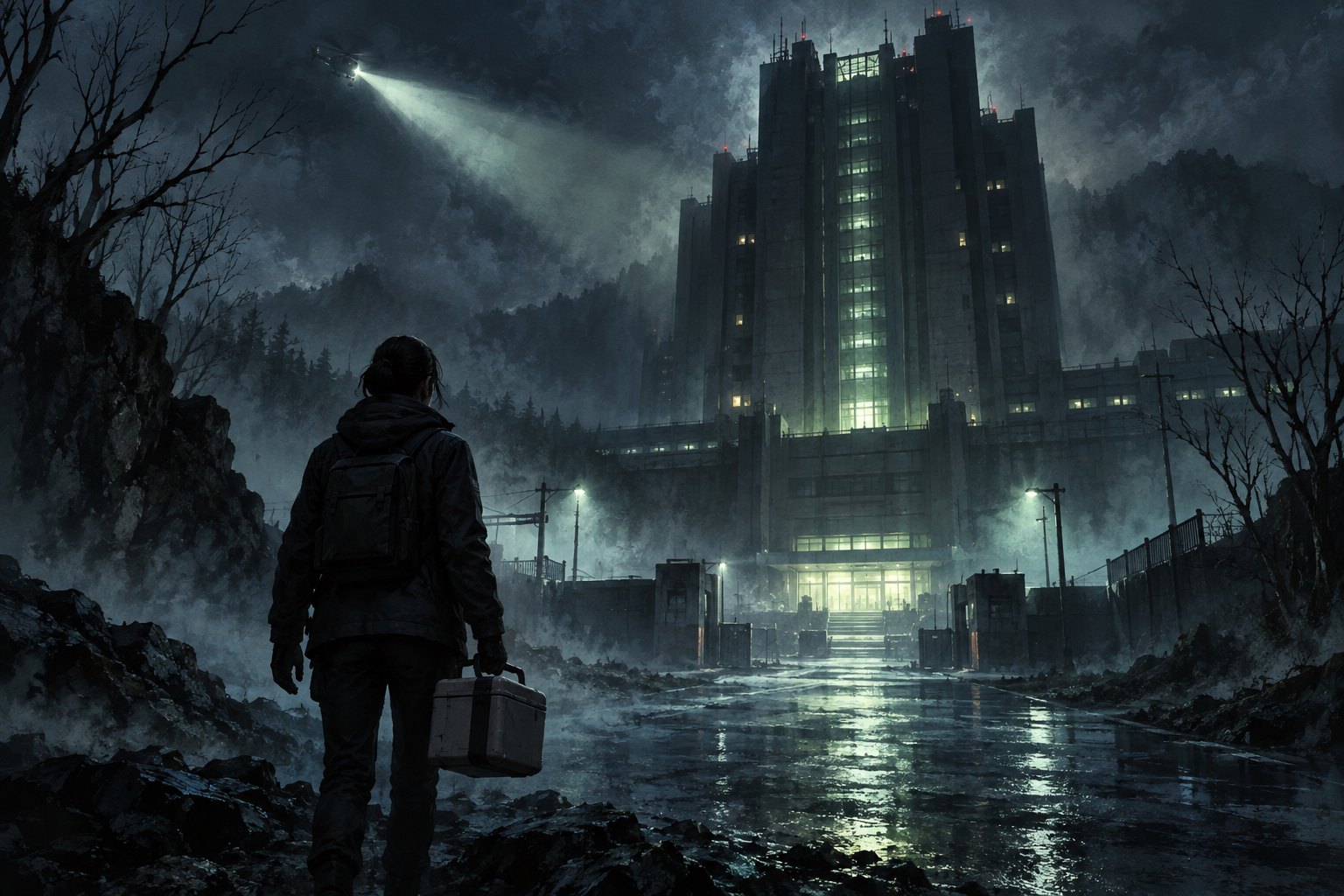
Resident Evil ends with Bryan completing his delivery and losing himself anyway. The medical courier reaches the researchers who need his cargo, but his infection overwhelms him before they can administer treatment. His transformed body attacks the scientists, and the syringe containing the cure falls from the hospital. The crucial distinction is that Bryan succeeds at his assignment without securing his survival. The final sequence is documented in [GamesRadar+’s ending breakdown](https://www.gamesradar.com/entertainment/horror-movies/resident-evil-movie-ending-explained/).
That outcome makes the ending more than a last-minute monster reveal. Cregger has built a story around reaching a destination, then breaks the comforting assumption that arrival means safety. My reading is that the finale’s strongest idea lies in this separation: Bryan can do everything required of him and still run out of time.
What happens to Bryan in the laboratory?
Played by Austin Abrams, Bryan enters the final stretch already infected. Inside the laboratory, he tries to conceal his worsening condition while the scientists work. When the transformation accelerates, his body develops appendages and a monstrous mouth that attack the people around him. He continues to want help even as his body makes helping him almost impossible. [ComicBook’s account of the finale](https://comicbook.com/movies/feature/resident-evils-controversial-ending-is-actually-perfect-but-what-comes-next/) describes that painful overlap between his pleas and the violence.
This is the distinction that makes the sequence tragic: Bryan does not choose to turn against his rescuers. His intentions and his actions become horribly disconnected. For a few moments, the person we have followed is still present enough to understand what he is losing, while the body carrying him has become an independent threat.
From the scientists’ perspective, the emergency changes just as abruptly. The person delivering their chance to stop the outbreak becomes an immediate danger inside their workspace. Treatment now requires approaching the very body attacking them. Knowledge alone cannot resolve that practical problem.
The scene therefore closes a cruel circle. Bryan needs other people to save him, but the infection destroys the conditions under which they could do so. Calling this simply a punishment for hiding his symptoms would flatten a situation driven by terror, desperation, and rapidly disappearing options.
Why the cure matters even though Bryan never receives it
The syringe gives the finale a concrete object to organize its suspense around. Salvation is no longer an abstract promise somewhere across the city. It is small, visible, and apparently close enough to touch.
Its fall should not be confused with a confirmed shot of its destruction. The ending leaves its condition after the drop unresolved. That uncertainty permits speculation about recovery, but does not establish that anyone retrieves it or that Bryan can subsequently be restored. The distinction between an unanswered question and a promised rescue matters here.

As an image, the falling syringe reverses the logic of Bryan’s journey. So much effort has gone into getting something essential to the right place; a few seconds undo that movement. The emotional scale is much larger than the object itself. A fragile container briefly carries the possibility of a future.
For me, this is more effective than a speech announcing that hope is gone. The audience can follow the failure physically. Distance, which Bryan has spent the movie overcoming, becomes decisive again.
How Bryan’s earlier humor changes the ending
“I only use guns in video games,” Bryan says earlier. His follow-up, “It’s confusing in real life!” expresses the gulf between recognizing a survival situation and knowing how to handle it. Both lines are quoted in [the Associated Press review](https://apnews.com/article/82a73a5e863c0b726fcbf001038323a0).
Those jokes also create an expectation. A protagonist allowed to be awkward, frightened, and funny often earns our confidence that he will muddle through. Each escape can feel like another installment of an unspoken bargain: stay with this man, laugh at his frustration, and eventually see him get home.
The finale refuses to honor that bargain. Our analysis of Bryan as an ordinary horror protagonist considers the appeal of his vulnerability. The ending makes that vulnerability permanent rather than treating it as a preliminary stage before heroic mastery.
That choice has a cost. Viewers invested in the movie’s comic momentum may find the conclusion emotionally abrupt. I find the reversal compelling because it changes the meaning of the earlier humor: Bryan’s complaints become traces of an individual whose voice the infection will erase. Still, the concept’s force does not require every viewer to find its execution satisfying.
The approaching helicopter changes who gets to look
The finale brings National Guard helicopters into view as Bryan’s transformation reaches its conclusion. Where the audience knows a courier’s ordeal, approaching outsiders encounter a monster. [Polygon’s ending analysis](https://archive.vn/2026.09.18-011344/https%3A/www.polygon.com/resident-evil-ending-explained/) describes that final arrival and the unresolved possibility surrounding the cure.
This change in perspective is the ending’s sharpest move. Bryan’s history does not disappear, but it becomes invisible to anyone arriving now. They cannot see the effort that brought him here or distinguish his original intentions from the danger his body presents.
The effect resembles encountering a formidable enemy in a survival-horror game after having lived through that enemy’s human backstory. That is an interpretation of the structure, not confirmation that Bryan becomes a particular game boss. His narrative role has changed before our attachment to him can catch up.
A related question runs through our analysis of sympathy and monstrosity in Hope: what happens when a threatening body retains a claim on the audience’s compassion? Here, the disturbing answer is that understanding someone does not make them safe to approach.
Does the ending promise a sequel?
Resident Evil has no mid-credits or post-credits scene revealing Bryan’s rescue or a new mission. The unfinished outbreak leaves room for another story, but narrative room is different from an announced continuation.
Nor does the ending need a sequel to acquire meaning. Bryan’s personal trajectory has reached its terrible conclusion even though the larger emergency continues. Reading every unresolved detail as franchise preparation risks overlooking the emotional finality already present.
The deeper horror: becoming unrecognizable
My interpretation is that Resident Evil ends with a failure of recognition as much as a failure of treatment. We remember Bryan as a person. The world now has urgent reasons to respond to him as a threat.
His delivery remains an achievement, but achievement offers no immunity. His desire to live remains understandable, but desire cannot control his body. The ending holds those truths together instead of converting perseverance into a guaranteed reward.
That is why the final monster carries more weight than its anatomy alone could provide. The frightening thing is not simply what Bryan becomes. It is how much we know about the person everyone arriving afterward will never meet.
Original content by this site's editorial team. Published: September 18, 2026 at 04:13:00 PDT (Los Angeles time)