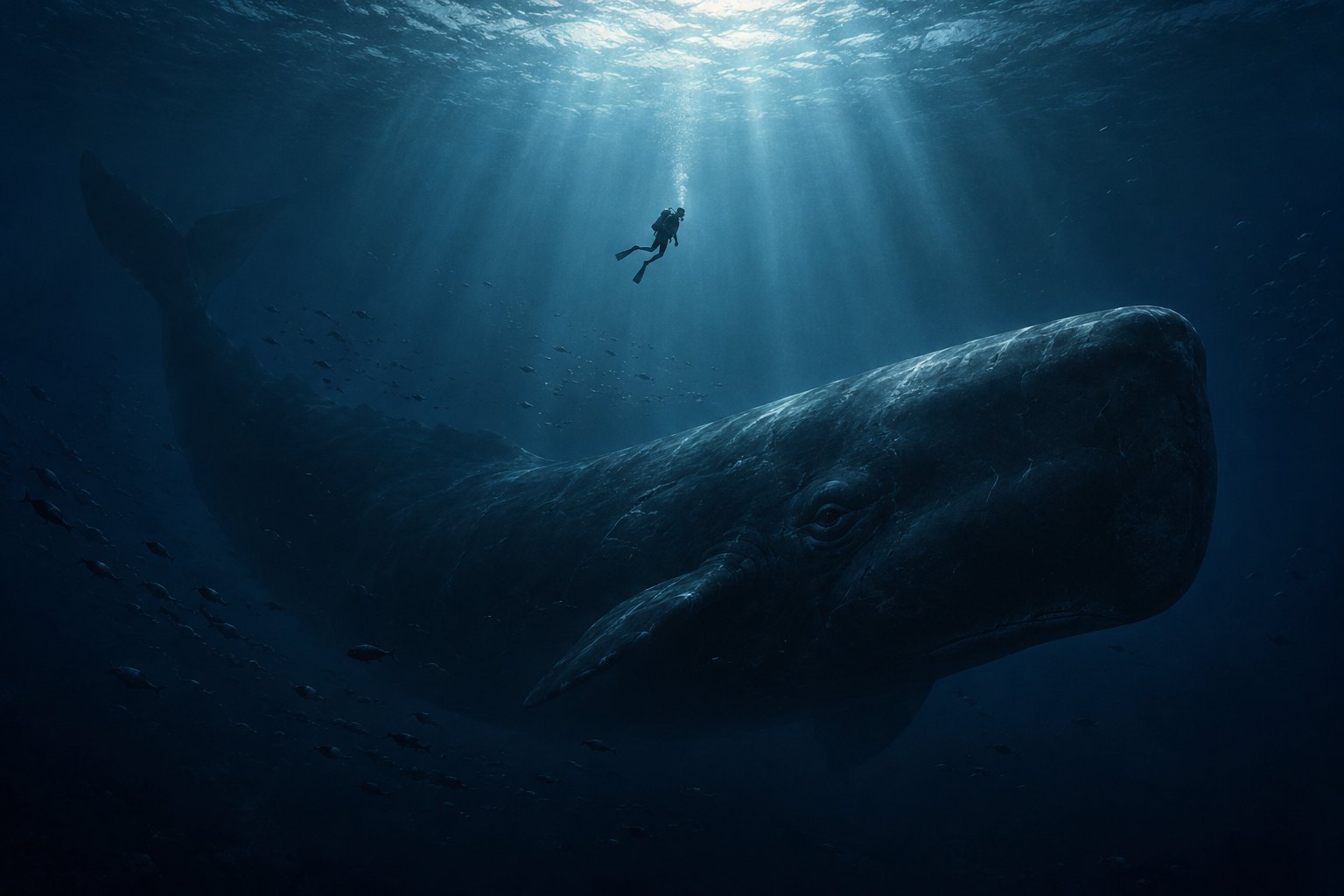
Whalefall gives its protagonist an extraordinary survival problem and a painfully recognizable emotional one. Jay Gardiner must escape the sperm whale that has swallowed him while deciding what to do with the father whose influence he cannot escape. The most compelling reading of this story rests on a distinction: accepting something useful from a parent does not require accepting everything that parent did.
Brian Duffield directs the adaptation of Daniel Kraus’s novel, with a screenplay by Duffield and Kraus. Austin Abrams plays Jay, opposite Josh Brolin as his father, Mitt. Their relationship gives the underwater emergency its emotional stakes. Beneath the outrageous premise sits a difficult question about inheritance: how much of another person can you carry without surrendering yourself?
Spoiler warning: This analysis discusses the central predicament, the father-son relationship, and the final letter. The story also addresses parental abuse, suicide, and distressing bodily peril.
Jay’s dive starts with unfinished grief
The essential setup is straightforward. Following his father’s death, Jay dives off California’s central coast to search for his remains. A sperm whale swallows him, leaving him trapped with a dwindling air supply. The studio’s synopsis establishes roughly an hour of oxygen and identifies Mitt’s lessons as a possible means of escape.
That initial search matters as much as the accident. Jay enters the water looking for something tangible. A body can be located, recovered, and mourned through familiar rituals. A damaged relationship offers no comparable procedure. The dive turns an emotional problem into an undertaking with an apparent objective, even though finding Mitt cannot retroactively repair their history.
My reading is that this makes Jay vulnerable before the whale arrives. His need to accomplish something for his father pulls him toward danger. Once trapped, however, his task changes: the living son needs the care and attention previously directed toward the dead parent. Survival forces a rearrangement of priorities.
The whale makes every ordinary action consequential
Inside the animal, survival becomes a matter of bodily limits. Jay cannot negotiate with his surroundings or appeal to their sympathy. Breathing, moving, and understanding what is happening consume resources. The premise makes even a pause feel consequential because time belongs to the body before it belongs to the plot.
One particularly effective line captures that helplessness: “it’s chewing me,” Jay says as he recognizes the danger of the liquid around him, a moment described in Katie Walsh’s Tribune News Service review. The wording collapses the distance between an external threat and an ongoing physical process. Being swallowed has not finished the attack on his body; it has placed him inside something that continues without regard for him.
The distinction matters for the film’s moral atmosphere. A creature does not need human malice to become terrifying. Jay’s predicament emerges from the mismatch between his urgent personal story and an environment that cannot recognize it. That indifference gives the survival narrative a different shape from a contest against a calculating villain.
For a contrasting treatment of a protagonist trapped by an environment, our analysis of belonging and entrapment in The Wicker Man examines danger organized by human intention. With Jay, the absence of an intention to defeat is precisely the difficulty.
Mitt’s lessons carry both knowledge and injury
Flashbacks connect Jay’s emergency to his upbringing under Mitt, whose forceful expectations have damaged their relationship. The story gives paternal instruction a practical afterlife: knowledge Jay acquired from his father can help him navigate the crisis. Yet usefulness is an inadequate measure of whether that instruction was delivered lovingly.
That is where the film’s central idea becomes most interesting—and most open to challenge. A lesson can be correct while the person teaching it behaves cruelly. A son can demonstrate competence without proving that cruelty was necessary. Treating survival as evidence that a harsh father was right about everything would diminish Jay’s achievement by returning ownership of it to Mitt.

“The ocean provides,” a recurring paternal phrase documented in Walsh’s review, holds that tension in miniature. It offers a way of attending to the environment: look again, recognize what is available, keep working. But a useful maxim cannot settle the entire relationship. Its value depends on what Jay does with it now.
I find the more persuasive interpretation in Jay’s ability to select and transform his inheritance. He can keep a skill, reject an expectation, and remember an injury simultaneously. Emotional maturity need not mean reaching one final verdict on Mitt. It can mean refusing to let that verdict determine every future decision.
Memory can deepen suspense—and explain too much
The movement between danger and memory gives Whalefall a built-in dramatic tension. Each return to Mitt can reveal why Jay responds as he does. It can also pull attention away from the immediate uncertainty of his predicament. The structure asks viewers to hold bodily urgency and emotional history together.
The critical question is whether a memory complicates Jay or merely supplies an answer. If every obstacle corresponds neatly to a paternal lesson, survival risks becoming a demonstration of earlier instruction. Jay becomes more interesting when remembering still leaves him with a choice—when inherited knowledge requires judgment rather than obedience.
This is also why a character-centered reading should resist reducing him to resilience. Fear, hesitation, and dependence belong to his experience too. Our commentary on watching faces and reactions explores a useful viewing habit here: attend to the response before the decisive action. A character’s uncertainty often reveals more than eventual competence.
The final letter preserves something private
The ending offers an especially useful boundary for interpretation. Jay reads a letter from Mitt and responds with a smile and laughter, but the audience does not see its contents. In an interview with SYFY WIRE, Duffield confirmed that he has an answer to what the letter says while declining to disclose it.
That leaves the wording unresolved. A proposed message, however emotionally plausible, should remain a theory. The observable change belongs to Jay: he can receive something from his father and respond without explaining that response to everyone else.
My interpretation is that this privacy strengthens the ending. A fully revealed letter could turn Mitt’s final words into the authoritative explanation of their relationship. Withholding them leaves attention on the son. Whatever the message contains, Jay’s response has an existence beyond the audience’s ability to judge whether he has grieved correctly.
What survival means beyond escape
The deepest question in Whalefall is who gets to define Jay after Mitt’s death. If the father remains the sole explanation for the son’s strength, then physical escape still leaves Jay emotionally confined. A more generous reading allows him authorship: the knowledge may be inherited, but the decisions are his.
That makes the film’s emotional proposition valuable, though uncomfortable. Loving someone, resenting them, and benefiting from something they taught you can coexist. None of those feelings automatically cancels the others. Reconciliation becomes meaningful only when it leaves room for the person who was hurt.
Whalefall is most rewarding as a story about that unfinished separation. Jay goes into the ocean searching for his father. The larger possibility is that he can emerge with a life whose value no longer depends on completing that search.
Original content by this site's editorial team. Published: October 22, 2026 at 09:50:46 PDT (Los Angeles time)