The Love Hypothesis makes its first kiss and its Chapter 16 encounter carry very different emotional burdens. One launches a performance; the other threatens to make that performance impossible to sustain. Director Claire Scanlon’s discussion of the adaptation offers a useful way into both scenes: their importance lies in what Olive and Adam understand—or misunderstand—about each other.
Spoilers follow for the romance and a later sexual-harassment storyline. This is an analysis of the film’s documented story choices and Scanlon’s explanations, rather than a firsthand assessment of every performance or shot.
The first kiss means something different to each person
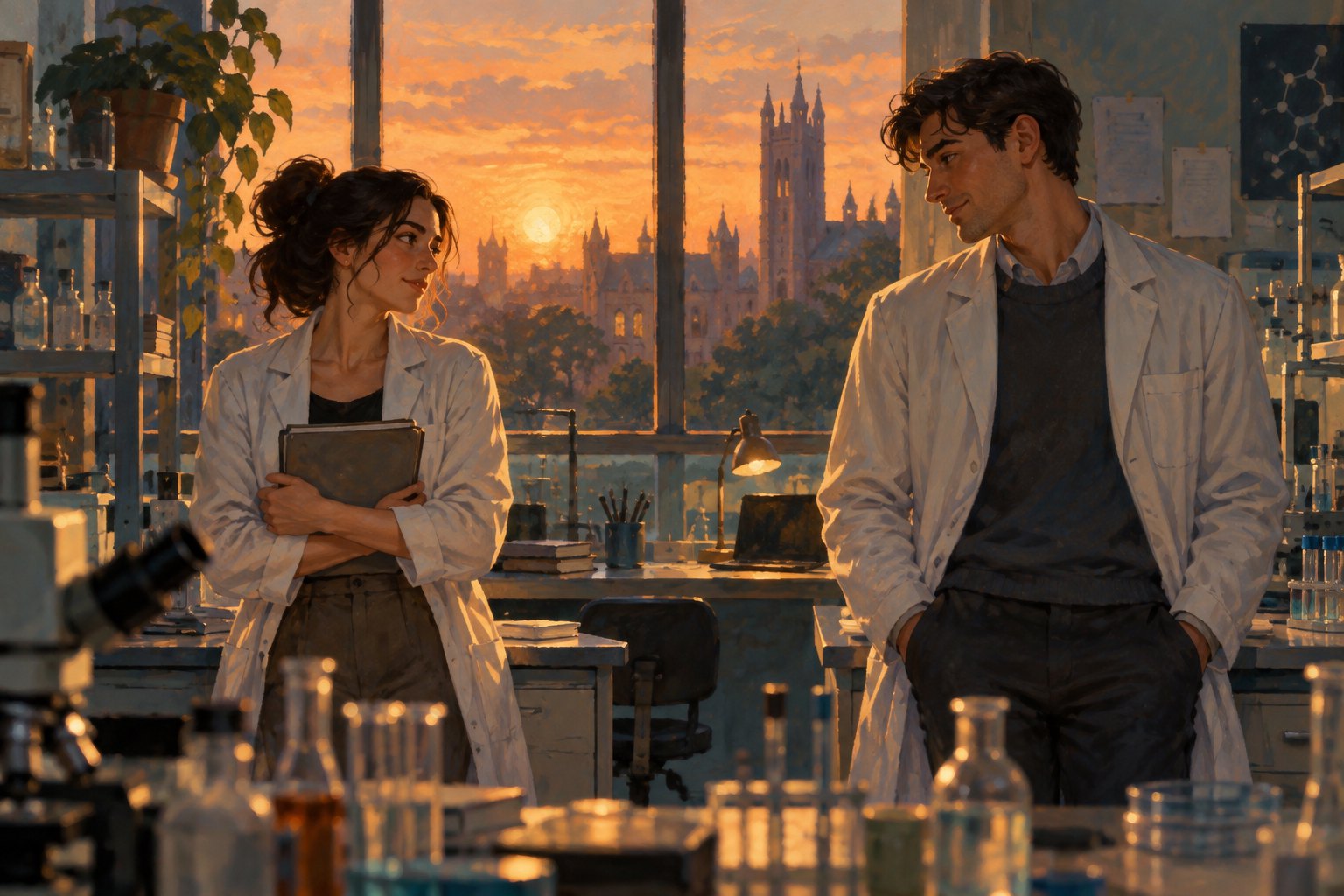
The premise places Olive Smith, played by Lili Reinhart, in a predicament she tries to solve through appearances. Hoping to convince her friend Anh that she has moved on from Jeremy, Olive kisses intimidating professor Adam Carlsen, played by Tom Bateman. Their subsequent fake relationship gives both characters something useful: Olive can reassure her friend, while Adam can suggest that he intends to remain at Stanford. The film’s published synopsis establishes this progression from impulsive gesture to negotiated arrangement. [Film synopsis and cast](https://www.rottentomatoes.com/m/the_love_hypothesis).
From Olive’s perspective, the kiss is a hurried answer to an immediate social problem. That makes it comic, but it also reveals a habit worth watching: she tries to manage what other people believe before admitting what she wants. Her apparent boldness can therefore be read as a form of avoidance. Taking a dramatic action is sometimes easier than having an embarrassing conversation.
Adam occupies the other side of that misunderstanding. He is the person unexpectedly recruited into someone else’s story. Reading the moment through his perspective complicates the familiar fantasy of an intimidating man suddenly disarmed by affection. Surprise, attraction, irritation, and embarrassment need not cancel one another out.
That imbalance of information gives the opening its potential. Olive knows what she wants the kiss to communicate to Anh. Adam does not initially share that script. The audience’s pleasure comes from recognizing how much interpretation can fit inside a gesture that looks simple from a distance.
Chapter 16 changes the question from appearances to trust
For readers unfamiliar with Ali Hazelwood’s novel, Chapter 16 refers to the intimate encounter whose adaptation has drawn particular attention. In her Swooon interview, Scanlon explained the difficulty of compressing an extended, dialogue-heavy passage while preserving its emotional character. Her concern was translating the experience into cinema rather than reproducing its length. [Scanlon’s Chapter 16 interview](https://www.tvinsider.com/swooon/1302159/the-love-hypothesis-preview-chapter-16-scene-director-claire-scanlon-interview/).
That is a meaningful distinction. A novel can pause within an encounter to explain hesitation, recall an earlier conversation, or reveal a private fear. A film must distribute that information among speech, expression, movement, and silence. Keeping every sentence would not necessarily preserve the scene’s effect.
My reading is that the crucial transition here concerns permission to be emotionally sincere. Fake dating gives Olive and Adam a convenient explanation for closeness. They can participate while pretending that participation reveals nothing. Genuine intimacy weakens that protection: what happens between them can no longer be explained entirely by the agreement.
The first kiss asks what another person will believe. The later encounter asks whether these two people can believe each other. That is why evaluating the adaptation only by explicitness or duration misses its more interesting dramatic work. The useful question is whether intimacy changes the relationship’s meaning.
A changed sequence makes Olive’s vulnerability more complicated
In her Deadline interview, Scanlon discussed placing Tom Benton’s harassment of Olive after the central intimate encounter, changing the novel’s sequence. She also described filming the first kiss during the first week and deliberately acknowledging the book-cover image. These are separate adaptation decisions with a shared purpose: making familiar material work through cinematic timing. [Deadline’s interview, republished by Yahoo](https://malaysia.news.yahoo.com/love-hypothesis-director-claire-scanlon-212610262.html).
The reordered confrontation matters because emotional context changes how an event lands. A moment of closeness followed by exploitation can make the contrast between trust and manipulation especially sharp. Olive’s willingness to become vulnerable with one person does not make her available to another. The distinction is essential to any serious reading of this storyline.
It also complicates the academic setting. Professional opportunity and personal attention can occupy the same spaces without carrying the same meaning. For Olive, the challenge is not simply interpreting whether a man likes her. It is navigating circumstances in which other people can misrepresent her work, her motives, and her access to a future.
There is a critical risk here, too. A harassment storyline can become a device for demonstrating the romantic hero’s protectiveness. The stronger interpretation keeps Olive’s experience at the center: her judgment, her right to refuse, and her professional ambitions matter independently of Adam’s response.
That relationship between romance and autonomy also informs our analysis of Baby’s growing independence in Dirty Dancing. Romantic satisfaction becomes more substantial when the heroine’s development has consequences beyond securing a partner.
Anh’s questions test Adam more effectively than his reputation does
Scanlon’s account of Anh confronting Adam adds another perspective. Recalling the exchange, she includes the pointed question, “Did you know?” and the later acknowledgment, “You’re a good friend Anh,” answered with “Yeah, duh.” These are fragments as remembered in the interview, rather than a complete dialogue transcript.
The question is the important part. Anh does not assume that being the romantic lead establishes Adam’s integrity. She seeks information before deciding where he stands. That gives friendship an active role in the story: caring for Olive involves judgment and intervention, not merely encouraging the central couple.
For Adam, this creates a more revealing test than whether he can appear charming. Being misunderstood is uncomfortable; being asked to examine someone close to him is consequential. Romance gains credibility when the person who inspires desire also demonstrates that another person’s account deserves attention.
The deeper idea: being seen without controlling the story
My central interpretation is that The Love Hypothesis uses fake dating to explore the limits of managing perception. Olive and Adam begin with an arrangement designed to influence observers. Its emotional difficulty arrives when their private experience stops matching the public explanation they have constructed.
That makes the first kiss and Chapter 16 complementary rather than interchangeable attractions. The former creates a story for others; the latter demands an answer from the people living it. The romance’s strongest underlying proposition is that closeness requires surrendering some control over how one is understood.
A book-cover homage, and a cameo that did not happen
Scanlon identified the first kiss as an intentional homage to the novel’s cover. She also said an Ali Hazelwood cameo was discussed but did not happen; a set visit should not be mistaken for an onscreen appearance. Those details reward attention without requiring viewers to invent hidden connections.
Readers interested in the film’s musical references can continue with our separate exploration of The Love Hypothesis soundtrack. Here, the most revealing connection remains between two encounters: the moment affection becomes a convincing performance, and the moment performing no longer feels sufficient.
Original content by this site's editorial team. Published: September 23, 2026 at 17:06:08 PDT (Los Angeles time)