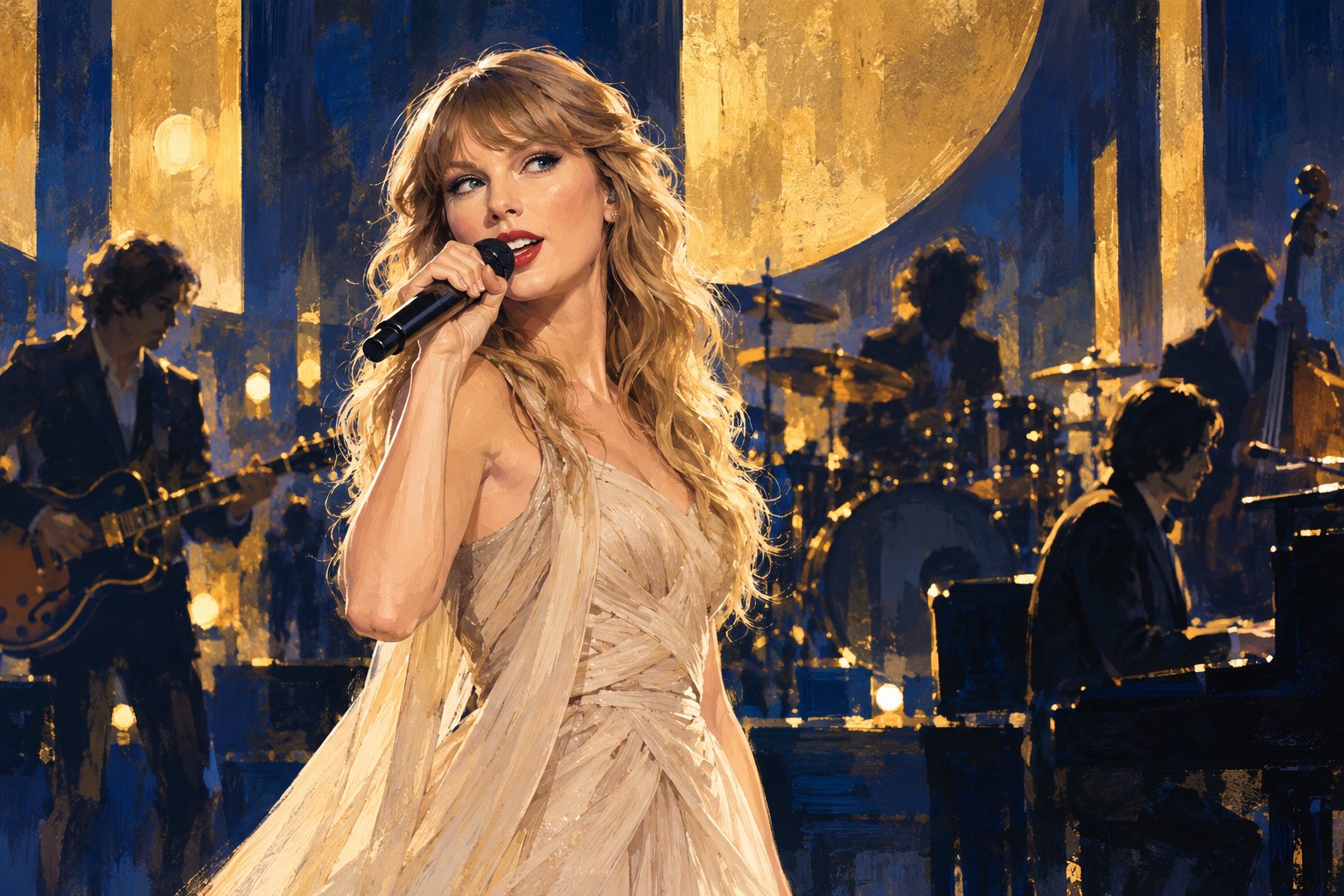
Taylor Swift’s Academy Museum Gala appearance brought a compact musical return into a film-centered setting. Variety reported that she performed four songs in her first band performance since the Eras Tour. For fans, the immediate attraction is that return to performing with a band. For movie audiences, the setting adds another question: what changes when a pop performance becomes part of Hollywood’s conversation about cinema?
The reported connection to a Toy Story 5 song gives that question a specific focus. A song can command attention as a live performance while serving a very different purpose within a movie. My reading of the gala’s significance rests on that distinction: Swift’s appearance puts musical storytelling in the spotlight, but understanding its cinematic value requires listening beyond the occasion.
What the four-song performance establishes
The central reported facts are straightforward: Swift appeared at the Academy Museum Gala, performed four songs, and returned to a band setting for the first time since the Eras Tour. That last detail matters precisely because it is specific. A first band performance should not automatically be described as a first public appearance, a first musical appearance of any kind, or the announcement of another tour.
Likewise, four songs establish the scale of the set without establishing its running time, arrangements, or artistic success. Those judgments require a fuller account of the performance. Calling an appearance a major entertainment story is different from assessing how well the musicians played together or how effectively the singer shaped individual phrases.
There is still a meaningful editorial point in the format. A four-song set offers limited room to establish a mood and leave an impression. In principle, each selection carries considerable weight: an opening can create familiarity, a change in pace can redirect attention, and an ending can determine what listeners take away. That is a useful way to think about the format, without pretending to know the intention behind every choice made here.
Why the band matters to the story
The band is more than a detail attached to Swift’s return. In live music, accompaniment helps determine how a song communicates. A rhythmic accent can make a line sound decisive; a quieter passage can leave a vocal exposed; a sustained instrumental phrase can delay the emotional release a listener expects.
Those possibilities explain why a return to band performance deserves attention even when the songs themselves may be familiar. Listeners are hearing relationships among musicians as well as a lead vocal. The arrangement can alter the balance between intimacy and spectacle, giving a song a different dramatic shape.
None of that establishes what happened at this particular performance on a phrase-by-phrase level. It does explain what would make a substantive review valuable. Rather than relying entirely on celebrity reactions or the occasion’s prestige, a critic should ask how the ensemble supported the songs and whether the short set developed a coherent emotional progression.
The Toy Story 5 connection changes the listening question
Coverage of Swift’s gala appearance also connected the evening to a Toy Story 5 song. That is the clearest bridge to film analysis, although the connection alone does not establish where the song appears in the movie, whose perspective it expresses, or how it interacts with a particular scene.
For a live audience, the performer is the immediate center of attention. In a movie, a song may need to direct that attention toward someone else. Its strongest contribution might be helping viewers understand a character’s longing, recognize a change in a relationship, or carry an unresolved feeling beyond the final image.
That shift makes character perspective essential. When evaluating a film song, the useful question is not simply whether its sentiment is moving. It is whether that sentiment belongs to the story. Does the music express something the character cannot say? Does it complicate the emotion on screen, or merely repeat what the dialogue has already explained?
These are criteria for assessing the reported film connection, rather than claims about Toy Story 5’s plot. Without established scene details, assigning the song to a particular character or quoting supposed movie dialogue would substitute imagination for criticism. The gala can prompt interest in that relationship; the film itself must supply the evidence.
A gala appearance and a film achievement are different judgments
A high-profile performance can make a song newly visible to people who encounter it through film coverage. Visibility has practical value: it gives an audience a reason to listen. Yet a song’s effectiveness as part of a movie remains a separate artistic question.
The distinction becomes especially important around prestigious events. The setting can encourage audiences to hear an appearance as a statement about status. It is tempting to treat a place on the program as proof of broader industry approval, or to turn attention into a prediction about awards. Neither conclusion follows automatically from the fact of a performance.
Our commentary on Michael’s Gotham musical tribute and the questions beyond the applause explores a related concern: the excitement surrounding a musical occasion can be worth discussing while still leaving the work itself open to judgment.
For Swift’s gala set, the most productive response is to hold both interests together. The return with a band is a music story in its own right. The film connection invites a second conversation about how a song serves cinematic storytelling. One does not need to settle the other.
What movie viewers can listen for next
When encountering a film-associated song both on stage and within its movie, start with perspective. Identify whose feelings seem to organize the scene, then consider whether the music brings those feelings into sharper focus. A memorable melody may attract attention immediately; a precise relationship to character often becomes clearer with time.
Next, consider placement. Music heard during an action, across a transition, or after the story has ended can perform different jobs. Finally, consider what remains in memory: the singer’s presence, the melody, a character’s decision, or some combination of the three. There is no mandatory answer, but the distinction helps explain the experience.
That relationship between entertainment and emotional memory also runs through our reflection on how cinema becomes part of everyday life. A song can become one of the ways viewers carry a film with them.
The deeper significance of Swift’s return
My interpretation is that Swift’s four-song appearance is interesting because it places two kinds of storytelling beside each other. Live performance concentrates attention on the person delivering the song. Cinema can redistribute that attention across characters, images, and remembered moments.
The Academy Museum Gala provided an occasion for those forms to meet. The lasting artistic question is what survives the change of setting: whether the music that draws attention to Swift on stage also helps listeners hear something more clearly in a film. That is a richer measure of the connection than the glamour of the evening alone.
Original content by this site's editorial team. Published: October 19, 2026 at 03:27:15 PDT (Los Angeles time)