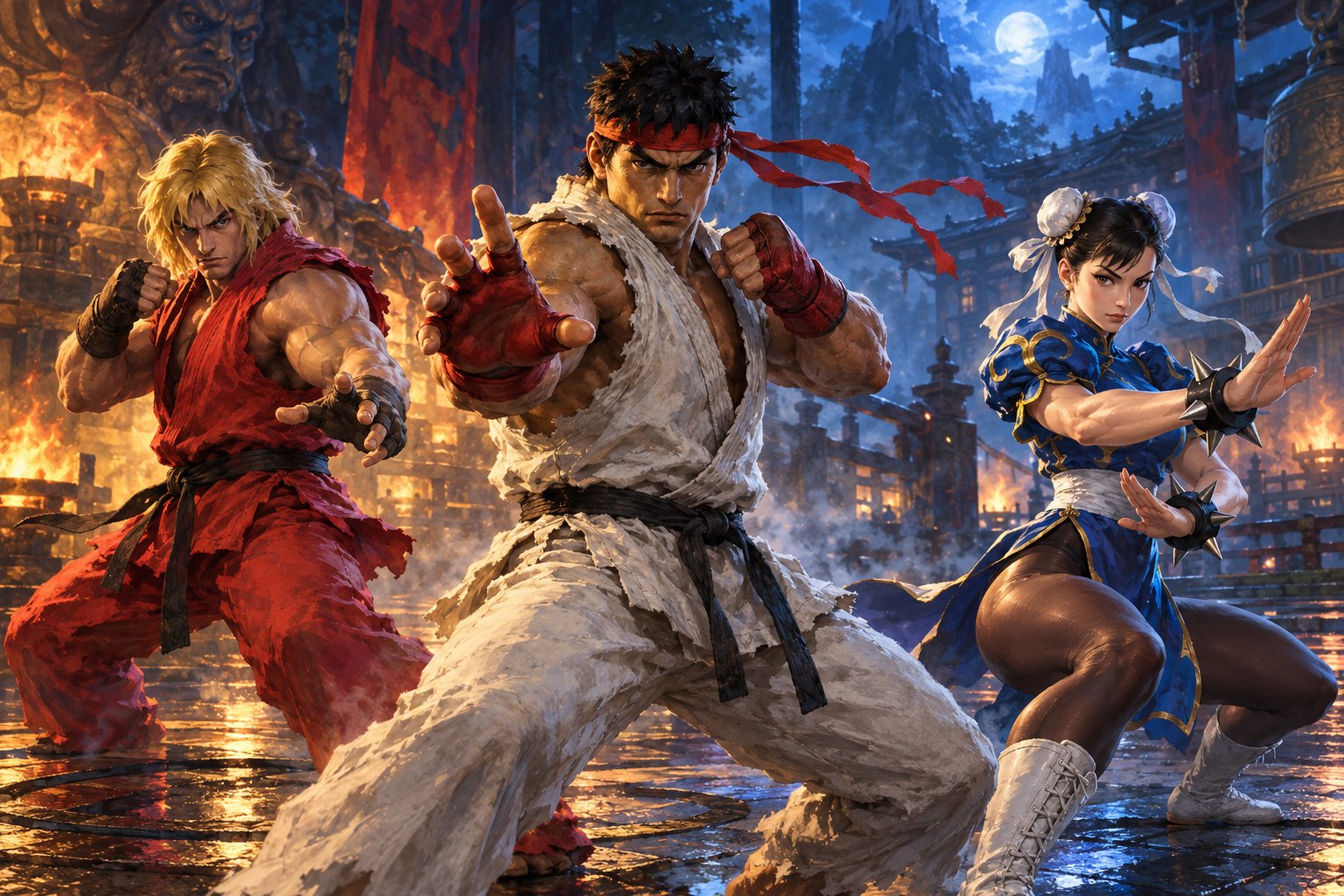
Street Fighter puts Andrew Koji in Ryu’s white gi, Noah Centineo in Ken Masters’ corner, and Callina Liang in the role of Chun-Li. Around them, a cast that includes professional wrestlers, musicians, comedians, and martial artists takes on Capcom’s unusually expressive collection of fighters. The useful question goes beyond who resembles a character portrait: what does each performer need to communicate once the fighting stops?
Directed by Kitao Sakurai, the film’s officially announced premise places the action in 1993. Ryu and Ken are estranged when Chun-Li recruits them for the World Warrior Tournament, with a conspiracy complicating their reunion. That makes their damaged relationship the clearest starting point for understanding the ensemble.
This is a cast guide and adaptation analysis, rather than a firsthand screening review. It discusses the announced premise and established game characteristics without revealing the film’s ending. Game histories are identified separately from movie events.
Street Fighter’s principal cast at a glance
The official trailer’s cast credits identify the following actor-and-character pairings:
- Andrew Koji: Ryu
- Noah Centineo: Ken Masters
- Callina Liang: Chun-Li
- Joe “Roman Reigns” Anoa’i: Akuma
- David Dastmalchian: M. Bison
- Cody Rhodes: Guile
- Jason Momoa: Blanka
- Vidyut Jammwal: Dhalsim
- Curtis “50 Cent” Jackson: Balrog
- Orville Peck: Vega
- Olivier Richters: Zangief
- Hirooki Goto: E. Honda
- Andrew Schulz: Dan Hibiki
- Rayna Vallandingham: Juli
- Alexander Volkanovski: Joe
- Eric André: Don Sauvage
These names establish casting, not equal narrative importance. An ensemble can contain sixteen distinctive performers while still depending on three characters to give its action emotional direction.
Ryu and Ken: the friendship underneath the rivalry
Andrew Koji as Ryu
In the games, Ryu’s identity rests on disciplined training and the pursuit of improvement. His familiar appearance makes him easy to recognize, but his seriousness presents a harder acting assignment: concentration must remain interesting even when the character has little to say.
For Koji’s Ryu, the announced estrangement from Ken creates a productive dramatic question. What happens when someone who understands combat has difficulty sustaining a friendship? That is an interpretation of the premise, not a claim about an unverified scene. It gives viewers something more useful to watch than whether the headband sits correctly.
My view is that Ryu works best when restraint has a visible cost. A pause before answering Ken could reveal as much as an elaborate attack, provided the film lets us understand what he is withholding.
Noah Centineo as Ken Masters
Ken is Ryu’s fellow martial artist and longstanding rival in the games. Their shared techniques make their differences especially valuable: similar training does not have to produce similar personalities.
Centineo’s assignment therefore depends on contrast. Ken needs a way of occupying space, reacting to embarrassment, and seeking acknowledgment that separates him from Ryu. The movie’s reunion premise makes that distinction consequential. Two fighters exchanging blows can supply spectacle; two former friends trying to prove something to each other can supply drama.
This is the broader problem explored in our analysis of how strong adaptations turn familiar material into cinematic experience. Recognition gets an audience through the door. A chosen perspective gives them a reason to care.
Chun-Li: the person who gets the story moving
Callina Liang plays Chun-Li. In the movie’s announced setup, she recruits Ryu and Ken. That is a concrete narrative function: she initiates their return to the tournament rather than simply appearing beside them.
Chun-Li’s game identity combines investigative purpose with a fighting style strongly associated with kicks. Those qualities suggest two distinct demands for a live-action performance. Her physical precision should be legible, and her decisions should make sense independently of the men she brings together.
Calling her mysterious can create intrigue, but mystery alone is not characterization. The useful viewing question is whether withholding information gives her agency or merely delays an explanation. A compelling Chun-Li should seem to be pursuing something even when other characters cannot yet see the whole picture.
Guile and Dhalsim: personality expressed through movement
Cody Rhodes plays Guile; Vidyut Jammwal plays Dhalsim. Their game counterparts illustrate how much storytelling can happen before anyone speaks. Guile’s military bearing and compact posture communicate a different relationship to combat from Dhalsim’s yoga-based, fantastical movement.
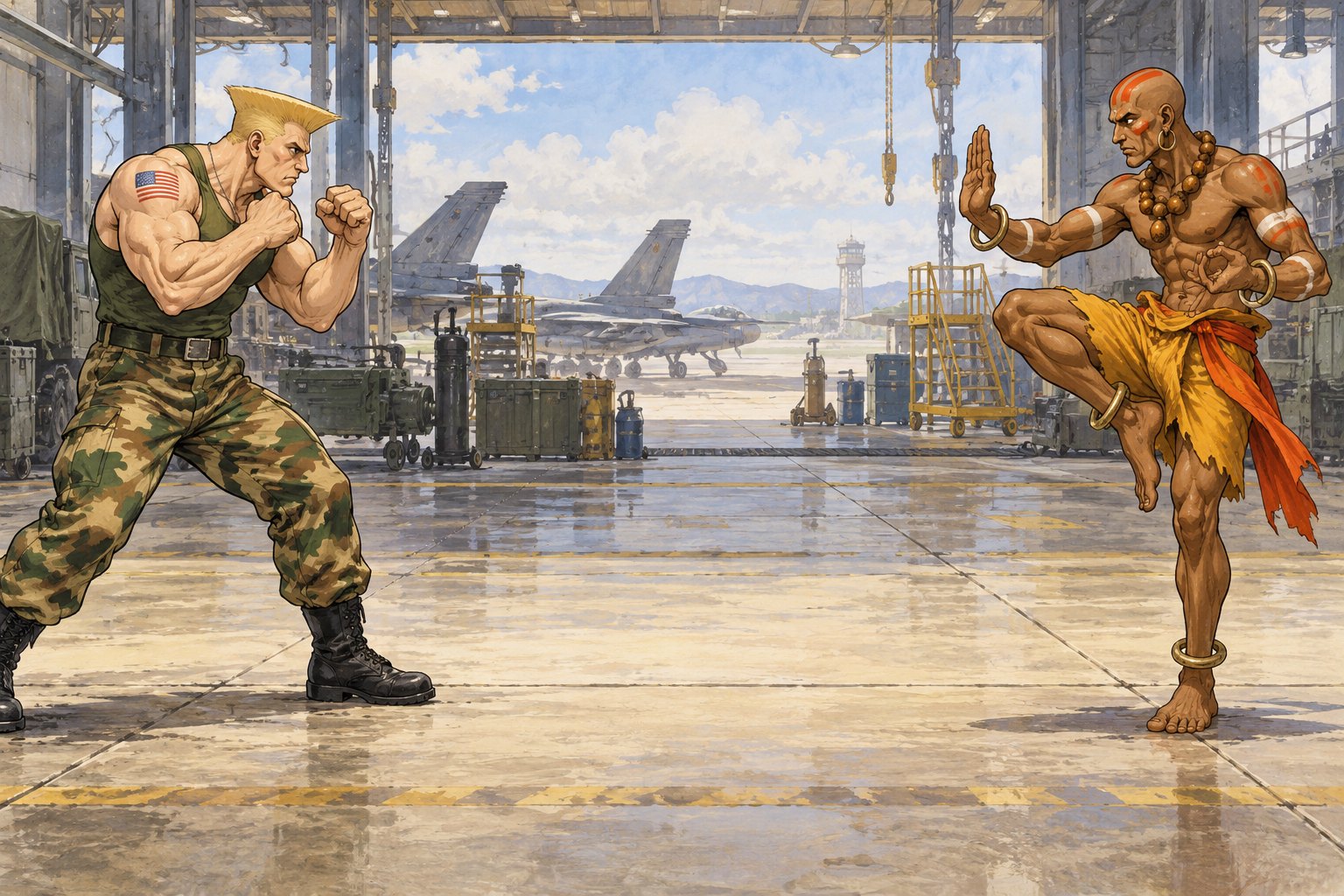
The illustration emphasizes that contrast; it does not depict a verified movie encounter. In an adaptation, preserving such differences matters because interchangeable choreography can flatten even an accurately costumed cast.
For Rhodes, the interesting challenge is making Guile’s discipline readable beneath an extravagant silhouette. For Jammwal, it is giving Dhalsim a consistent physical presence when the character’s abilities exceed ordinary anatomy. Effects may extend a body, but performance must still establish its rhythm.
Akuma and M. Bison represent different kinds of danger
Roman Reigns plays Akuma, while David Dastmalchian plays M. Bison. Their game identities should not be collapsed into a single category of intimidating antagonist. Akuma is associated with an extreme pursuit of martial power; Bison with domination and the criminal organization Shadaloo.
As an adaptation principle, that distinction creates two pressures on a hero. One challenges what a fighter might become through the pursuit of strength. The other treats strength as a means of controlling people. These are readings of the characters’ established functions, not assertions about particular movie confrontations.
The contrast also changes what a performance needs. Stillness can make Akuma threatening because it suggests confidence in his own capacity. Bison benefits from a sense that his ambition reaches beyond whoever stands directly in front of him. Our discussion of making power feel dangerous in an adaptation addresses a related issue: impressive appearances need consequences.
Blanka, the grapplers, and the supporting fighters
Jason Momoa’s Blanka brings one of the roster’s sharpest departures from ordinary human appearance. The familiar game character’s green skin and electrical attacks make visual effects central to recognition. The performance challenge is retaining intention beneath that spectacle: viewers should understand a reaction rather than merely register a creature effect.
Olivier Richters’ Zangief and Hirooki Goto’s E. Honda represent different grappling traditions. Their size alone cannot communicate those differences. Balance, preparation, and the way each closes distance are more revealing measures of whether the adaptation understands them.
50 Cent’s Balrog and Orville Peck’s Vega offer another useful contrast. The games distinguish a boxer’s direct physical threat from a masked, claw-wielding fighter’s theatrical elegance. Those are recognizable starting points; a film still has to decide what each person wants.
Andrew Schulz’s Dan Hibiki introduces the possibility of comedy built around self-image. Dan’s game persona makes inflated confidence part of his appeal. The strongest version of that joke would let him believe in himself even when others do not. Juli, Joe, and Don Sauvage further expand the cast, although a credit alone cannot establish how substantial their roles are.
What makes a fighter survive the move to film?
My critical benchmark is straightforward: each fighter should remain recognizable through behavior after the costume is mentally removed. Ryu needs a relationship to discipline, Ken a distinct relationship to rivalry, and Chun-Li a purpose that drives her decisions. The supporting cast needs enough variation in movement and temperament to make the tournament feel populated by individuals.
That is the deeper promise of this ensemble. A fighting game lets players supply intention through their choices. A movie must make intention visible through acting, staging, and consequences. The most meaningful fidelity comes when a familiar fighter becomes someone whose next decision matters—not simply someone whose next special move we recognize.
Original content by this site's editorial team. Published: October 17, 2026 at 04:38:48 PDT (Los Angeles time)