Resident Evil director Zach Cregger says he was unprepared for the fan backlash surrounding his adaptation. That admission puts a useful question at the center of the discussion: when a filmmaker and an audience recognize different things as essential to the same series, whose definition should guide the movie?
The answer requires more than choosing a side. A director can sincerely love a property and underestimate what viewers want from it. Fans can reasonably miss familiar characters without proving that an alternative approach is artistically empty. My view is that an adaptation earns its freedom through the specificity of its characters and the consequences of their decisions. Neither affection nor recognition can do that work alone.
Spoiler-free commentary: this article examines the reported backlash and the critical questions it raises, rather than offering a scene-by-scene verdict on the film.
What Cregger’s response actually tells us
In the interview reported by BBC Newsbeat, Cregger describes wanting to preserve the experience of playing Resident Evil rather than retell an existing game story. The report identifies objections to the absence of familiar characters and creatures. His explanation reveals a disagreement over the purpose of adaptation: he emphasizes an experience, while those objections emphasize recognizable people and material. [Read the reported interview](https://bbc.com.im/news/articles/cm4g525l8jwwo).
Those positions can overlap, but they are not interchangeable. Recognizing a character can bring years of affection into a theater before the screenplay has established anything. Recreating an experience asks the film to build that attachment through its own dramatic language. The second approach may offer more freedom, but it also assumes more responsibility.
Cregger’s surprise is revealing as a statement about his expectations. It does not measure the size of the backlash, establish that it represents most fans, or determine whether the criticism is persuasive. A director describing an uncomfortable response and an audience delivering a settled verdict are different events.
Familiar characters are more than decorative references
It is easy to dismiss complaints about missing characters as demands for cameos. That interpretation is too convenient. A beloved protagonist may represent a particular kind of courage, humor, loyalty, or vulnerability. Viewers asking for that person may be asking for an emotional relationship they already value.
From that perspective, replacing the familiar cast can feel like changing the reason to watch. An audience member who wants to see an established relationship translated into performance and dialogue has a coherent preference. A new character cannot satisfy that exact desire simply by occupying the same fictional setting.
But preference needs to remain distinguishable from criticism. Saying that a movie does not offer the adaptation you wanted identifies a mismatch. Demonstrating that its protagonist lacks motivation, that its relationships feel arbitrary, or that its dramatic choices contradict its own rules identifies problems within the film. The strongest negative review explains both, without treating them as identical.
Our character-focused reappraisal of The Transformers: The Movie approaches another franchise through that distinction: recognition becomes meaningful when the story gives attachment consequences.
A new protagonist has to earn the audience’s investment
Original characters provide a real opportunity for an adaptation. Without an established history to protect, their behavior can be uncertain. Viewers have fewer reasons to assume who will survive, whom they will trust, or whether an apparently sensible decision will expose a weakness.
That uncertainty becomes dramatically useful only when the character is specific. An unfamiliar name is not characterization. The screenplay still needs to establish what the person notices, what they misunderstand, and what they consider worth risking. Otherwise, the audience watches a body move between threats without developing much interest in the mind directing it.
Consider a hypothetical survival-horror dilemma: someone hears a cry beyond a closed door. Opening it might express compassion, guilt, professional duty, or a desperate hope of finding help. The physical action could be identical in all four versions. Its meaning changes with the person making the choice.
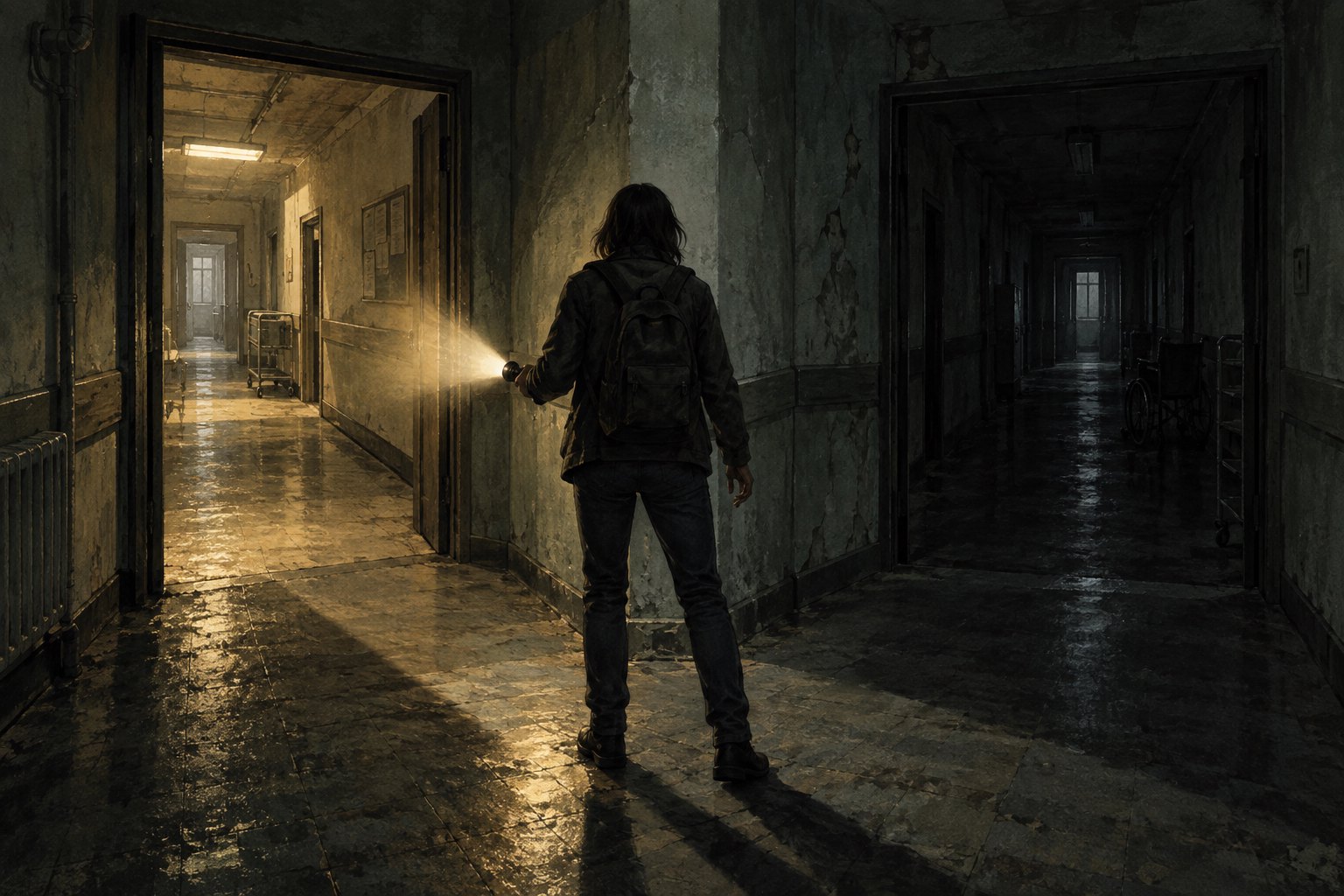
This is where I would locate the strongest defense of an original Resident Evil protagonist. The character should give the film an angle on its world that familiar figures might not provide. That is a standard for judging the approach, not a claim that introducing someone new automatically meets it.
The experience of playing needs a cinematic equivalent
Cregger’s emphasis on the playing experience raises a difficult practical question. A player participates in a decision. A movie audience observes one. The emotional connection between those activities has to be constructed; it cannot be assumed because the setting looks recognizable.
In a hypothetical game sequence, choosing the wrong passage may feel frightening because the player committed to it. On film, the same movement needs legible stakes. We need enough information to understand why the character takes that route, enough uncertainty to fear the choice, and enough continuity to remember what the decision costs.
That gives viewers something more useful to examine than a checklist of references. Does the film make alternatives understandable? Do mistakes change what becomes possible afterward? Does escape depend on a character learning something, or merely on a convenient interruption?
These questions concern cinematic craft as much as fidelity. Our discussion of how Resident Evil can make survival feel frightening explores the related issue of translating vulnerability into screen tension. Here, the consequence for the backlash debate is straightforward: claims about preserving an experience should be evaluated through identifiable filmmaking choices.
Creative freedom does not settle the argument
I favor allowing adaptations to make substantial changes. Literal reproduction can preserve events while losing the reasons those events mattered. A movie needs room to reorganize information, shift emphasis, and create relationships that work within its own running time.
Still, invoking creative freedom is the beginning of an explanation. The useful next question is what a particular change makes possible. Does it sharpen a character’s dilemma? Give the audience a revealing perspective? Produce an emotional effect that a more familiar approach would struggle to achieve?
Fans deserve the same level of specificity. A criticism becomes stronger when it explains what has been lost and why that loss affects the viewing experience. The absence of a favorite figure may be disappointing. Showing that the replacement leaves the story without a compelling relationship makes a fuller argument.
The deeper dispute is about trust
The most interesting issue behind Cregger’s surprise is the trust a franchise name asks audiences to extend. It promises some continuity with an experience they value. An adaptation can renegotiate that promise, but viewers are entitled to ask what survives the negotiation.
For me, the persuasive answer would come from character: understandable choices, distinctive reactions, and consequences that make survival matter beyond the next shock. Familiar faces can carry those qualities. New faces can discover them. Either approach needs to make the audience care.
Cregger’s intentions help explain his position, and disappointed fans can explain theirs. The film’s artistic case ultimately depends on whether its departures produce something worth following. The most productive review will identify that achievement—or its absence—with the same precision it brings to a recognizable reference.
Original content by this site's editorial team. Published: September 19, 2026 at 10:59:11 PDT (Los Angeles time)