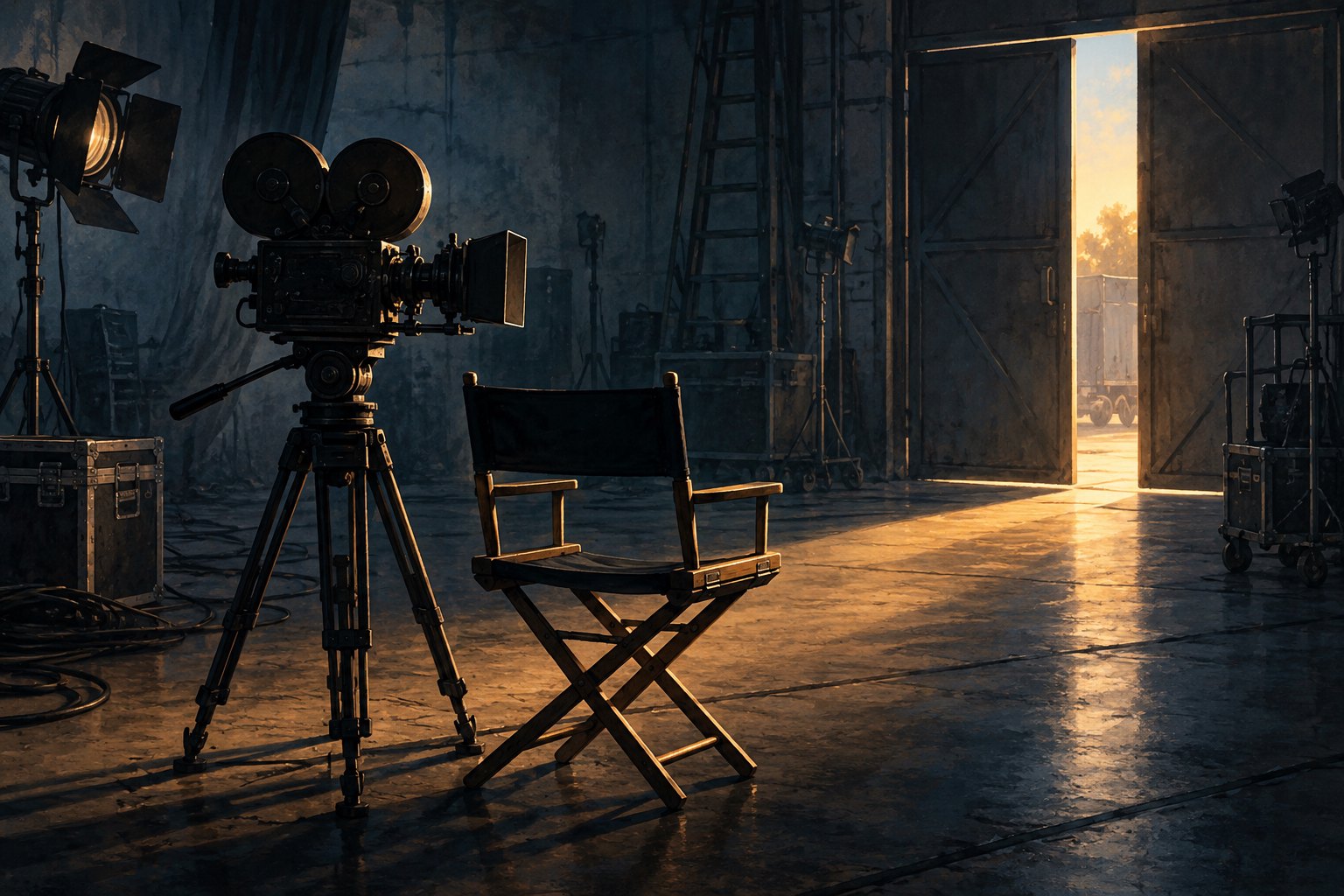
Primetime becomes more interesting when you understand how deliberately its apparent disorder was constructed. The cameras, the unpredictable performances, and the moments allowed to continue beyond the script all bear on the same question: what happens when someone becomes both a journalist and the central attraction of his own show?
The most revealing behind-the-scenes details concern that tension. Director Lance Oppenheim and cinematographer David Bolen describe a production that made room for instability while Robert Pattinson played a man associated with composure. My reading is that this conflict offers the clearest route into the film: the host needs to control the encounter, while the filmmaking keeps challenging our confidence in that control.
Spoiler notice: This analysis discusses the premise, character relationships, dialogue, and broad trajectory of Primetime. It draws on published production interviews; interpretations below concern the film’s dramatized characters, not verified private motives of their real-life counterparts.
Chris Hansen’s ambition gives the spectacle a center
A24 identifies Oppenheim as the director and Pattinson as the film’s lead. Set in 2006, the story follows To Catch a Predator host Chris Hansen pursuing television history, with a disastrous operation turning that ambition toward catastrophe. That premise makes professional success inseparable from the consequences of manufacturing an event for an audience.
One revealing line, quoted in Zachary Lee’s interview with the director and cast, is Hansen’s declaration to producer Andie, played by Merritt Wever: “I’m gonna be bigger than Lost!” The comparison makes his ambition unusually legible. A news program’s reach has become comparable to the popularity of a scripted entertainment phenomenon.
To my mind, the telling word is “bigger.” It supplies a measure of achievement without requiring a discussion of what that achievement accomplishes. Audience size is countable; public benefit is harder to demonstrate. A character who confuses those measures can experience every professional advancement as moral confirmation.
This is where a character-centered reading becomes useful. We can recognize the seriousness of the crimes under investigation while questioning the rewards attached to broadcasting a confrontation. Those judgments can coexist. The film’s dramatic problem depends on their coexistence.
Pattinson studied the frame as part of the performance
In his interview with The Credits, Bolen described Pattinson checking the monitor before shots to understand the framing and the placement of light and shadow. He could then shape his movements around what the camera would reveal. Bolen also said Pattinson varied his performance so much that the filmmakers abandoned their shot list on the first day.
That production detail changes how I would assess the character’s physical authority. A face emerging from shadow may communicate calculation, vulnerability, or a desire for attention. Knowing that the actor worked with the frame makes such a moment worth examining as a dramatic choice, rather than treating it only as attractive lighting.
There is a useful distinction here between the actor’s craft and the character’s psychology. Pattinson understanding a camera does not prove that every gesture by his Hansen is consciously staged. It creates the possibility of ambiguity: someone can become so practiced at appearing authoritative that the performance no longer feels like a performance to him.
The strongest question to carry through these scenes is therefore practical: does Hansen seem to be responding to another person, or preparing the response an audience will remember?
The different cameras make certainty harder to maintain
Oppenheim told ShotDeck that the production used more than 12 camera formats and 25 camera bodies. Bolen separately explained that the principal digital footage was given additional texture through a transfer to 16mm film. Vintage broadcast equipment supplied another visual register, including pronounced color shifts used for passages connected to Hansen’s subjectivity.

These choices invite viewers to pay attention to the status of an image. A degraded picture can suggest evidence, memory, or something accidentally captured. A richly colored picture can suggest sensation or fantasy. Neither appearance guarantees truth. The interesting effect comes from making us notice how quickly we assign credibility to a visual texture.
My reservation about this approach is also its central critical test. Unsettling photography can deepen an encounter, but it can also instruct us to distrust someone before the drama has earned that distrust. The useful question is whether a change in format reveals a change in perspective, or merely makes an already troubling situation look more sinister.
Decoy Dan turns acting into a moral problem
Skyler Gisondo’s Dan occupies a particularly complicated position: an adult performer playing a young teenager within the television operation. BuzzFeed reports that Gisondo’s real audition became Dan’s on-screen audition. That small overlap between casting and storytelling makes the character’s desire to perform especially relevant.
Hansen tells Dan, “You’re cleansing the world of an ancient evil,” another line documented in Lee’s cast interview. The language offers more than encouragement. It gives the job a grand purpose, potentially making doubts about the work feel like doubts about the mission itself.
I read this relationship as a struggle over who gets to define participation. For an ambitious performer, being useful to a powerful mentor can feel like progress. But usefulness does not necessarily bring authority over the circumstances in which one works. Dan’s role makes that imbalance visible without requiring every participant to possess the same motives.
That distinction also connects with our discussion of why a character needs an independent perspective within a powerful person’s story. Supporting characters become more revealing when their hopes cannot be reduced to what the central figure needs from them.
Letting scenes run complicates the appearance of spontaneity
Oppenheim explained to ShotDeck that he sometimes kept filming after actors finished the scripted material. In the edit with Daniel Garber, uncertain or unplanned moments could take precedence over written exchanges. This gives the production’s documentary background a concrete expression: attention to behavior that continues after the expected dramatic beat.
The critical value of that method lies in the possibility of unresolved reactions. A pause can leave room for several feelings at once. It can prevent a character from becoming merely the delivery system for a point the screenplay wants to make.
Still, spontaneity remains something an editor selects. An unscripted moment is not automatically a more truthful account of a historical person. It may be an effective piece of characterization inside a fictional interpretation. Preserving that distinction is essential to discussing a movie built around recognizable people.
The deeper question is who controls the meaning
For me, the production reporting makes Primetime most compelling as a study of authorship. Hansen presents an encounter; Dan performs within it; the television apparatus turns it into a story. Oppenheim’s team then constructs another story around that process. Each level involves choices about visibility, emphasis, and whose discomfort deserves attention.
That connects with the question explored in our commentary on the difference between putting people on screen and giving them a voice. Being seen can confer influence, but it can also mean surrendering control over how an experience is understood.
The behind-the-scenes details are valuable because they sharpen that distinction. They encourage us to examine the construction of authority rather than simply responding to its appearance. The lasting interpretive question is whether the person arranging the spectacle can still recognize consequences that do not fit the story he wants to tell.
Original content by this site's editorial team. Published: October 6, 2026 at 20:36:59 PDT (Los Angeles time)