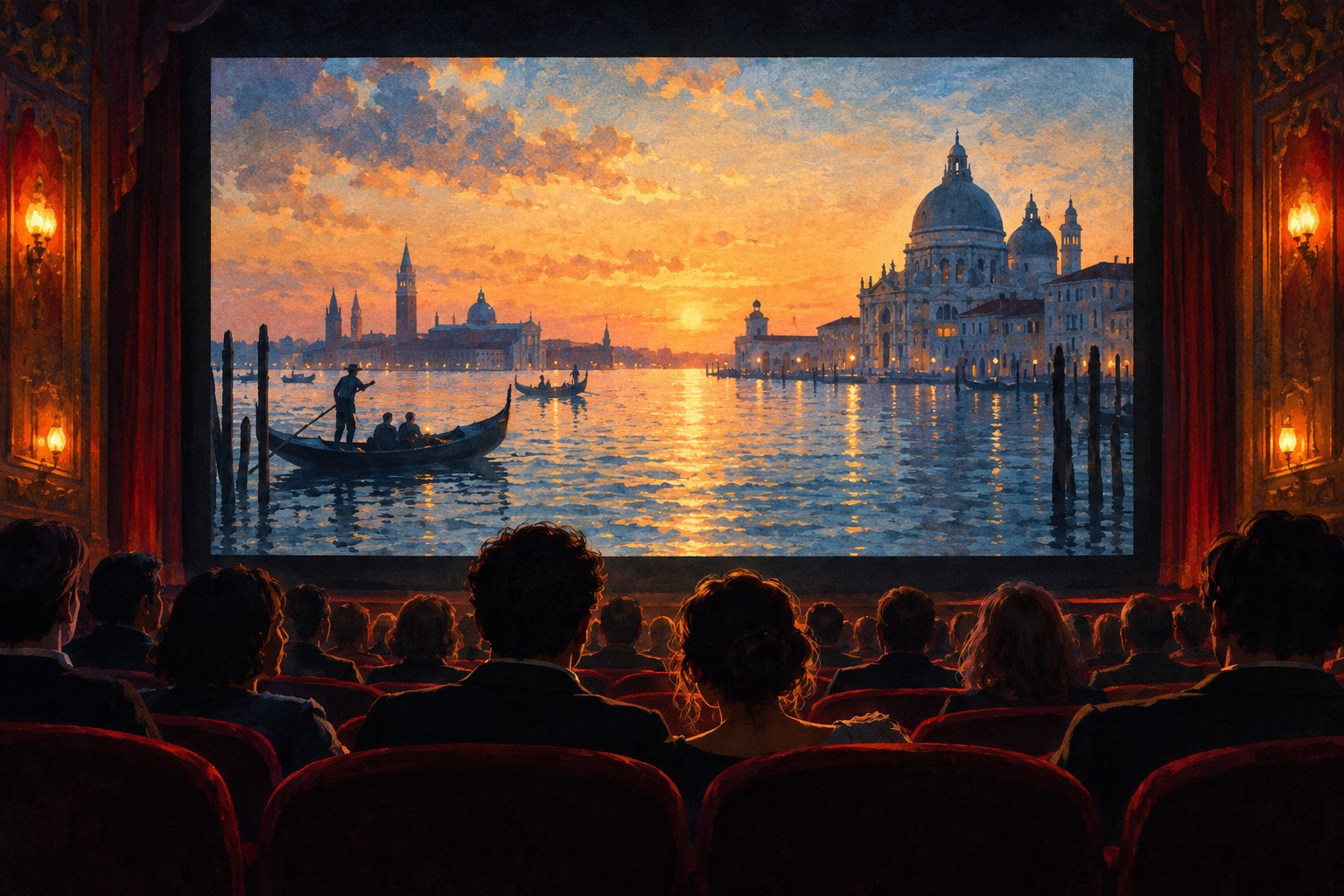
The Venice Film Festival, “Writing in Public,” and lunchtime chamber music make an intriguing combination in YaleNews’s Humanitas coverage. For movie lovers, their connection offers a useful question: what happens between encountering a work of art and deciding what it means? A screening requires attention, writing makes a response available for discussion, and music rewards the ability to hear relationships developing over time.
My reading of this grouping is that it offers three complementary approaches to film criticism. Venice supplies the occasion to consider judgment. Public writing raises the responsibility of explaining that judgment. Chamber music suggests a way to notice the interplay that makes a performance work. This is cultural commentary on those connections, rather than a review of an individual festival title.
Venice and the difference between recognition and understanding
A festival name can become a shortcut in conversations about movies. It gives viewers a reason to investigate a title, but it cannot explain what they will experience. Even an enthusiastic recommendation leaves the central questions unanswered: whose experience organizes the story, how does the film guide our sympathies, and what does its style allow us to understand?
For me, the most useful response to festival coverage begins by separating curiosity from conviction. A film can sound fascinating because of its subject, its setting, or the discussion around it. Whether it succeeds depends on decisions visible and audible in the finished work. A striking premise still needs a convincing relationship between action, perspective, and consequence.
That distinction matters especially when discussing characters. Calling a protagonist complicated tells a reader very little. A stronger analysis identifies the competing obligations that make a decision difficult, then examines how the film communicates those pressures. Does the camera remain with the person making the choice? Does an edit take us to someone who will bear its cost? Does the screenplay give both people a credible understanding of the conflict?
These questions make international film coverage more useful without pretending that every viewer must share the same taste. Festival attention can open the door. Criticism earns its place by describing what happens after we sit down and watch.
“Writing in Public” and the obligation to explain a reaction
The phrase “Writing in Public” is particularly suggestive for movie reviewing. An immediate response belongs to the viewer: boredom, excitement, discomfort, delight. Once that response becomes an article, it asks strangers to spend time with it. The writer owes them enough detail to understand how the conclusion was reached.
Consider the familiar complaint that a film feels slow. That may be a completely honest reaction, but it remains incomplete as criticism. Long scenes might withhold necessary information, repeat an established emotional point, or make us feel the weight of waiting. Those effects deserve different evaluations. The question is what the duration accomplishes and whether that accomplishment justifies the demand on our attention.
The same discipline applies to praise. Describing acting as powerful should lead to an observable choice: a change in vocal rhythm, an interrupted gesture, a gaze that arrives after the dialogue has moved on. Specificity lets readers test an interpretation against their own experience. It also makes disagreement more interesting than a contest over who appreciated the movie correctly.
Context has a place in that process, provided it leads back to the work. Our commentary on Bill Hader’s directing ambitions and influences considers a related question about the relationship between an artist’s background and the expectations surrounding a film. Biography can sharpen curiosity; the finished movie must still support the judgment.
What chamber music can teach us about ensemble acting
Lunchtime chamber music introduces a different scale of attention into this conversation. As an analogy for watching movies, a small ensemble is especially productive: it encourages us to follow how one contribution changes another. A performance can become expressive through timing, restraint, and response as much as through an arresting solo passage.

Apply that listening habit to a conversation scene. The person speaking may carry the information while the person listening carries the emotional change. A slight delay before answering can suggest resistance or uncertainty. Whether either interpretation holds depends on the surrounding performance, the established relationship, and what the next exchange reveals.
Editing participates in that relationship. Holding both actors in the frame allows us to choose where to look. Cutting to a listener directs us toward a particular response. Remaining on the speaker can deny us confirmation that the words have landed. These choices shape our access to the characters, even when the dialogue itself is straightforward.
Sound deserves the same care. Before praising a score for creating emotion, ask what the scene gives us without it. Then consider what the music adds: reassurance, tension, distance, perhaps a feeling that contradicts the visible action. I find criticism more persuasive when it describes that interaction than when it treats an affecting soundtrack as automatic evidence of an affecting drama.
Follow a character’s knowledge before judging the choice
The connection among watching, writing, and listening becomes most practical when a movie asks us to evaluate a character’s conduct. Viewers may possess information that the character lacks. A review that forgets this difference can mistake restricted knowledge for stupidity, or interpret fear as indifference.
A useful approach is to reconstruct the decision from inside the scene. Identify what the character knows, what outcome they want, and what alternatives they can reasonably perceive. Then examine what the film gives the audience beyond that perspective. The gap may create suspense, irony, sympathy, or justified frustration.
Perspective also determines whose experience becomes legible at all. Our discussion of Nuisance Bear and the assumptions contained in its title approaches that problem through the language used to frame a subject. A description can quietly assign authority before an argument begins.
None of this requires excusing a character’s actions. Understanding the conditions of a choice can make an ethical judgment more precise. It can also expose a weakness in the filmmaking if the story demands sympathy that its scenes have not earned.
A better conversation after the screening
The deeper connection I see in this Humanitas grouping is the movement from private attention to shared interpretation. The festival, the public-facing page, and the musical ensemble suggest different forms of encounter. Together, they invite a criticism that remains alert to how meaning develops between people.
After a film, try beginning the conversation with one moment that changed your understanding of someone on screen. Describe the action, the performance, and the information available at that point. Invite another viewer to explain what they noticed. A difference in attention may reveal more than a difference in ratings.
That is the standard I would bring from this cultural pairing back to movie reviews: observe closely enough to make a specific claim, explain it clearly enough that someone else can challenge it, and remain willing to hear a detail you missed. The reward is a fuller encounter with the film—and a more worthwhile conversation when the lights come up.
Original content by this site's editorial team. Published: October 19, 2026 at 20:06:42 PDT (Los Angeles time)