John Constantine is the subject of a movie reportedly in development at DC from Francis Galluppi, whom Deadline identifies with Evil Dead Wrath. That is an intriguing combination of character and filmmaker, but the development status matters: this is an opportunity to consider an adaptation’s direction, not a finished movie whose performances, scares, or ending can already be judged.
The most interesting question is what the film might ask audiences to feel about Constantine. Supernatural danger can supply an immediate hook. A more lasting movie would make viewers consider the consequences of trusting the person who seems best equipped to confront it. My hope for this project is a horror story in which escaping the threat and doing the right thing become meaningfully different challenges.
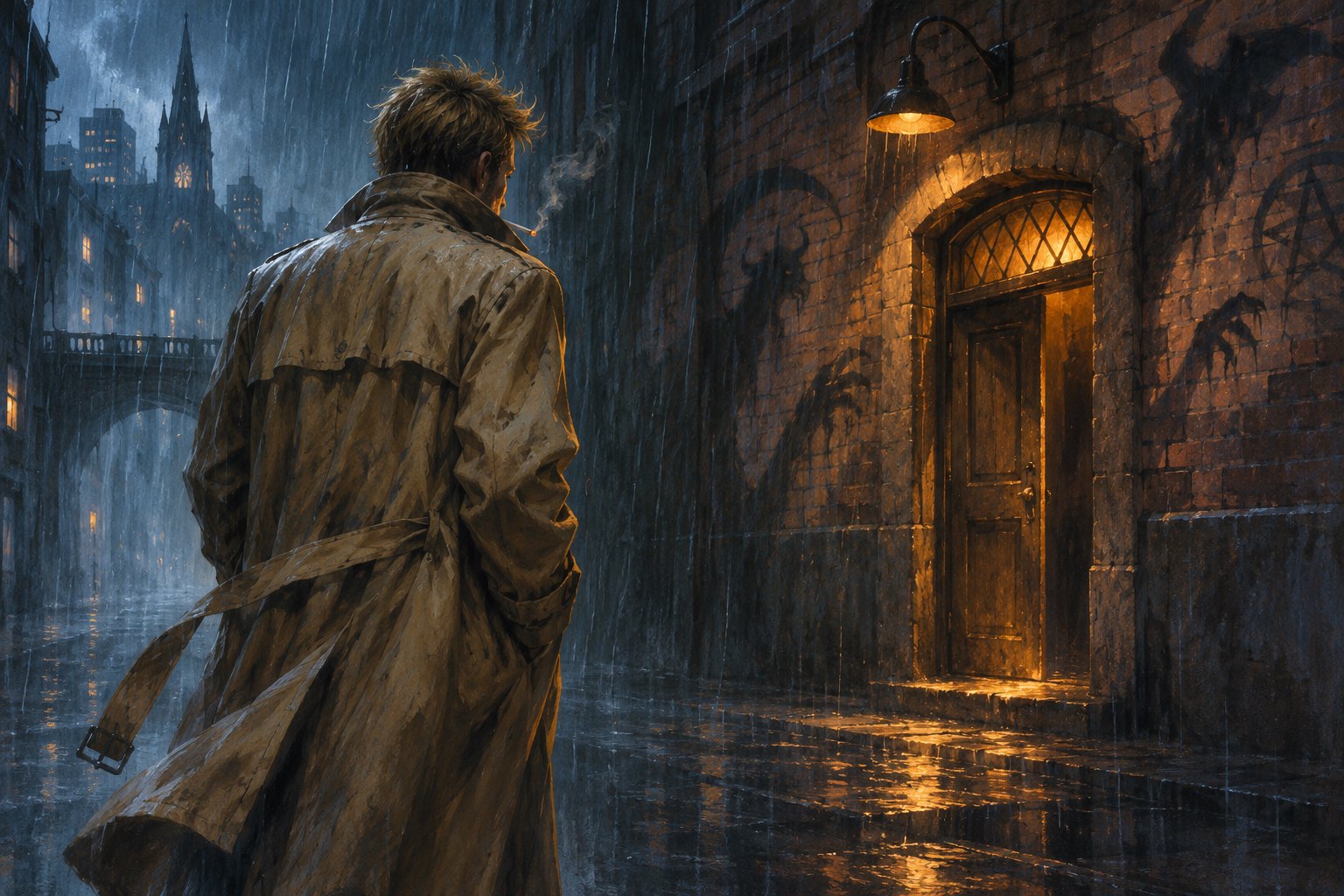
Spoiler-free development commentary: No scenes, dialogue, casting choices, or plot developments from the proposed film are established here. The illustrations are conceptual artwork, not production images.
What the Constantine development report establishes
The central reported information is specific and limited: a John Constantine movie from Galluppi is in development at DC. The association with Evil Dead Wrath supplies a horror connection, but it does not establish what this project will look like, how violent it will be, or which creative choices it will make.
That distinction also applies to franchise questions. The announcement alone does not settle casting, continuity, the relationship to other screen versions, or a release timetable. Readers should not treat the words “in development” as evidence that filming has started or that a completed film is approaching theaters.
There is still something worth discussing before those details arrive. An adaptation begins with decisions about emphasis: whose experience organizes the story, what information the audience receives, and what a victory costs. Those decisions will tell us more about this Constantine movie than a collection of familiar visual references could.
The strongest starting point is a problem expertise cannot solve
For a character-centered approach, I would want the screenplay to distinguish knowing how to confront a supernatural threat from knowing how to treat another person. Technical competence can make a protagonist compelling. It cannot, by itself, make his decisions morally persuasive.
A useful dramatic test would be whether someone affected by Constantine’s choices can reasonably disagree with him. If every objection exists only to delay the expert until everyone admits he was right, the supporting cast becomes an obstacle course. The more interesting possibility is that his practical judgment works while his treatment of another person remains indefensible.
This is a creative criterion, not a description of Galluppi’s story. It offers a way to assess the eventual film without reducing fidelity to wardrobe, iconography, or the number of recognizable names. Character emerges through decisions under pressure, especially decisions that the screenplay refuses to excuse.
We explored a related adaptation question in our discussion of why character perspective matters in the Magic: The Gathering movie. Elaborate fictional worlds become accessible when viewers understand what someone wants and what pursuing it might destroy.
Let other characters experience the cost
A Constantine film organized entirely around its central figure’s cleverness could be entertaining and still feel emotionally narrow. The people who encounter him need their own understanding of events. Someone seeking help, for example, might judge success differently from the person providing it. That difference can generate drama without requiring another monster or a larger climax.
The crucial issue is agency. Would another character receive enough information to make a meaningful choice? Could that person refuse the proposed solution? Would the film remain interested in the refusal after it complicated the protagonist’s plans? These are questions for the eventual screenplay, not predictions about its plot.
Giving those questions room would make the horror more intimate. A dangerous encounter can end when a threat disappears. A damaged relationship continues into the next scene. That lingering consequence gives an audience something to carry beyond the immediate shock.
It also changes how a leading performance should work. Confidence becomes more interesting when another actor can unsettle it. Humor gains an edge when the listener does not find it reassuring. Silence can reveal that a successful intervention has failed to restore trust.
What the Evil Dead Wrath connection can—and cannot—tell us
Galluppi’s association with Evil Dead Wrath naturally draws attention to the project’s horror possibilities. It would nevertheless be premature to assume a particular rhythm, level of gore, or balance of comedy and dread. A credit connects a filmmaker to a project; it does not function as a complete aesthetic forecast.
For this adaptation, my preference would be tension that makes the audience work alongside the characters. A room should have understandable geography. A threat should have limits that matter. A proposed escape should require a decision, allowing suspense to develop from what someone might do rather than from withholding every useful piece of information.
Restraint and spectacle could both serve that approach. A large supernatural image can express how powerless a character feels, while a close-up can expose the instant someone decides to conceal the truth. The important relationship is between the visual choice and the human action it clarifies.
That is also the principle behind our look at the character relationships that could shape Violet: promising names attract attention, but the finished film must give their presence dramatic purpose.
What meaningful progress would look like
The next useful information would clarify the project’s actual creative commitments. A defined premise could reveal the central conflict. Casting could suggest the balance between authority and vulnerability. Footage, if eventually released, could show whether the film gives conversations and reactions as much attention as supernatural imagery.
Until then, there is no responsible basis for quoting memorable lines from this version, explaining its ending, or identifying its Easter eggs. Those pleasures depend on material that can actually be examined. Familiarity with other interpretations should not become a substitute for evidence about this one.
The deeper opportunity: survival without moral escape
The most promising interpretation of this development is an opportunity to make supernatural horror carry an argument about responsibility. My ideal Constantine film would understand that surviving a crisis does not automatically justify every choice made inside it. The ending could resolve the immediate danger while leaving the audience with a harder judgment about the person who resolved it.
That would give the proposed movie an emotional identity beyond its development headline. Galluppi’s connection makes the project worth following; the eventual measure of success will be whether Constantine’s choices remain troubling, revealing, or moving after the spectacle ends. A frightening world gets us into the theater. A difficult human decision gives us something to discuss afterward.
Original content by this site's editorial team. Published: November 4, 2026 at 17:57:28 PST (Los Angeles time)