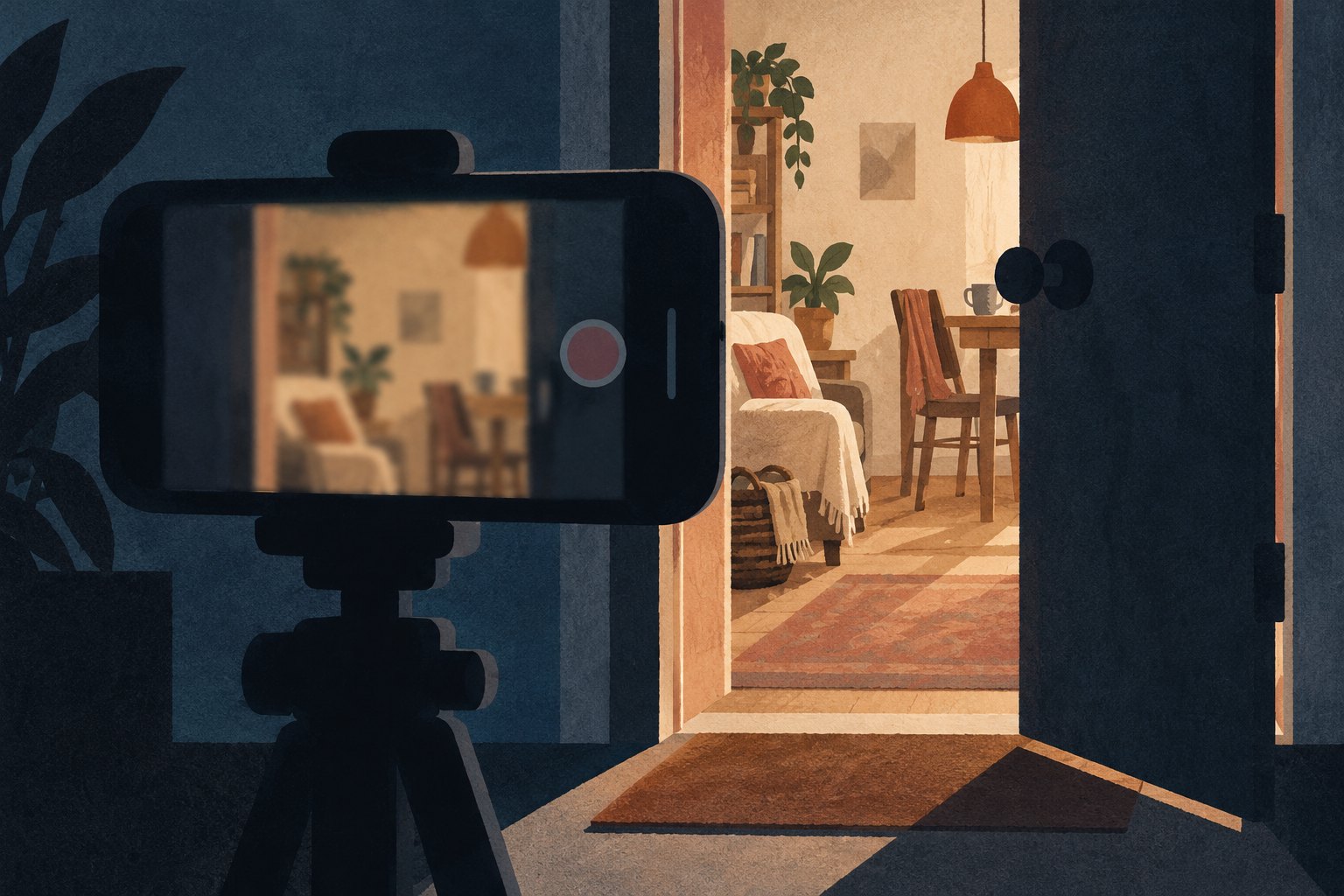
Content creators described as “English nationalist” have filmed themselves inside a house accommodating asylum seekers, according to The Guardian. The reported act raises a question that belongs squarely within screen criticism: when people turn someone else’s home into the setting for their own on-camera story, whose perspective does the audience receive?
A recording can establish that something happened in front of a lens. Its meaning requires more work. Who chose the setting, who controls the account, and who gets to explain their presence all affect what viewers understand. In this case, the distinction between showing a place and understanding the people who live there deserves particular attention.
This is commentary on the reported filming and its storytelling implications, rather than a review of a feature film or a shot-by-shot assessment of the footage.
What the reported filming establishes—and what it leaves open
The central reported fact is limited: creators associated with the description “English nationalist” filmed themselves in asylum seekers’ housing. That description alone does not establish the circumstances of access, the residents’ understanding of the recording, or what any individual intended. It also cannot substantiate conclusions about the residents’ lives or asylum claims.
These distinctions matter because a compelling visual premise can encourage viewers to fill in missing information. A camera inside a house may feel like privileged access. But proximity supplies neither a complete explanation nor automatic credibility. The ability to record a room does not make every accompanying assertion about that room true.
There is also no reason to impose the expectations of a conventional movie review on this event. These are real people and a real domestic setting. Inventing dialogue, assigning character arcs, or treating uncertainty as suspense would undermine the very scrutiny the situation requires.
Self-filming puts the creator at the center
When creators film themselves, they can occupy two positions at once: participant and storyteller. Their actions become the material, while their framing helps determine how audiences interpret those actions. That arrangement deserves scrutiny regardless of the filmmaker’s politics.
Consider the structure of an encounter video in general. The person holding the camera can decide when recording begins, which direction the lens faces, and what question starts the exchange. If the material is edited, further choices determine duration, sequence, and emphasis. These are possibilities inherent in the format, not claims about particular cuts in this footage.
For viewers, the result can resemble a familiar dramatic alignment. We follow one person through a space and gradually adopt that person’s priorities. Whatever they investigate seems important; whoever interrupts them can appear to obstruct the story. Yet a resident’s priorities may be entirely different. Understanding who is present, protecting personal space, or declining to participate may matter more than answering an audience-facing question.
My critical concern is that the creator’s ability to organize the experience can be mistaken for the authority to define it. Screen presence is persuasive. It still needs evidence behind it.
A home has meaning beyond what the camera shows
A domestic interior is an unusually loaded setting. In fiction, filmmakers use rooms and possessions to suggest character, history, or conflict. Viewers learn to interpret an object on a table or a closed door as significant. Applying that habit to footage of strangers’ homes can produce unwarranted conclusions.
Ordinary possessions do not explain a person’s circumstances. A brief view of accommodation cannot establish how decisions about that housing were made. Even an accurately recorded detail can become misleading when presented as representative of a larger system without supporting evidence.

The distinction between visibility and understanding also informs our discussion of observation and self-presentation in documentary storytelling. Access gives a filmmaker material. Interpretation requires context, and context includes the limits of what the camera can reveal.
With asylum seekers’ housing, the domestic setting should sharpen that distinction. People do not become reliable illustrations of an entire political argument simply because a lens can reach their living space.
Taking residents’ perspectives seriously without inventing them
A responsible analysis should consider the people whose home becomes content. It should also resist claiming to know what they thought or felt. Sympathy does not justify invented testimony any more than suspicion does.
The useful questions are practical. Did residents understand who was recording and why? Could they choose whether to participate? Were they able to explain themselves in their own terms? Could an audience distinguish their account from someone else’s description of them? These questions identify information needed to evaluate the filming; they are not assertions that particular answers have been established.
Consent also deserves more careful thought than the mere presence of a camera. Agreeing to a conversation, understanding that it is being recorded, and understanding how it may be published are different matters. An ethical assessment should examine those differences without pretending to deliver a legal judgment.
Our commentary on filmmaking, testimony, and accountability addresses a related question: whether the people represented have room to complicate the story being told about them. That is a useful standard here, too.
How to evaluate the images without accepting every inference
Viewers can assess this kind of material more carefully by separating several layers of meaning. The goal is to identify what the recording supports and where interpretation takes over.
- Distinguish observation from allegation. Something visible in a room may be observable; a claim about why it is there may require independent support.
- Identify who defines the encounter. Notice whose questions organize the story and whether other participants can introduce concerns of their own.
- Look for missing context. Events before and after a recorded exchange can change its meaning. Uncertainty should remain uncertainty.
- Examine the public-interest argument. Ask what the footage helps establish about an issue and whether showing private details is necessary to establish it.
- Separate confidence from credibility. A forceful delivery can make a claim memorable without making it better supported.
These standards apply across political positions. They become especially useful when a recording invites an audience to make broad judgments about people who have little control over its presentation.
The deeper issue is who gets to define belonging
The reported combination of nationalist identity, self-filming, and asylum seekers’ housing brings the question of belonging into the frame. A home can be presented as someone’s ordinary living space, or made to function as an exhibit in someone else’s argument. The camera’s presence does not settle which interpretation is justified.
My view is that worthwhile scrutiny must preserve the distinction between examining a housing system and turning its residents into symbols. Institutional claims require institutional evidence. Individual people deserve an account that allows for the complexity of their circumstances.
The strongest screen criticism asks what a work enables us to understand. Applied here, that means looking beyond the drama of access to the quality of the explanation. A camera can bring an audience into a house. Whether it brings that audience any closer to understanding the people connected to it is a separate, more demanding question.
Original content by this site's editorial team. Published: October 14, 2026 at 11:40:03 PDT (Los Angeles time)