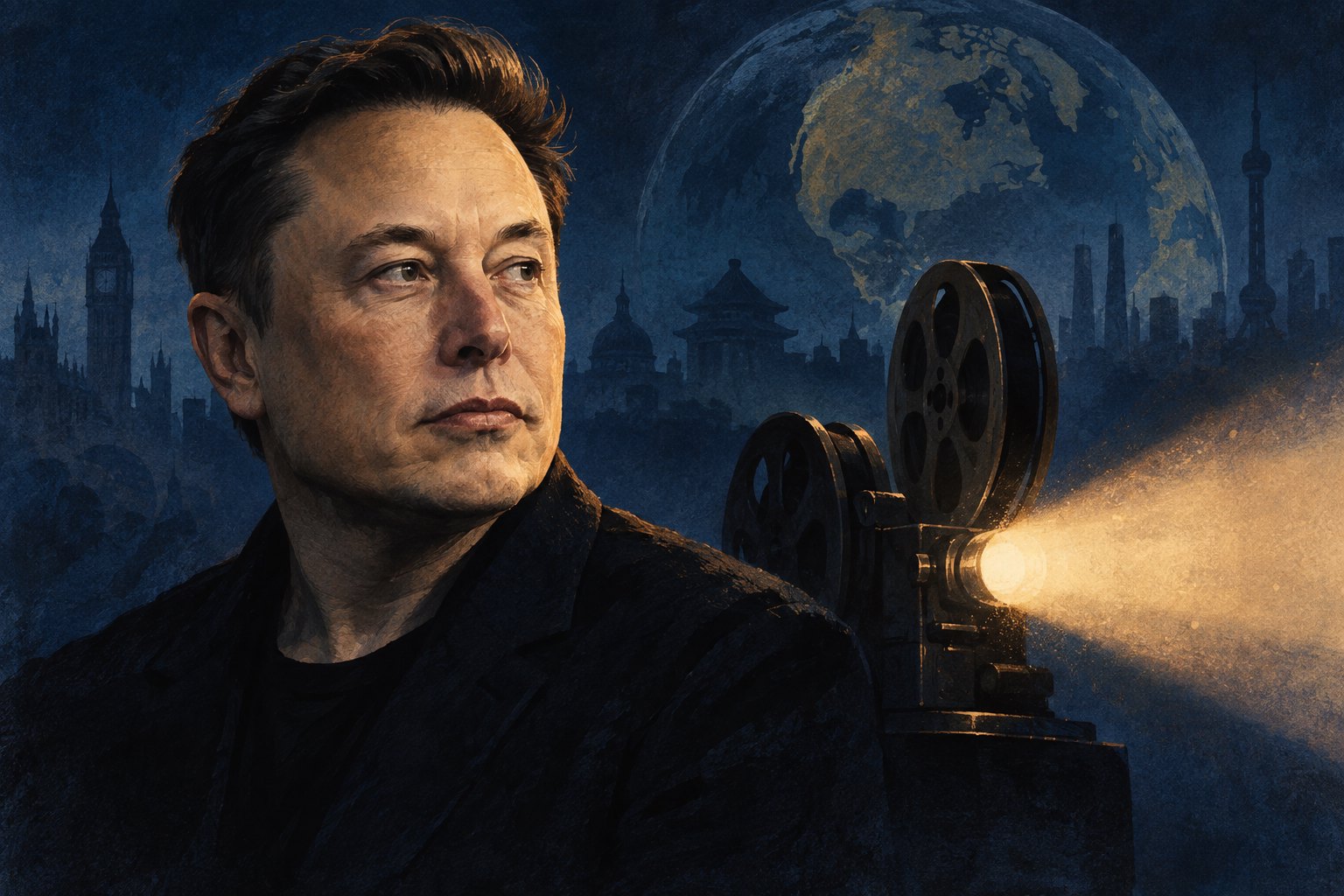
A sharply critical film about Elon Musk is approaching its U.S. release amid concerns overseas, according to The New York Times. That combination puts two questions before prospective viewers: what argument will the movie make about its subject, and how widely will audiences be able to examine that argument for themselves?
Those questions belong together, but they require different kinds of evidence. A release controversy can explain why a movie deserves attention. It cannot establish whether the filmmaking is persuasive, whether individual claims hold up, or whether the portrait reveals something that headlines have missed.
This is spoiler-free commentary on the film’s approaching release and the critical questions surrounding it, rather than a review based on a screening. No scene descriptions or dialogue are presented as verified film content.
What the release news establishes—and what it leaves open
The central development is straightforward: an Elon Musk film characterized as sharply critical is nearing American release while concerns surround its arrival overseas. The distinction matters for readers trying to understand availability. An approaching U.S. release does not, by itself, establish when viewers in another country will have access.
Equally, overseas concerns do not automatically establish a ban, a canceled release, or political interference. Those are separate claims that require specific evidence. Treating uncertainty as a settled explanation would turn the distribution story into something more dramatic than the facts support.
For moviegoers, the practical distinction is between an announced release, a confirmed local booking, and a film that can actually be watched. These stages can generate similar-looking headlines while describing different levels of access. Readers outside the United States should avoid assuming that an American opening guarantees simultaneous availability elsewhere.
That separation between industry news and audience experience also informs our discussion of what a high-profile premiere tells viewers about a movie’s arrival. Public attention is one part of a release; the opportunity to see the work is another.
A critical portrait needs more than an unmistakable target
The description of this Musk film as sharply critical signals an angle, not a quality verdict. A forceful movie can be rigorous, selective, illuminating, repetitive, or several of those things at once. Its emotional temperature tells us less than the relationship between its evidence and its conclusions.
My critical preference is for a portrait that makes its reasoning visible. If a film asks viewers to reconsider a public figure, the audience should be able to follow how a statement, decision, or documented consequence supports that reconsideration. Music, juxtaposition, and editing can intensify a point, but intensity should not carry an argument that the underlying material cannot sustain.
This is particularly important when viewers arrive with strong opinions about the subject. Agreement can make weak reasoning feel convincing; dislike of the filmmaker’s position can make careful reasoning easy to dismiss. A useful review must scrutinize both reactions. The question is whether the movie earns its conclusions through what it shows and establishes.
Reading Musk as a screen subject without inventing his inner life
A character-centered approach to a film about a living person requires restraint. In fiction, dialogue, performance, and narrative structure may invite us to interpret a character’s private motivation. With a real person, an interpretation of motive remains an interpretation unless the evidence supports something more definite.
For this Musk portrait, the most revealing critical questions concern agency and perspective. How does the finished movie connect what its subject says with what he does? Does it preserve the circumstances surrounding a decision? Where it suggests a contradiction, does it give viewers enough context to assess that contradiction independently?
These are questions for evaluating the film, not descriptions of scenes it contains. They matter because a portrait can flatten its subject through either admiration or hostility. A person reduced to a symbol becomes narratively convenient, but the convenience can conceal the decisions and relationships that would make the analysis worthwhile.
Our examination of the challenge of turning a public persona into a screen character raises a related storytelling problem. Recognition gets an audience through the door. Specific behavior, competing perspectives, and meaningful consequences give that audience something to think about afterward.
Whose perspective gives the portrait its depth?
A movie centered on a prominent individual also makes choices about everyone around that individual. Other people can become independent sources of experience, or they can be used merely to reinforce the central portrait. The difference has substantial consequences for both storytelling and credibility.
When assessing the completed Musk film, viewers should consider how any participating voices establish what they know. Direct experience, documented observation, and interpretation are all potentially useful, but they are not interchangeable. A compelling speaker may offer valuable insight without being positioned to verify every conclusion associated with that insight.
The same attention should extend to disagreement. Fairness does not require mechanically matching every criticism with praise. It does require representing relevant evidence accurately and avoiding a structure in which inconvenient information disappears simply because it complicates the argument. A critical film becomes stronger when its reasoning survives complexity.

Why overseas access matters to film criticism
The overseas dimension has significance beyond scheduling. Where audiences cannot yet watch a film, publicity and secondhand accounts occupy the space that direct engagement would otherwise fill. People can debate whether a work is fair or effective before they have access to the material necessary to judge either proposition.
That creates a risk of circular criticism: supporters treat the controversy as proof of the movie’s importance, while detractors treat the same controversy as proof of its agenda. Neither reaction tells us much about the quality of a sequence, the strength of an evidentiary claim, or the coherence of the film as a whole.
Wider access would allow more viewers to test those competing accounts against the work itself. This is why distribution deserves attention without becoming an automatic endorsement. Wanting audiences to see a film and deciding that the film succeeds are distinct judgments.
The deeper question: can a portrait sharpen the viewer’s judgment?
The most valuable possibility here is a film that leaves audiences better equipped to evaluate its subject. That is a more demanding achievement than confirming an existing attitude. It requires a portrait whose particulars remain meaningful after its most forceful emotional moments have passed.
For now, the approaching U.S. release and overseas concerns make access the immediate story. The eventual critical judgment must come from the movie: its handling of evidence, its treatment of people, and the relationship between its form and its claims. The controversy explains the attention. The filmmaking will have to justify it.
Original content by this site's editorial team. Published: September 17, 2026 at 18:29:39 PDT (Los Angeles time)