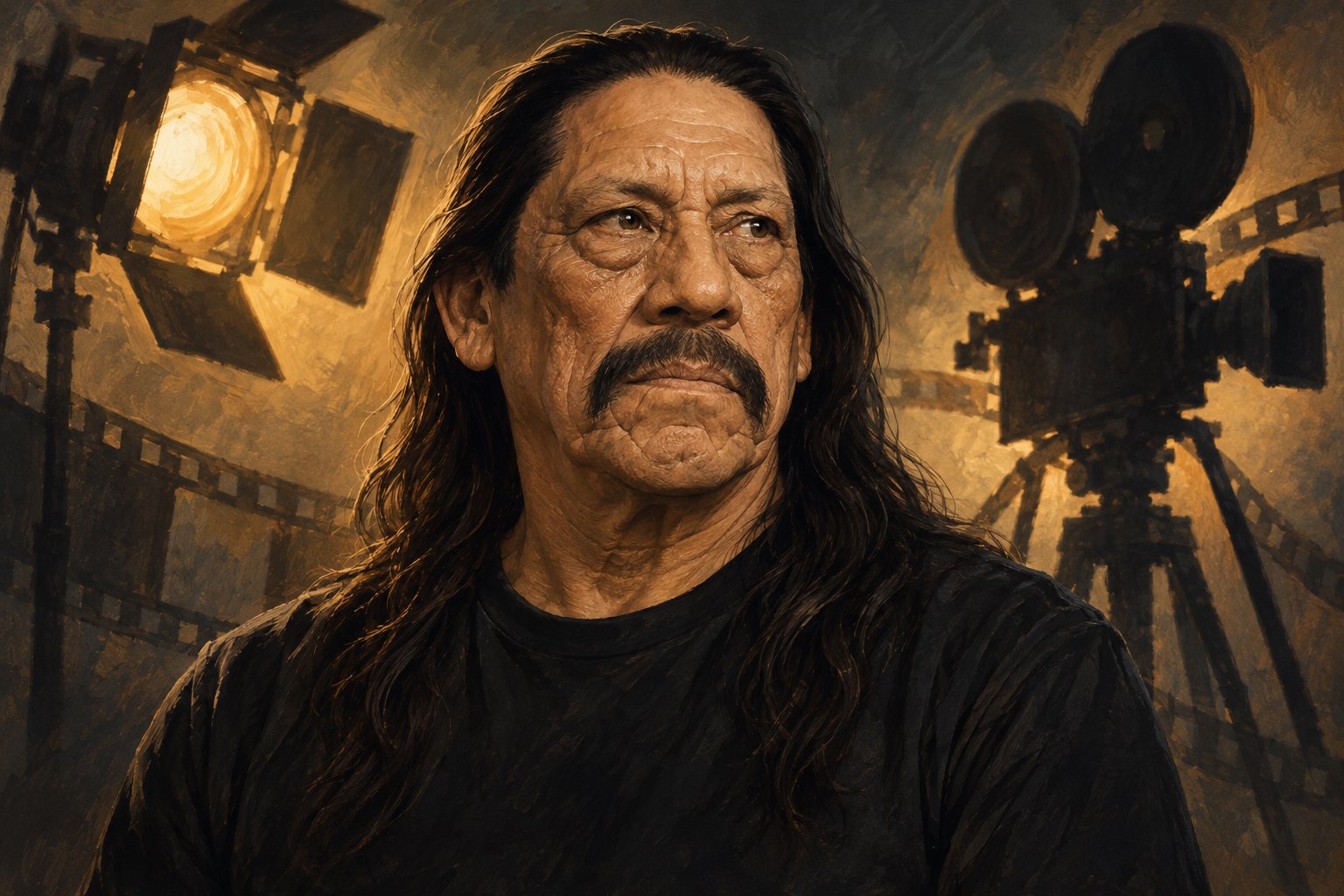
Danny Trejo says he is “not pro-ICE” after being cast in a movie from Ben Shapiro’s company, according to NBC News. His statement addresses the central question raised by that association: whether accepting a role should be understood as endorsing the politics audiences connect with the production.
The answer deserves more care than a casting announcement can provide. Trejo’s words establish his stated position. His participation establishes a professional association. Neither fact, by itself, explains what his performance means within the movie or how the finished film organizes its political argument.
That distinction matters for viewers deciding how to approach the project. It also creates a useful critical challenge: taking an actor’s declaration seriously while still examining what the work asks its audience to believe. This is commentary on the casting and its implications, not a review of the finished film. There is no basis here for evaluating specific scenes, quoting character dialogue, or assigning the movie an artistic verdict.
What Trejo’s statement actually answers
The phrase “not pro-ICE” is a direct rejection of a particular political identification. It should be reported as Trejo’s expressed position, without expanding it into a detailed account of his beliefs or treating it as proof of his intentions at every stage of the production.
Equally, appearing in a movie does not automatically make an actor the spokesperson for everyone involved in financing or producing it. Acting requires people to inhabit perspectives they may not share. A character can defend an institution, make a cruel decision, or misunderstand another person without those actions becoming the performer’s personal platform.
But the opposite shortcut is unsatisfying, too. Professional participation can have consequences beyond a performance. A recognizable actor helps a project attract attention and can make unfamiliar material feel approachable. Audiences are entitled to consider that contribution when deciding whether to support a film.
My view is that these two propositions belong together. Trejo’s statement deserves an accurate hearing, and his casting remains open to scrutiny. Criticism becomes weaker when it assumes that one must cancel out the other.
Why the company connection matters to viewers
The reference to Ben Shapiro’s company gives the casting a context beyond ordinary entertainment news. For readers who associate Shapiro with a political outlook, the connection may influence expectations before a trailer, a scene, or a performance enters the discussion.
That is a reasonable starting point for questions. It is a less reliable endpoint for film criticism. Knowing who stands behind a production can help explain why viewers approach it cautiously, but it cannot establish the precise meaning of an unseen sequence or the quality of an actor’s work.
There are also different decisions at stake. A viewer choosing where to spend money can weigh a company association heavily. A reviewer claiming that a film endorses a specific position needs to explain how the film expresses that position. Those decisions overlap, but they require different kinds of evidence.
This is related to the problem explored in our commentary on how a famous person’s endorsement shapes expectations for Digger. Public associations can frame a viewing experience powerfully. They still leave the film’s actual achievements and failures to be demonstrated.
The character is where a serious review must begin
For this project, the most productive eventual analysis will start with Trejo’s character: what that person wants, what choices are available, and what happens when those choices affect someone else. A character’s dramatic function tells us more than the mere presence of a familiar face.
Consider the difference between a character who reaches a conclusion after confronting difficult evidence and one whose purpose is simply to approve another character’s actions. Both might deliver a similar line. Only the surrounding story reveals whether that line expresses an earned judgment, a mistake, a compromise, or a message the screenplay wants accepted without examination.
Those are critical possibilities, not descriptions of Trejo’s role. Without verified scenes, assigning any of them to this film would manufacture the very evidence a review should investigate.
The same standard applies to character identity. A film may give someone substantial screen time while allowing that person little independent judgment. Conversely, a brief supporting role can introduce a perspective that unsettles the whole story. The important question is how much meaningful agency the writing and performance provide.
Our discussion of why character relationships matter more than a familiar casting choice in Batman Beyond approaches a different project through the same principle: the actor attracts attention, but the character’s place in the drama determines what that attention ultimately serves.

A performance’s meaning extends beyond its dialogue
Even a carefully developed character does not control a film’s argument. Editing, framing, sound, and the distribution of information can change how viewers interpret the same action. A close-up invites attention to one person’s fear; a distant shot can make another person’s fear difficult to register.
A film dealing with institutional power can also direct sympathy through what it chooses to explain. Whose circumstances receive context? Whose actions remain mysterious? Who gets a quiet scene that establishes a life outside the immediate conflict? These choices can matter more than an explicit speech about right and wrong.
This is why memorable dialogue should be examined within a sequence rather than collected as proof of a movie’s politics. Trejo’s “not pro-ICE” statement is a public comment, not a line from the film. Turning it into a substitute for character analysis would blur two different subjects.
A useful review would therefore trace the relationship between performance and presentation. It would ask whether Trejo’s expressions, pauses, and decisions complicate the story, and whether the surrounding filmmaking preserves that complexity. Those judgments require the actual work.
How to assess the controversy without inventing certainty
Readers can keep the discussion grounded by separating three questions:
- What has Trejo said? He has publicly rejected being identified as pro-ICE.
- What does the casting establish? He has a professional connection to a movie from Shapiro’s company.
- What does the movie argue? That requires examination of its narrative, characterization, and filmmaking, rather than inference from the first two answers.
This approach does not require anyone to suspend personal values. It asks that conclusions remain proportionate to evidence. Someone can object to the association without claiming to know the actor’s private motives. Someone can accept his statement without declaring the project politically harmless.
The deeper issue is who controls a performance’s meaning
Trejo’s situation highlights a tension built into collaborative filmmaking. An actor supplies a face, a voice, and a human interpretation. The finished production places those contributions within a larger structure that the actor does not necessarily control.
That gap makes both blanket condemnation and blanket absolution inadequate. Personal belief, professional responsibility, and artistic meaning are connected, but they are not interchangeable. The strongest criticism explains those connections instead of assuming them.
Trejo has answered a question about his stated allegiance. The film must eventually answer a different question through its treatment of people: whose humanity it recognizes, whose choices it takes seriously, and whether its conclusions survive the complexity it puts on screen. That is where a defensible critical judgment begins.
Original content by this site's editorial team. Published: October 15, 2026 at 19:05:08 PDT (Los Angeles time)