
Bread and Roses makes workplace politics painfully personal: what happens when fighting for a better life threatens the fragile life a family already has? Ken Loach’s 2000 drama is the subject of Marquette’s October 14 Politics and Film event. The university’s announcement lists a screening at 5:30 p.m. in Wehr Chemistry 002, hosted by the Political Science Department. [Marquette’s event announcement](https://today.marquette.edu/2026/10/politics-and-film-bread-and-roses-2000-oct-14/)
The film earns that discussion through the conflict between two sisters. Maya believes their circumstances can change; Rosa knows what surviving those circumstances has already cost. My judgment is that their relationship gives the movie its lasting force, even when its organizing story becomes more schematic.
Spoiler warning: This review discusses Rosa’s disclosures, Maya’s actions, and the ending. The film includes sexual exploitation, strong language, and immigration-related distress.
Maya: Finding a Voice at Work
Directed by Loach and written by Paul Laverty, the film stars Pilar Padilla as Maya, Elpidia Carrillo as Rosa, and Adrien Brody as union organizer Sam. Maya arrives from Mexico and eventually joins her sister cleaning Los Angeles offices. The production’s credits and central premise are documented in the Singapore International Film Festival’s contemporary program. [Festival program](https://sgiff.com/wp-content/uploads/2025/08/SIFF-2001-1.pdf)
Maya’s energy matters because the story asks us to encounter a worker before encountering a political position. She can be impulsive, funny, curious, and impatient. Those qualities make her attraction to organizing feel like an extension of her personality: she resists being told that the available arrangement is the only imaginable one.
The office setting sharpens that resistance. Cleaners maintain spaces whose comfort and prestige belong to other people. Read through Maya’s perspective, the building becomes a lesson in conditional belonging. Being necessary to a workplace does not automatically mean having influence within it.
Her developing confidence gives the film momentum, but it also creates a blind spot. Once Maya sees collective action as possible, another worker’s hesitation can seem like a failure of courage. The drama becomes more interesting when that assumption encounters responsibilities she has not fully understood.
Sam: Persuasion Does Not Mean Equal Risk
Sam brings organizing experience and an infectious sense of possibility. Brody’s role also presents a challenge for the film: a charismatic outsider can easily become the person through whom everyone else’s struggle acquires meaning. The most revealing exchanges question his position instead of simply celebrating his commitment.
Maya’s blunt question, “What do you risk?”, cuts through the excitement of mobilization. It asks who bears the consequences when a persuasive idea becomes a dangerous decision. The film’s dialogue repeatedly connects organizing to the workers’ particular vulnerabilities. [Dialogue transcript](https://www.springfieldspringfield.co.uk/movie_script.php?movie=bread-and-roses)
Sam’s sincerity cannot make his exposure identical to theirs. That distinction gives the relationship an ethical weight beyond attraction or shared enthusiasm. An organizer must convince people that acting together offers power while recognizing that those people may lose things he cannot replace.
For me, the film is strongest when it leaves that imbalance visible. Sam can help create an opportunity, but the workers must decide whether to enter it. Their uncertainty deserves as much dramatic attention as his confidence.
Rosa: The History Behind Her Refusal
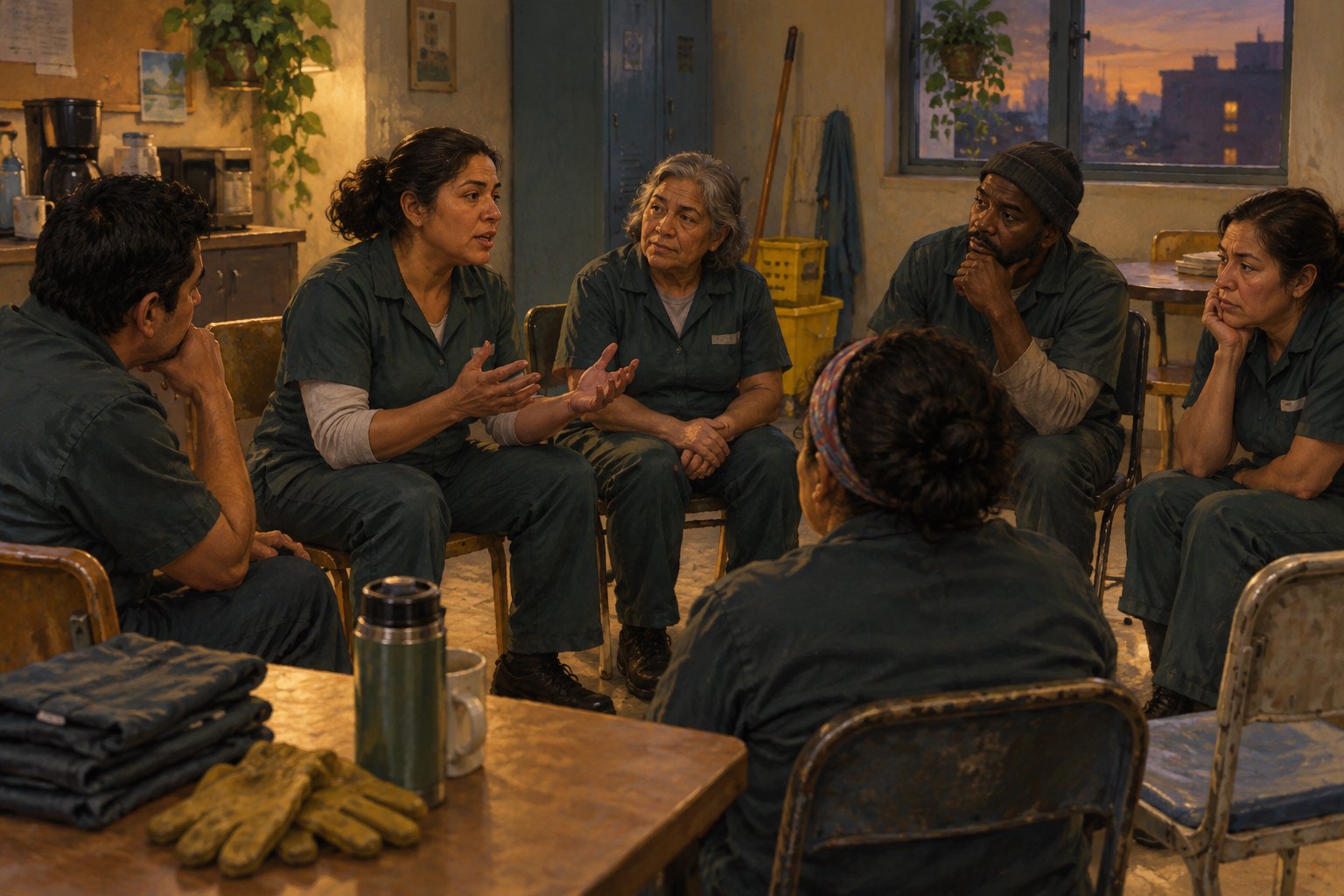
Rosa initially appears to obstruct the possibility Maya has discovered. Her resistance becomes much harder to judge when their confrontation reveals the sexual exploitation and sacrifices behind her support of the family, including what securing Maya’s job required. Laverty discussed the sisters’ confrontation and its construction in his BAFTA screenwriting lecture. [Paul Laverty’s lecture](https://static.bafta.org/uploads_pre_202411/transcripts/29_sept_2011_screenwriters_lecture_by_paul_laverty.pdf)
Carrillo makes this the film’s emotional center. Rosa’s anger exposes an arrangement in which other people have benefited from her sacrifices without understanding them. Her exhaustion is inseparable from the resentment of having been useful for so long and understood so little.
Her informing against the organizing effort still harms other workers. Understanding her history does not erase that harm. It changes the viewer’s responsibility: condemnation now has to account for the conditions under which she learned to survive.
This is where the film’s politics become most demanding. Rosa has already given herself to other people’s needs. A further appeal to sacrifice can sound, from her perspective, like another request that she absorb the damage. Maya sees an opening toward the future; Rosa hears the accumulated demands of the past.
The shift also illustrates why whose perspective shapes a film matters. When Rosa receives space to explain herself, the audience must reconsider a judgment the story previously made easy.
The Strength and Strain of Loach’s Approach
The film’s directness is both an advantage and a limitation. Workplace intimidation is immediately legible, and the campaign supplies a clear dramatic direction. At times, however, the opposition feels arranged to make the moral argument quickly. The sisters are more complicated than the forces lined up against them.
That imbalance keeps this from being an entirely seamless drama. Yet its accessibility has value. Humor, attraction, and everyday friction give viewers reasons to care about the people carrying the argument. Political conviction does not occupy every minute of their emotional lives.
The most useful standard here is to examine how power operates within scenes, a distinction also explored in our commentary on separating an actor’s public position from a film’s politics. In Bread and Roses, the revealing questions concern who can speak, who must listen, and whose losses count as acceptable.
The Ending: A Victory Maya Cannot Share Fully
The final movement refuses an uncomplicated reward. Maya steals money to help a coworker pursue college. The theft later catches up with her, and she faces deportation as the organizing struggle achieves a breakthrough. The dialogue makes that connection explicit; her removal should not be described simply as punishment for joining a union.
Dramatically, the theft can feel heavily engineered, a device that brings Maya’s generosity and impulsiveness into one consequential act. Nevertheless, the ending poses a serious question: how should a group understand success when someone who helped make it possible cannot remain to enjoy it?
The farewell’s “We’re with you, Maya!” expresses affection without providing rescue. That gap is devastating. Solidarity remains meaningful even where it cannot deliver the outcome its participants want.
What the Roses Add to the Bread
“We want bread, but we want roses too” gives the film its clearest statement of purpose. Material survival matters, but a life also needs pleasure, affection, respect, and room for choice. The demand becomes especially powerful when considered through Rosa, whose years of providing for others have narrowed that room.
My reading is that the sisters embody two obligations any credible movement must hold together: changing intolerable conditions and recognizing what people have already endured. Maya supplies the belief that the future can be different. Rosa insists that the past cannot be wished away by enthusiasm.
That tension makes Bread and Roses a worthwhile film for an October 14 discussion. Its deepest achievement is making solidarity harder to pronounce casually. The word requires attention to the person beside you, including the history that makes their choices different from your own.
Original content by this site's editorial team. Published: October 9, 2026 at 19:33:23 PDT (Los Angeles time)