
Matthew Rhys’s success at the 2026 Emmys gives the celebration of actors’ actors a particularly useful example. His work in Widow’s Bay centers on a man whose authority keeps colliding with his limitations. That is fertile territory for acting: someone trying to control what everyone sees while struggling with what he knows about himself.
The Television Academy confirms that Widow’s Bay won six awards during the main ceremony, including Outstanding Comedy Series, and that Rhys won leading-performance awards for both that show and The Beast in Me. Those results reward range, but they also invite a closer look at the kinds of characters television gives performers room to develop. [Television Academy’s ceremony recap](https://www.televisionacademy.com/features/news/awards-news/78th-emmys-winners-recap).
Spoiler note: This character-focused commentary discusses the premise of Widow’s Bay and selected details from “Lodging” and “The Inaugural Swim.” It does not assess every episode or disclose the season’s ending.
What an Actor’s Actor Actually Brings to a Story
An actor’s actor is usually understood as a performer admired for craft: the ability to make contradictory feelings legible, adjust to a scene partner, and give even an awkward silence a purpose. The phrase becomes less useful when it turns into a moral ranking of careers. Celebrity and dramatic skill can inhabit the same person.
The Atlantic’s account of the ceremony emphasizes Rhys alongside fellow Widow’s Bay winners Kate O’Flynn and Stephen Root. Its central distinction—between public glamour and the work of inhabiting a role—offers a productive starting point for criticism, provided we keep looking at the performances rather than treating fame itself as a flaw. [The Atlantic’s Emmy commentary](https://www.theatlantic.com/culture/2026/09/emmys-2026-matthew-rhys-widows-bay/688625/).
Our character analysis of Tom Cruise in Jerry Maguire approaches the same question from a different direction. A familiar screen personality can become dramatic material when a story exposes the insecurity beneath its confidence. The useful question is what recognition allows an actor to do—and what the actor risks losing inside a role.
Tom Loftis Wants Prosperity—and an Audience
In Widow’s Bay, Rhys plays Mayor Tom Loftis, who wants to revive an isolated New England island community through tourism. He also wants a better future for his teenage son and respect from residents who doubt his courage. The town’s supposedly ridiculous supernatural stories prove to have substance. These are elements of Apple’s published premise. [Apple’s series description](https://www.apple.com/tv-pr/originals/widows-bay/).
My reading is that the most interesting conflict begins before the supernatural danger. Economic improvement and personal vindication are tangled together. Tom can sincerely want to help people while also wanting their gratitude to repair his self-image. Neither motive cancels the other, which makes him more interesting than a straightforwardly selfish official.
That distinction matters from the residents’ perspective, too. Being governed by someone who needs approval can become exhausting. Every objection risks being heard as an insult; every warning can sound like another refusal to believe in him. A public disagreement becomes a private injury.
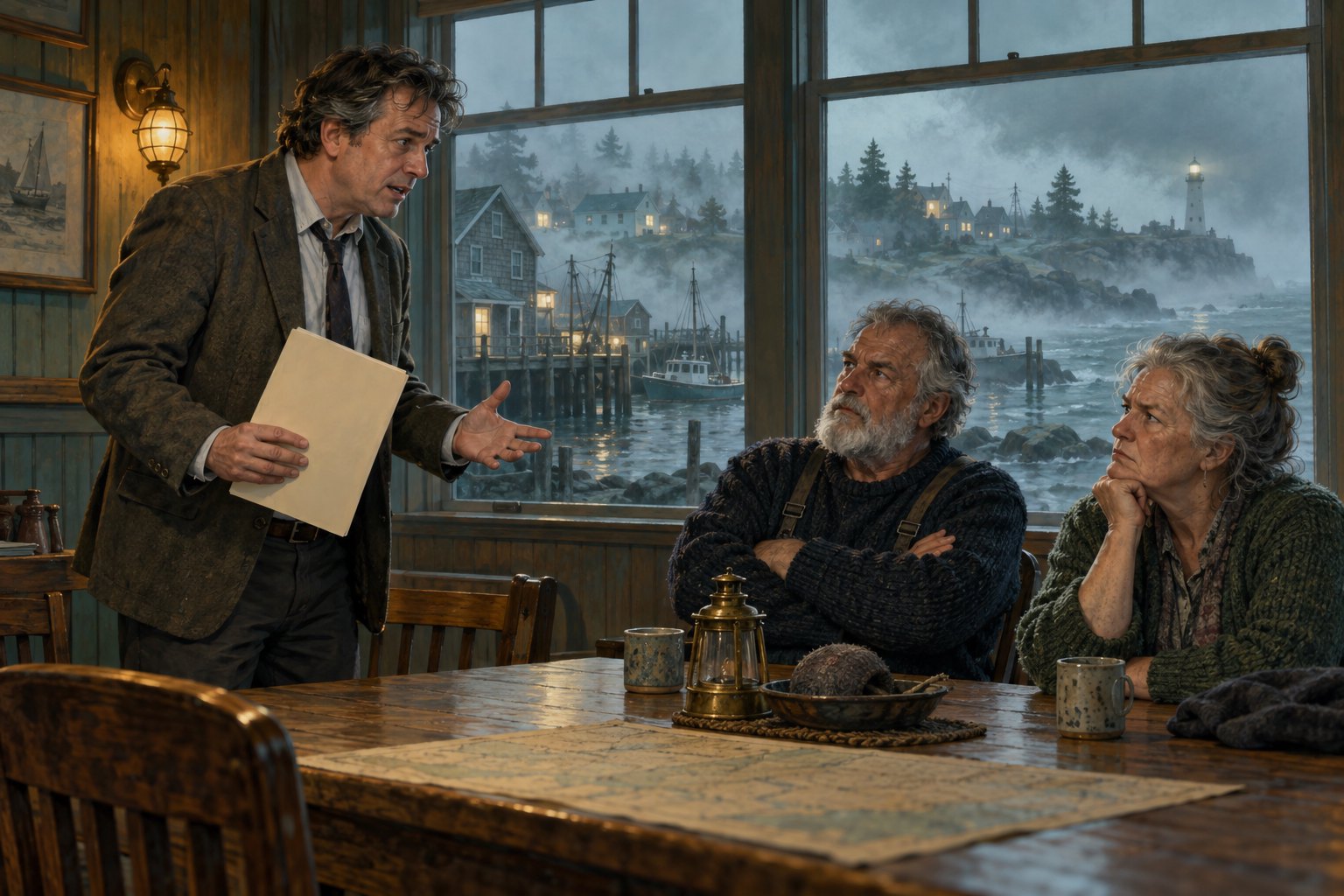
This is where the role connects to the larger awards conversation. A character like Tom needs more than an attractive surface or an entertaining collection of flaws. The actor must preserve the possibility that he means well even when his need to be taken seriously makes him unreasonable.
Fear Makes Status Impossible to Maintain
The Television Academy’s interview with Rhys and creator Katie Dippold describes two revealing situations: Tom staying at a haunted inn to disprove its reputation, and his encounter with the Sea Hag during an island swim. Rhys also identifies an intentional connection between Tom and the mayor in Jaws. [Rhys and Dippold on the show’s character and scene construction](https://www.televisionacademy.com/features/online-originals/widows-bay-matthew-rhys-katie-dippold).
Both situations put a public position under physical pressure. Declaring oneself rational is relatively easy. Maintaining that identity when afraid is another matter. Horror can make this gap immediate: the body reacts before the person has prepared an explanation.
For me, that is the strongest conceptual link between the show’s comedy and its fear. Embarrassment and terror both interrupt self-presentation. A person wants to appear composed, but breathing, movement, and attention disclose something else. An effective performance lets those involuntary reactions disturb the character’s preferred version of himself.
This also explains why tonal range deserves more precise praise than simply calling an actor versatile. Moving between funny and frightening material requires continuity. The audience should still understand the same person’s needs after the emotional temperature changes. Otherwise, the performance becomes a sequence of demonstrations.
An Ensemble Gives the Lead Something to Lose
Recognition for supporting performers is particularly welcome in stories organized around a community. A protagonist’s authority only means something if the people around him have independent judgments. Agreement, skepticism, and indifference need to feel like responses from other lives.
One useful way to watch ensemble acting is to follow the person who is listening. Does that character seem to anticipate a familiar excuse? Does a pause suggest disappointment, calculation, or a decision to disengage? These are viewing questions, rather than claims about particular unverified shots. They help locate the work that a highlight reel can miss.
The same principle shapes our guide to watching films through character choices: reputation can draw attention, but the scene must give that attention somewhere meaningful to go.
The Deeper Conflict: Recognition Without Understanding
An awards ceremony and a fictional mayor’s struggle for respect share an intriguing concern: recognition. Yet being applauded, being obeyed, and being understood are different achievements. Confusing them creates disappointment in public life and rich material in drama.
My interpretation of Tom’s central predicament is that usefulness requires listening to people whose opinions wound him. That is harder than winning an argument. It demands accepting that someone can underestimate you personally and still understand a danger better than you do.
The Emmy results cannot settle the quality of every scene or establish a permanent victory for one kind of performer. Their value for viewers is more practical: they direct attention toward acting that makes competing motives understandable. The rewarding question is whether we can see a person thinking, defending himself, and changing under pressure.
A Small Detail Worth Catching
In the same Television Academy interview, Dippold points to the briefly visible game title “She Shouldn’t Have Said That” in “Lodging.” It is a small background discovery rather than a key to the entire story.
Its wording nevertheless makes an apt closing thought. It suggests a world where people already have rules about what can be said safely. For a character determined to explain that world on his own terms, listening may be the most difficult—and consequential—act of all.
Original content by this site's editorial team. Published: September 15, 2026 at 15:44:50 PDT (Los Angeles time)