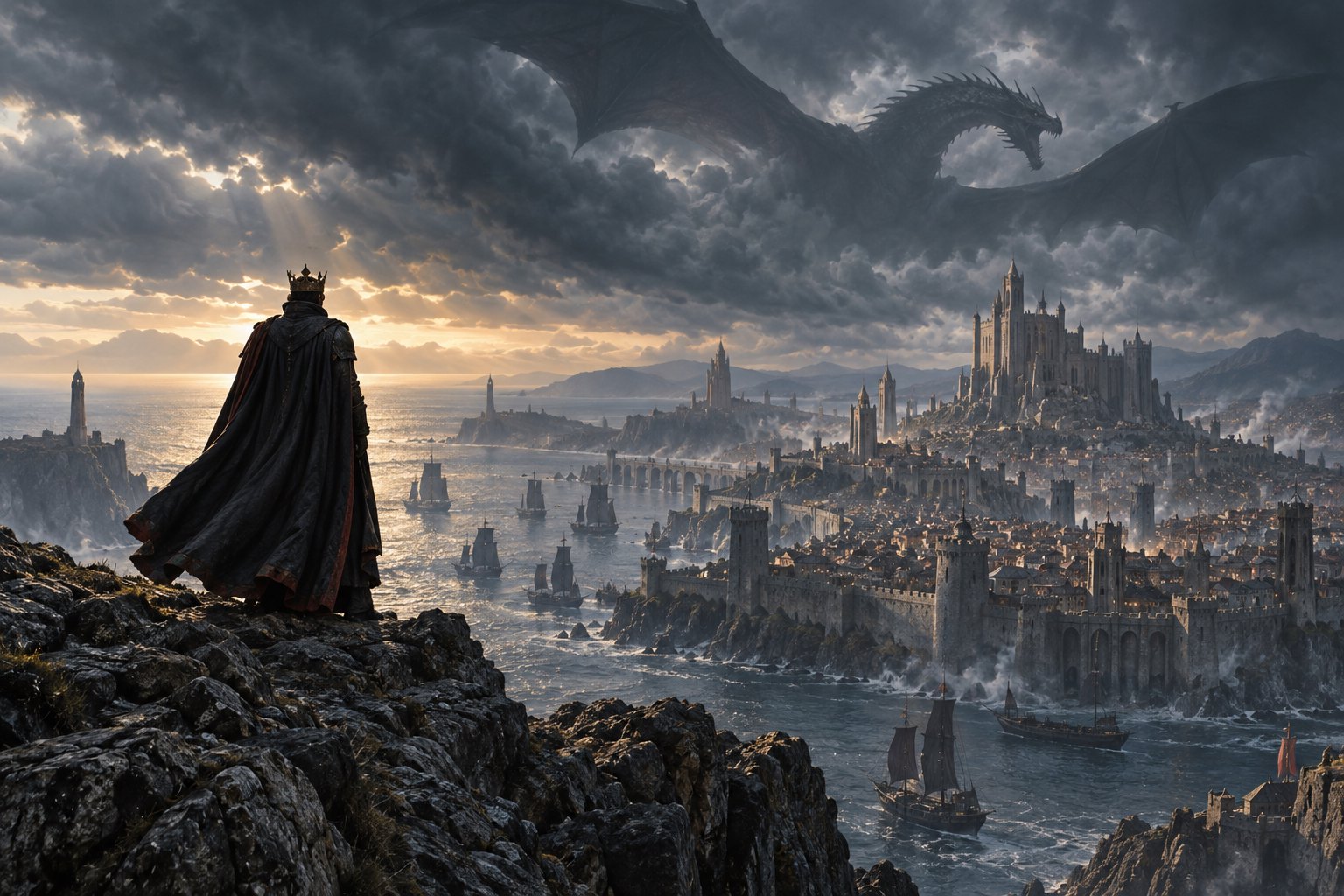
Aegon’s Conquest is bringing Game of Thrones to movie theaters in 2029 through Warner Bros., according to [The Hollywood Reporter’s report](https://www.imdb.com/news/ni66038722/). The prospect invites an obvious attraction: a fantasy world experienced at theatrical scale. But the title raises a more interesting question than how enormous the spectacle might look. When a movie takes a conqueror as its organizing figure, whose experience of conquest becomes the story?
This is a spoiler-free critical preview, not a review of the finished film. The reported release year establishes the project’s destination; it does not establish its artistic success. No performance, scene, or line of movie dialogue is being evaluated here. The useful question now is what a character-centered treatment could accomplish—and where the premise demands particular care.
What the 2029 movie announcement tells us
The essential news is straightforward: Warner Bros.’ Aegon’s Conquest is the vehicle for taking Game of Thrones onto the big screen, with 2029 as the reported release year. That gives audiences a concrete project to anticipate. It should still be understood as a future release plan, rather than a guarantee that every detail of the eventual theatrical presentation is settled.
A release announcement cannot tell us how much narrative ground the movie will cover, whose perspective will dominate, or how successfully it will balance political drama with action. Those distinctions matter particularly here. A title can identify a historical undertaking within a fictional world without revealing the emotional structure of the adaptation.
For viewers deciding what to expect, the most productive distinction is between scale and scope. Scale concerns how overwhelming an image feels. Scope concerns how much story the film attempts to contain. A movie can have tremendous scale while concentrating on a small number of consequential decisions. That concentration could be this project’s greatest advantage.
Aegon needs a point of view, not just an imposing presence
The title places Aegon at the center, but centrality alone does not create a compelling protagonist. A character becomes dramatically legible through the distance between what he wants, what he believes he is doing, and what his actions actually cause. For a conquest narrative, those three things need not align.
An approach worth pursuing would let audiences understand the attraction of Aegon’s ambitions without requiring them to accept his interpretation of events. Understanding a ruler’s reasoning can make a story more troubling: an audience may recognize the internal logic of a decision while remaining appalled by its consequences. That tension offers more dramatic substance than alternating between grand speeches and displays of strength.
This is a critical preference, not a claim about the screenplay. The film could choose many different approaches to its central figure. But I would be more interested in watching Aegon confront an inconvenient judgment than in watching everyone around him repeatedly confirm his importance. Authority becomes revealing when another person refuses to describe it in the ruler’s preferred terms.
Our discussion of how doubt changes the appeal of a leading character considers a related problem. A protagonist does not have to become indecisive to become complex. Certainty itself can be the revealing trait, especially when the audience sees something the character will not acknowledge.
The people facing conquest need dramatic agency
A conquest story has an immediate imbalance: the person advancing across the landscape usually supplies the momentum, while everyone else risks becoming an obstacle. That structure is efficient, but it can make a richly populated world feel strangely empty. People become markers of progress instead of participants in the drama.
The remedy is not necessarily a sprawling collection of subplots. One carefully developed opposing perspective can change the meaning of an entire sequence. Someone deciding whether to resist, negotiate, or accommodate an approaching power has a conflict of their own. Survival, responsibility, pride, and loyalty may point in different directions.
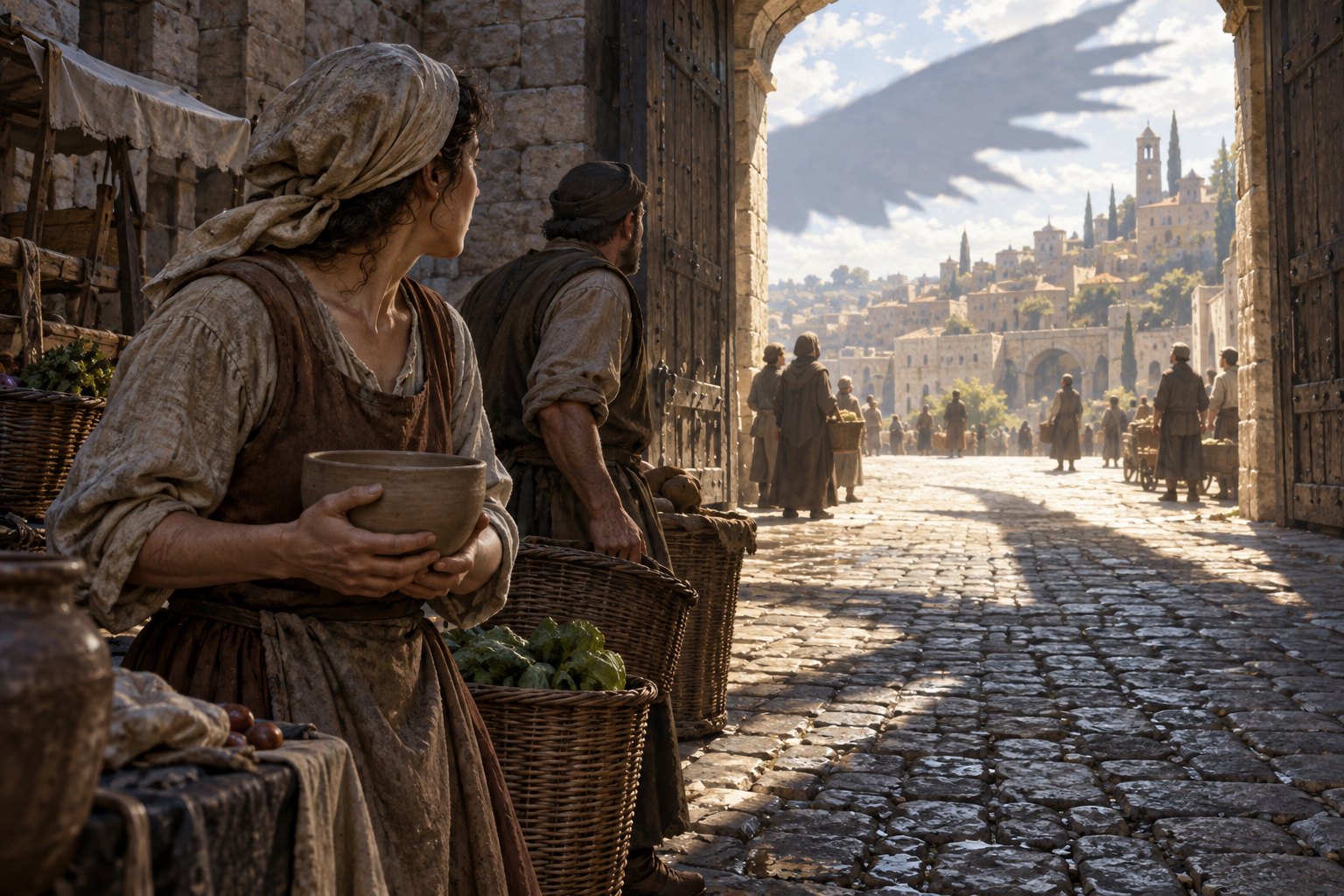
The illustration above visualizes that shift in perspective; it does not depict a confirmed movie scene. From a ruler’s elevated viewpoint, a city can appear to be a single objective. From the street, it contains livelihoods, attachments, and people with incompatible ideas about what safety requires. A film’s choice of viewpoint determines whether viewers feel that difference.
Giving those people agency also improves suspense. If everyone outside the protagonist’s circle merely waits for events, the narrative has only one active intelligence. Let other characters assess the situation, misjudge one another, and make consequential choices, and even an apparently straightforward campaign can become an unpredictable human encounter.
A theatrical epic needs consequences between its set pieces
The big-screen appeal is easy to grasp. Vast spaces and overwhelming threats can gain force when the audience shares a darkened room and a commanding image. Yet size becomes monotonous when every sequence asks for the same response. Awe needs contrast; otherwise, the supposedly extraordinary becomes the visual baseline.
For this film, the smaller scene after a major confrontation could matter as much as the confrontation itself. Not because quiet automatically means depth, but because consequences require time to register. An action sequence changes the practical situation. The following conversation can reveal whether it also changed a relationship, exposed a disagreement, or hardened someone’s convictions.
The distinction resembles the question explored in our analysis of power, responsibility, and self-image in Digger: how does a powerful person explain damage when accepting responsibility would threaten the story they tell about themselves? Applied here as an interpretive question, it offers a way to connect intimate characterization with epic consequences.
A useful test for any eventual set piece is therefore specific: what becomes impossible afterward? If the answer concerns only territory or military position, the movie may be advancing its campaign more effectively than its characters. If trust, allegiance, or self-understanding also changes, spectacle becomes part of the drama.
What would make Aegon’s Conquest worth the wait?
My strongest hope is for a movie that makes power persuasive before examining its limits. An entirely inscrutable conqueror can become a remote emblem. An unquestioned hero can turn the surrounding world into scenery. The more demanding approach gives the central figure understandable purposes while allowing other characters to expose the limits of those purposes.
That would also help the film stand on its own. Viewers should be able to understand a consequential decision through the people making it, without needing an encyclopedic grasp of the franchise. Recognition can enrich a scene, but it should not supply the emotion the scene has failed to create.
The deeper opportunity lies in the word conquest. It describes an achievement from the perspective of someone measuring success by acquisition. For those subjected to it, the same event may mean uncertainty, loss, compromise, or a changed understanding of home. A compelling adaptation can hold those experiences together without pretending they are equivalent.
That is what makes this announcement interesting beyond its theatrical novelty. Aegon’s Conquest could make audiences feel the attraction of an imposing vision and then ask them to look closely at the lives inside it. The most lasting image would not simply establish how much a ruler can command. It would leave us considering how much he fails to see.
Original content by this site's editorial team. Published: October 1, 2026 at 06:37:56 PDT (Los Angeles time)